Advances in Engineering Advances in Engineering features breaking research judged by Advances in Engineering advisory team to be of key importance in the Engineering field. Papers are selected from over 10,000 published each week from most peer reviewed journals.

Lithium-ion batteries age in ways that are far more erratic than engineers once expected. Cells in electric vehicles, stationary storage banks, or even handheld electronics are pushed through thousands of cycles under shifting thermal loads and manufacturing differences that accumulate over time. What looks like a uniform batch on paper often fragments into a collection of individuals, each drifting along its own degradation path. One cell may lose capacity gradually; another, supposedly identical, begins to show rising impedance or an abrupt acceleration in fade. This variability creates pockets of uncertainty that traditional reliability models struggle to capture. Earlier attempts to improve prediction accuracy—refinements of state-of-charge or state-of-health estimation using Kalman filters, response-surface methods, or deep-learning surrogates—often assumed that degradation unfolds smoothly. The experimental evidence rarely cooperates with that assumption. Instead, the data tend to show a kind of two-step rhythm: a lengthy, almost complacent degradation phase that suddenly gives way to a steeper decline. Crucially, the timing of this shift is not synchronized across cells, which makes population-level models misleading if treated too rigidly. Battery aging is shaped by a constellation of chemical reactions, mechanical stresses, and thermal excursions, which fluctuate randomly and cannot be observed directly. They cause degradation trajectories to bend and kink in ways that fixed-parameter models cannot keep up with. On the other hand, approaches driven purely by historical data may fit trends but rarely tell us how certain those predictions are or how they should adjust when a fresh measurement contradicts the past. This recognition has pushed the field toward frameworks that treat randomness as an inherent feature of battery aging. The inverse Gaussian process has become a natural candidate because it captures the one-way, cumulative nature of degradation while still allows forecasts anchored in actual observations. However, even this structure needs a mechanism for adaptation—an ability to revise its parameters as soon as a cell begins to deviate from its earlier trajectory. Only then can a model hope to reflect the lived aging behavior of real batteries rather than an idealized average. To this end, researchers from Hunan Institute of Engineering and Hunan University of Science and Technology published a new paper in the Journal of The Electrochemical Society, in which they developed an inverse Gaussian–based degradation model that treats lithium-ion battery aging as a stochastic, cumulative process rather than a deterministic trend. They integrated Bayesian online updating with an EM-based parameter estimation routine, allowing the model to adjust its internal representation of degradation as new operational data arrive. This combination produces individualized, real-time reliability assessments that track nonlinear and stage-dependent aging behavior.
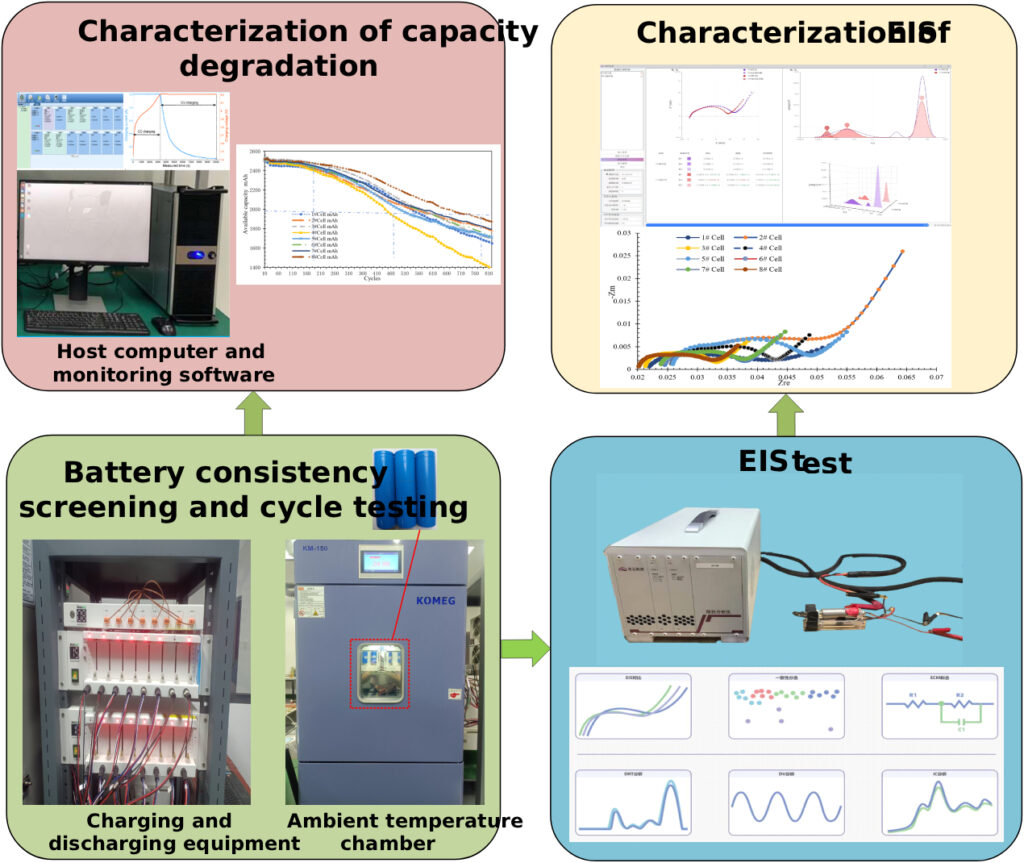
The research team performed a controlled aging experiment using eight commercial 18650 ternary lithium-ion cells selected from the same manufacturing batch to ensure that any observed variability would reflect intrinsic differences rather than sourcing inconsistencies. Before cycling, each cell was screened for basic consistency in capacity and impedance, confirming that nominal specifications aligned closely enough to permit a meaningful comparison of degradation behavior. The researchers then subjected all cells to repeated charge–discharge cycles under a fixed protocol: constant-current charging to a voltage cutoff, constant-voltage charging until the taper current fell to a predefined level, a short rest, and constant-current discharge down to the lower cutoff. Environmental temperature was tightly regulated to avoid confounding thermal effects. Throughout the cycling process, the system recorded voltage, current, capacity, and related parameters at high temporal resolution, yielding a long sequence of degradation increments for each cell.
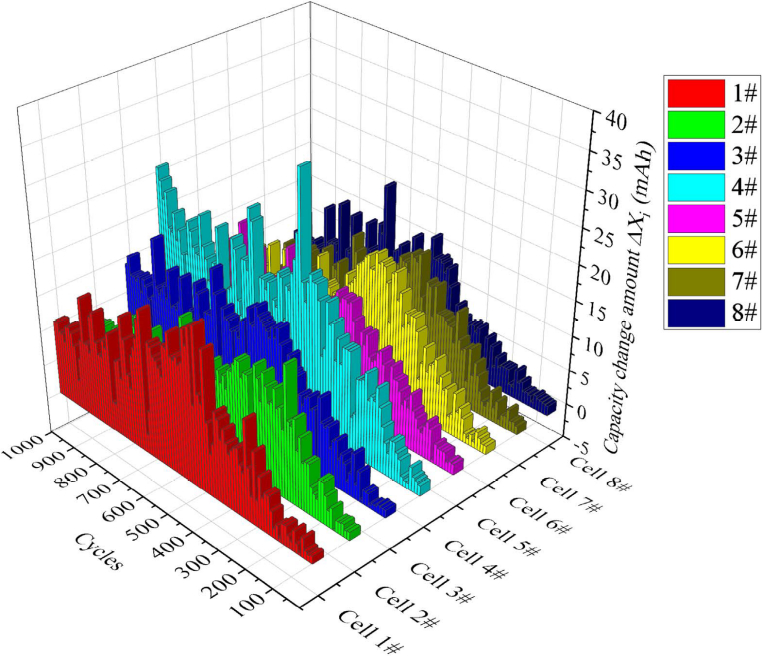
They extracted capacity data at regular intervals, which showed that degradation did not proceed uniformly. They also marked early cycles by modest capacity loss, but several cells transitioned into a more rapid degradation phase after roughly one hundred cycles. Others deteriorated much later, and one cell demonstrated unusually sudden acceleration after a lengthy period of relative stability. The authors found the divergence between cells grew steadily: differences that appeared negligible at the beginning widened into hundreds of milliamp-hours by the later stages of the test. This spreading of trajectories, despite identical test conditions, underscored the degree to which internal microstructural differences guide aging behavior. Electrochemical impedance spectroscopy measured after extended cycling further highlighted these distinctions. Frequency-dependent impedance responses shifted in ways that suggested cell-specific evolution of interfacial films and charge-transfer resistance, which aligned with the capacity trends observed earlier. Afterward, the team fed the degradation increments into the proposed model. The inverse Gaussian process provided the structural backbone, but the heart of the approach lay in its adaptive estimation of parameters. After each update interval, the Bayesian module revised its characterization of the cell-specific degradation rate, while the EM algorithm refined the uncertainty parameters in light of the newly accumulated data. When applied to the capacity history of a representative cell, the model’s predicted probability distributions gradually narrowed, reflecting increased confidence as aging progressed. The real-time reliability curves decreased in a manner that mirrored the experimental degradation, demonstrating that the model could track shifts in degradation rate rather than averaging them away. By the later stages of cycling, the adaptive updates captured both the rapid acceleration in capacity loss and the reduction in prediction uncertainty.
In conclusion, the new work by researchers from Hunan Institute of Engineering and Hunan University of Science and Technology offers a practical foundation for embedding adaptive reliability prediction directly into next-generation battery-management systems. Indeed, the innovative modeling strategy introduced in their work carries implications that extend beyond the immediate dataset. A good reliability model must treat each battery as an individual, not assume that all cells behave the same throughout their lifetime. Models that ignore this divergence will misinterpret remaining useful life in ways that compromise safety or lead to premature retirement. The inverse Gaussian-based framework provides a structured way to encode the fact that degradation is cumulative and irreversible, while the Bayesian updates ensure that the model does not cling to outdated parameter estimates when a cell’s behavior changes. This combination of structure and adaptivity places the method between traditional physics-based models and data-driven predictors, inheriting interpretability from the former and flexibility from the latter. Additionally, the authors illustrate a path toward battery-management systems capable of adjusting their assessments on the fly by demonstrating how reliability curves evolve as new data arrive. This is important in electric vehicles, where cells experience vastly different stress patterns depending on driver behavior, climate, and daily usage. Static models trained on historical averages would fail to anticipate abrupt shifts in degradation, whereas the present framework can detect and respond to them early. This responsiveness could prevent both overly optimistic and overly conservative predictions—each problematic in its own way. For instance, an optimistic model may fail to remove a failing cell from service in time, while a conservative one may prematurely reduce power availability or trigger unnecessary maintenance.
The study also reinforces that capacity fade and impedance evolution are rarely linear. The model’s success in capturing stage-dependent aging suggests it could help illuminate when and why a cell moves from a slow to a rapid degradation regime. It may be possible to tie model parameters more closely to underlying mechanisms such as loss of active lithium, film thickening, or particle-crack propagation by integrating impedance or other electrochemical features in future iterations. Additionally, because the EM algorithm reaches parameter solutions efficiently, the method is compatible with embedded systems that cannot afford computationally heavy inference. In a broader sense, we believe this work contributes to the growing recognition that reliability assessment is more than just predicting a single failure time but of managing uncertainty throughout a battery’s life. The authors show that uncertainty itself evolves as the system gathers more information, and a model that reflects this dynamic uncertainty gives operators a truer picture of risk. In a nutshell, as we rely more heavily on batteries across the entire energy ecosystem, it becomes essential to use models that handle uncertainty in battery aging and can guide real-time operational choices.







Reference
Yang, Bowen & Huang, Liangpei & Wei, Kexiang & Shu, Xiong & Li, Yongjing & Ren, Bing & Tan, Linkai. (2025). Research on Degradation Characteristics and Real-Time Reliability Assessment of Lithium-Ion Batteries. Journal of The Electrochemical Society. 172. 10.1149/1945-7111/ade128.