 Advances in Engineering Advances in Engineering features breaking research judged by Advances in Engineering advisory team to be of key importance in the Engineering field. Papers are selected from over 10,000 published each week from most peer reviewed journals.

Significance
Floating structures have become increasingly important as offshore regions are developed for energy production, transportation, and habitation. Their ability to operate safely and reliably depends to a large extent on the performance of the mooring system, which governs both station keeping and the way environmental loads are transmitted to the structure. Conventional mooring arrangements—particularly taut mooring systems—offer simplicity and predictable behaviour, yet they often impose high pretension and experience substantial cyclic loading. As project depths increase and structural configurations diversify, these demands translate into higher fatigue exposure, increased anchor loads, and reduced operational margins. In recent years, several hybrid configurations have been proposed to mitigate these constraints. Systems incorporating clump weights or geometry modifications have shown that modest alterations in line configuration can produce meaningful shifts in tension distribution and platform response. However, most existing approaches remain limited by either their installation complexity or the difficulty of adapting them to platforms with varying mass distribution or modular layouts. This challenge is particularly relevant for emerging offshore concepts, such as hexagonal or composite platforms, where geometric symmetry and compartmentalized buoyancy give rise to motion characteristics that differ from those of conventional mono-hull structures. To this end, new research paper published in Ocean Engineering and conducted by Dr. Yufei Wu, Dr. Haohan Chen, Dr. Longting Qiu, and led by Professor Xiaoxu Huang from Shenzhen University, the researchers developed an adaptive pulley–weight mooring system that allows tension to redistribute naturally as a floating platform responds to waves. They coupled this mechanical concept with a neural-network surrogate model and a particle swarm optimizer to identify configurations that balance cost, safety, and motion performance. The result is a mooring architecture that lengthens the platform’s natural periods, suppresses fatigue-inducing tension cycles, and improves stability without increasing material demand. Their approach offers a flexible design philosophy for future offshore systems built around modular or unconventional geometries.
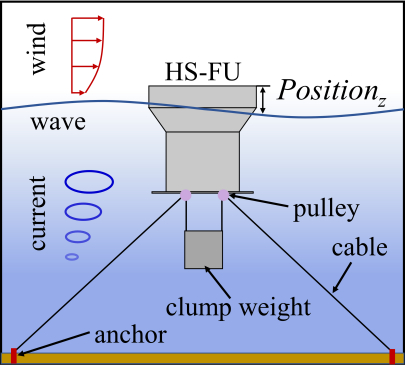
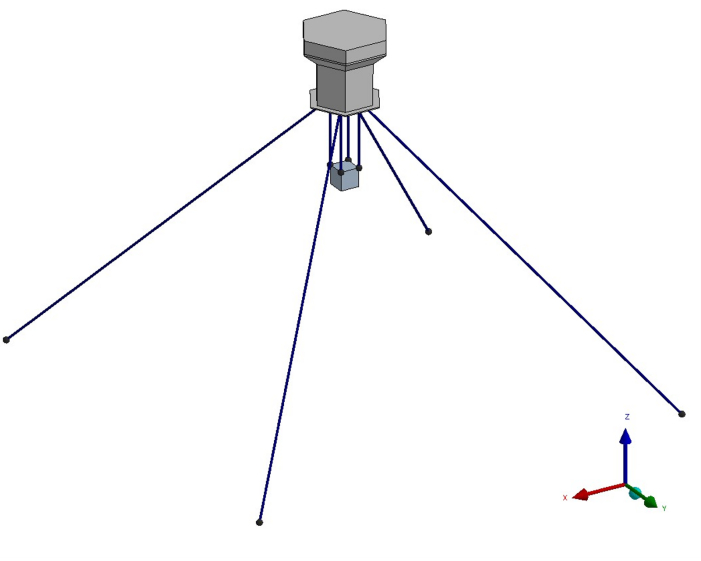
The research team started by embedding the pulley–weight mechanism into a representative offshore scenario based on a hexagonal concrete platform. This choice is deliberate: its geometry introduces rotational symmetry but also enough structural complexity to reveal whether the mooring concept behaves gracefully under shifting sea states. The mooring lines are modelled as nylon—chosen for their elasticity and well-characterized creep behaviour—and the clump weight is positioned below the water surface so that its submerged mass provides a passive, self-adjusting counterforce against environmental loads. To authors explored the mechanical consequences of this arrangement, they relied on nonlinear time-domain simulations incorporating wind, wave, and current effects consistent with conditions found in the South China Sea. Instead of relying on a single parameter set, they vary two quantities that strongly influence system behaviour: the filling rate of the platform’s internal water tanks and the mooring-line angle relative to the seabed. Adjusting the tank’s fill alters the displacement and thus the vertical force balance, while the mooring angle dictates how tension is partitioned between horizontal restraint and vertical lift. The team found that each simulation yields dozens of outputs—heave, surge, pitch, accelerations, tension cycles, freeboard behaviour—creating a dataset that quickly becomes too intricate for hand-tuning. To avoid the prohibitive cost of simulating every plausible configuration, a neural-network surrogate model is trained to learn the mapping between design parameters and structural responses. Once the surrogate reaches a level of accuracy acceptable for engineering judgement, it becomes the engine for a particle swarm optimization routine that searches for balanced solutions.
In conclusion, the research work of Professor Xiaoxu Huang and colleagues builtan optimized pulley–weight system that lowers the platform’s susceptibility to resonance by lengthening its natural periods, particularly in pitch and heave. This shift proves important because it pulls the structure’s natural dynamics away from the peak wave energy range. As a result, the platform moves more quietly, even under severe loading. The new findings also show a conspicuous reduction in peak and average tension along the mooring lines. The clump weight shares part of the pretension normally carried exclusively by the lines, leading to smaller tension fluctuations and, consequently, a significant decrease in fatigue damage. Interestingly, the system achieves these gains without relying on exotic materials or active control hardware; the pulley simply encourages the lines to redistribute forces more evenly as the platform responds to waves. Although the horizontal excursions become slightly larger than those observed in traditional taut-line systems, they remain within acceptable limits for a living-platform application. The overall picture is of a mooring architecture that tempers the sea’s unpredictability with a relatively modest mechanical gesture—one that becomes far more powerful when filtered through data-driven optimization. An important implication of the study of Shenzhen University scientists is how a simple geometric intervention (a pulley and a suspended mass) can meaningfully reshape the performance envelope of a floating structure when treated with the same seriousness as any major structural component. The study suggests that mooring design is not merely a matter of withstanding loads but of orchestrating how the platform engages with the surrounding ocean. By shifting pretension away from the anchor and distributing it through the clump weight, the system softens the platform’s interaction with waves, lowers structural stress, and extends the useful life of the mooring lines. Moreover, the reduction in fatigue damage is especially important. Offshore projects increasingly aim for service lifetimes spanning several decades, and fatigue is often the hidden cost driver. By suppressing tension cycles, the pulley–weight system sidesteps one of the chronic vulnerabilities of taut moorings. This could have meaningful downstream effects: anchors can be sized more conservatively, maintenance schedules may become less onerous, and cable replacement cycles could stretch further into the project’s lifetime. As offshore platforms take on more varied roles—housing, aquaculture, or mixed energy production—the appeal of mooring systems that can be adjusted without rebuilding the entire structure becomes clearer. What the authors show here is essentially a flexible design scaffold: a blend of neural-network surrogates and particle-swarm search that can absorb new engineering priorities without having to start over. In practice, one could layer in objectives that weren’t central to the present study, such as reducing lifecycle emissions or coordinating platform motions with onboard processes like desalination units or battery arrays. Because the approach depends mainly on the availability of reliable simulation data, it is not tied to any single hull shape or layout. More broadly, the work reflects an emerging shift in offshore thinking—from stiff, force-dominated restraint toward softer, gravity-assisted mechanisms that temper environmental variability rather than oppose it.

Reference
Yufei Wu, Haohan Chen, Longting Qiu, Xiaoxu Huang, Optimization of a new pulley–weight mooring system based on neural network and particle swarm optimization, Ocean Engineering, Volume 334, 2025, 121589,
Go to Journal of Ocean Engineering.