Advances in Engineering Advances in Engineering features breaking research judged by Advances in Engineering advisory team to be of key importance in the Engineering field. Papers are selected from over 10,000 published each week from most peer reviewed journals.

Significance
Long-span bridges are designed to span large distances, sometimes in hundreds of meters. They are essential for connecting regions separated by water or other geographical features. These bridges are commonly used for vehicles, trains, and pedestrians. Examples include suspension bridges, cable-stayed bridges, and arch bridges. The main challenges in constructing and maintaining long-span bridges include addressing the forces of nature, such as wind and earthquakes, as well as the immense structural loads they must bear. Monitoring the structural health of long-span bridges is a critical aspect of ensuring their safety and longevity. The process involves regularly assessing the bridge to detect any signs of deterioration or damage. Key elements in structural health monitoring (SHM) include for example accelerometers, strain gauges, displacement sensors, and other devices that measure physical parameters like movement, stress, and strain. These tools collect data that helps in assessing the bridge’s condition. The data collected from sensors are analyzed using advanced algorithms and software. The analysis helps in identifying trends, detecting defects, and predicting potential issues before they become serious problems. In addition to sensor-based monitoring, regular visual inspections by engineers are essential. They can identify issues that sensors might miss, such as surface cracks, corrosion, or other visible signs of wear and tear.
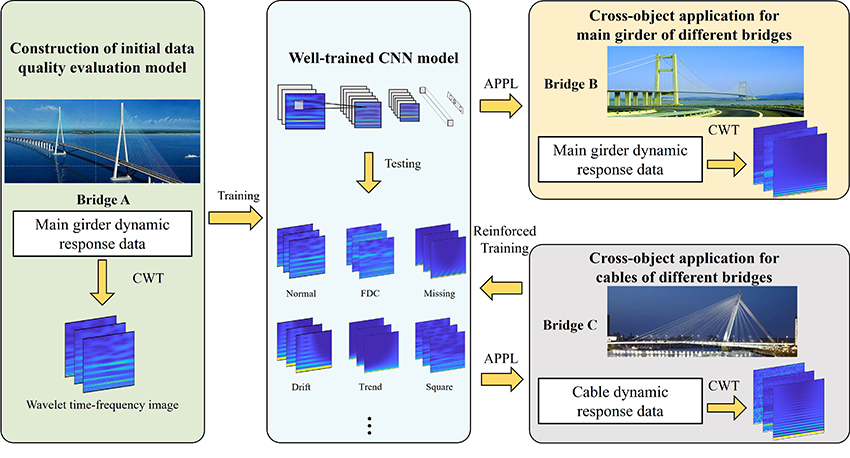
In a new study published in the Journal Mechanical Systems and Signal Processing and led by Professor Yang Deng, Hanwen Ju, Guoqiang Zhong, Aiqun Li, Youliang Ding from the Beijing University of Civil Engineering and Architecture, the authors provided an in-depth analysis of a data quality evaluation framework they developed for monitoring the structural health of long-span bridges. This framework focuses on addressing the challenges of low-quality data in SHM systems, specifically targeting the evaluation of both obvious abnormal and pseudo-normal data. The new framework utilizes Convolutional Neural Network (CNN) and Continuous Wavelet Transform (CWT) for classifying and evaluating the data quality. It demonstrates its effectiveness through case studies on different bridge types, showing how the framework can be applied for cross-object (different bridges) application, ensuring robustness and generalization capacity. The integration of advanced technologies like CNN and CWT in SHM of long-span bridges represents a significant leap in engineering practices. The new study investigated innovations of a comprehensive data quality evaluation framework developed for SHM systems. It highlighted the urgency of managing low-quality data, which is a common challenge in SHM, and the importance of differentiating between obvious abnormal and pseudo-normal data. The researchers elucidated a working mechanism of the proposed framework, emphasizing how it harnesses the power of CNN and CWT for accurate data classification and evaluation.
The strength of the new framework by Professor Yang Deng and colleagues lies in its ability to address the specific needs of long-span bridges, a critical infrastructure in modern transportation. It is different from traditional methods because it uses machine learning techniques to enhance the accuracy of data analysis in SHM systems. The framework’s ability to adapt to different bridge types demonstrates its versatility and wide-ranging applicability, a key consideration in the field of structural engineering. Moreover, the authors discussed the implications of this framework in the broader context of engineering. They highlighted how the framework aligns with the evolving landscape of engineering practices, where data-driven decision-making and automated processes are becoming increasingly prominent. The integration of this framework into existing SHM systems could significantly improve the efficiency and reliability of bridge monitoring, leading to enhanced safety and longevity of these vital structures. The researchers focused on a data quality evaluation framework for monitoring the structural health of long-span bridges. This framework employs a combination of CNN and CWT to assess data quality, distinguishing between obvious abnormal and pseudo-normal data. They Utilized CWT to extract the time-frequency characteristics of bridge acceleration data, transforming time-domain data into wavelet time-frequency images (WTF images). While they designed the CNN model to classify and evaluate data quality based on the extracted WTF images. The model includes layers for input, convolution, pooling, fully connected, and output operations. The training involves a balanced approach with a focus on different data types. The results and findings demonstrate the framework’s efficacy in identifying both obvious abnormal and pseudo-normal data with high accuracy. The application of the framework to different bridge types showed its robustness and generalization capacity, with accuracy exceeding 96% in some cases. The framework significantly improved the accuracy of data quality evaluation using time-frequency information, proving its utility in cross-object applications and enhancing the reliability of SHM systems in long-span bridges. Overall, the new study provided a comprehensive and insightful analysis of this novel data quality evaluation framework, showcasing its potential to revolutionize SHM practices in engineering.
Reference
Yang Deng, Hanwen Ju, Guoqiang Zhong, Aiqun Li, Youliang Ding, A general data quality evaluation framework for dynamic response monitoring of long-span bridges, Mechanical Systems and Signal Processing, Volume 200, 2023, 110514,