Advances in Engineering Advances in Engineering features breaking research judged by Advances in Engineering advisory team to be of key importance in the Engineering field. Papers are selected from over 10,000 published each week from most peer reviewed journals.

Significance
Reactive oxygen species generated at a polarized cathode can suppress microbial attachment before an aerobic hydrogenotrophic biofilm has established enough respiratory activity to consume oxygen near the electrode surface. That initial condition creates an unusual engineering problem for oxic microbial electrosynthesis: oxygen is required by the biocatalyst, yet its electrochemical reduction at a sparsely colonized cathode can interfere with the very colonization needed for sustained electroautotrophic growth. Once a biofilm develops, cellular respiration changes the local oxygen environment and the electrode–microbe interface becomes biologically different from the bare cathode encountered during inoculation. Establishing the biofilm is consequently part of the electrochemical process design rather than simply a preparative step.
Microbial electrosynthesis couples microorganisms to cathodic electron supply for carbon dioxide conversion. Oxic systems extend that concept to aerobic hydrogen-oxidizing bacteria, using electrochemically generated hydrogen as the energy source. Cupriavidus necator is especially relevant in this setting because the source study describes its metabolic flexibility and genetic tractability for carbon dioxide-based biotechnology. Yet its behavior as a cathode-associated organism had scarcely been resolved. Earlier direct observations relied on endpoint imaging of cells grown on planar platinum, leaving the time-dependent development of a C. necator cathode biofilm under defined flow conditions unknown. Continuous kinetic measurements were needed to distinguish genuine biofilm accumulation from a static picture of surface attachment.
Electrode architecture adds a second layer to the problem. Increasing cathodic surface area by moving from planar electrodes to three-dimensional structures can increase the space available for biocatalyst attachment, but useful surface area depends on accessibility, transport, electrical behavior, and the dimensions of the pore network. Dense porous electrodes can develop spatial gradients because reactants and metabolites must move through a colonized internal volume. Aerographite introduces a markedly different geometry: a very low-density carbon scaffold composed of interconnected hollow tetrapodal elements, with large open pore spaces extending through the material. Its architecture separates the amount of available internal surface from the projected reactor footprint, which makes electrode geometry itself a variable in biological loading rather than merely a support for cell adhesion.
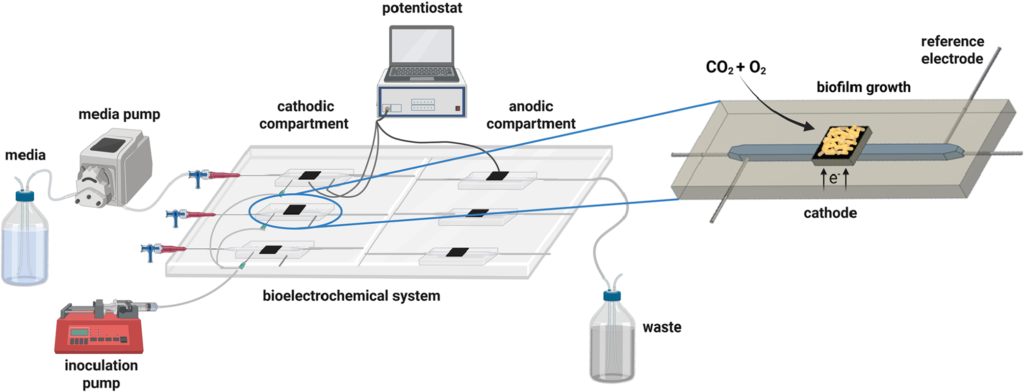
In a recent research paper published in Industrial & Engineering Chemistry Research Dr. Sri Sannihita Chavali; Dr. Christiane Roller; Dr. Tom Liebing; Dr. Rainer Adelung; Dr. Thorsten Alexander Kern; Dr. Miriam Edel; Professor Bodo Fiedler and Professor Johannes Gescher from the Institute of Technical Microbiology, Hamburg University of Technology in Germany together with Dr. Jonas Lumma and Dr. Morten Möller from Kiel University, The authors developed a microfluidic bioelectrochemical strategy for continuous kinetic measurement of C. necator H16 cathode biofilms under defined flow conditions. They paired a heterotrophic-to-electroautotrophic cultivation sequence with noninvasive OCT, open-circuit controls, electrochemical characterization, and three-dimensional Aerographite cathodes. The distinct technical element is the combination of controlled biofilm startup with an ultralow-density tetrapodal electrode whose internal pore network can support colonization beyond the externally perfused surface. This allowed biological loading to be examined in relation to electrode mass, accessible surface, and three-dimensional architecture rather than projected area alone.
The researchers compared graphite and Aerographite cathodes under matched electrochemical, hydrodynamic, and cultivation conditions so that differences in biofilm behavior could be related to electrode architecture rather than reactor operation. Cupriavidus necator was first allowed to establish a thin biofilm using an organic carbon source before the medium was changed to support electroautotrophic growth. This biphasic strategy was central to the experimental design because an established respiratory biofilm reduces the exposure of newly attached cells to reactive oxygen species formed at the polarized cathode. Open-circuit controls provided a direct comparison for determining whether continued biomass accumulation depended on cathodic electron supply.
Using optical coherence tomography, the team followed biofilm development repeatedly without disrupting the reactor. On graphite, biomass continued to accumulate after the transition to electroautotrophic conditions and developed into a substantial cathode-associated biofilm. Growth stopped in the corresponding unpolarized control after removal of the organic carbon source, linking sustained biomass formation to the polarized electrode. The time-resolved measurements were especially informative because they captured the development of C. necator on a cathode continuously rather than reducing colonization to a single endpoint observation.
The authors found Aerographite to produce a different spatial pattern. Its open tetrapodal structure provided a three-dimensional scaffold rather than a single exposed surface, so projected-area comparisons alone did not fully describe biomass loading. When the researchers considered electrode mass, Aerographite supported far more biomass than graphite. Electrochemical measurements gave the same architectural message: the porous material provided a much greater electroactive area relative to its mass, even though its bulk conductivity was much lower than that of graphite. Impedance measurements showed comparable interfacial charge-transfer behavior under the operating conditions used for cultivation, demonstrating that the low-density carbon network could still function effectively as the cathodic interface.
The team performed microscopy which provided direct evidence of how C. necator interacted with the porous scaffold. Cells colonized the external surface and extended into internal regions of Aerographite, showing that gases and nutrients could reach the pore network even under flow-over operation. The biofilm also formed extracellular polymeric structures that bridged neighboring tetrapod arms. This bridging behavior is mechanistically important because the cells were not simply coating isolated carbon elements; they were using the three-dimensional geometry to build connected biofilm patches across the scaffold. The large pore network consequently acted as both an electrochemical substrate and a physical support for spatial biofilm development.
The scientific value of the work of Professor Johannes Gescher and colleagues comes from separating cathode colonization into two distinct biological states. A bare polarized surface and a biofilm-covered polarized surface do not present C. necator with the same environment. By establishing biomass heterotrophically before requiring electroautotrophic growth, the researchers treated startup as a controlled transition in interfacial physiology. That distinction gives future studies of aerobic cathodic biocatalysts a more precise experimental basis for examining growth kinetics, current dependence, and electrode–cell interactions. For C. necator specifically, the continuous OCT measurements establish that cathodic biofilm accumulation can be quantified over time under defined flow conditions rather than inferred from endpoint surface coverage.
The Aerographite comparison also changes how electrode performance can be interpreted. Projected area alone is poorly suited to describing a material whose solid scaffold extends through a highly porous volume. A planar electrode concentrates biomass at one exposed boundary; the tetrapodal network distributes potential attachment sites throughout the electrode thickness. Mass-specific biomass loading and internal colonization consequently become informative measures of what the architecture is doing. The approximately 237-fold difference in biomass per electrode mass and the much larger mass-specific electroactive surface area are not merely consequences of adding porosity. They arise from combining very little carbon mass with an extended connected scaffold accessible to cells and electrolyte.
The pore dimensions carry a separate process implication. Aerographite contains interconnected spaces spanning roughly 10–500 μm, and a substantial part of that range exceeds biofilm thicknesses discussed by the authors for established electroactive systems. Larger pores can retain open transport spaces as biomass develops, allowing electrode thickness to become a usable reactor dimension rather than simply material separating the bulk liquid from the interior. The internal colonization observed under flow-over conditions is significant in that respect: cells reached regions not directly supplied by convective flow, so the scaffold was biologically accessible beyond its outer face. The authors connect this geometry to flow-through operation, where convective delivery through the pore network could recruit a greater fraction of Aerographite’s internal surface into electrochemical turnover. Their estimate of about 125 cm² total geometric surface, compared with the much smaller electrochemically accessed fraction under the tested flow-over conditions, makes that design direction concrete. The implication is not simply that greater area is desirable. The architecture provides physical space in which reactant delivery, electrode surface, and attached biomass could be brought into closer spatial correspondence by changing how fluid moves through the cathode. A further contribution is methodological. Noninvasive OCT supplies time-resolved biofilm state information, and microscopy resolves how that biomass is distributed through the porous structure. Coupled with electrochemical measurements, these techniques connect biological growth, material architecture, and cathodic behavior in the same reactor concept. The authors explicitly relate that combination to future bioelectrochemical systems in which electrode structure, biofilm state, and process operation can be considered together for carbon dioxide conversion.


Reference
Chavali, Sri Sannihita & Roller, Christiane & Liebing, Tom & Lumma, Jonas & Möller, Morten & Adelung, Rainer & Kern, Thorsten & Edel, Miriam & Fiedler, Bodo & Gescher, Johannes. (2026). Aerographite vs Graphite: Investigating the Role of Electrode Architecture in H2-Mediated Electroautotrophic Biofilms. Industrial & Engineering Chemistry Research. 65. 10.1021/acs.iecr.6c01035.
Go to Journal of Industrial & Engineering Chemistry Research