Advances in Engineering Advances in Engineering features breaking research judged by Advances in Engineering advisory team to be of key importance in the Engineering field. Papers are selected from over 10,000 published each week from most peer reviewed journals.

Significance
Crude oil continues to serve as the backbone of modern energy systems and even the most optimistic forecasts concede that oil will hold a central role for decades yet. But the process of extracting this resource is no longer straightforward. Aging oil fields now dominate production, and these mature reservoirs are becoming increasingly difficult. Remarkably, despite employing well-established recovery techniques like water flooding, it’s not uncommon for up to 70% of the original oil to remain trapped within the rock formations. Why does so much oil remain out of reach? The reasons are both complex and frustratingly persistent. High capillary forces and poor sweep efficiency work against efforts to dislodge trapped hydrocarbons, and the phenomenon known as viscous fingering only adds to the inefficiency. Then there’s the issue of interfacial tension—the invisible but powerful barrier between oil and water phases that resists any attempt at mobilization. Add to that the common oil-wet nature of reservoir rocks, and what you get is a scenario where conventional methods simply fall short, time and again. In response to these formidable barriers, the industry has leaned heavily on Chemically Enhanced Oil Recovery (CEOR) techniques. These include the use of surfactants, polymers, and foam to coax stubborn oil out of its hiding places. On paper, these methods seem promising, and indeed, they have yielded some success in controlled environments. But the reality underground is far harsher. High temperatures and salinity levels typical of deeper reservoirs often lead to the rapid degradation of these chemical agents. Worse still, their instability over time undermines long-term recovery efforts. And then comes the question of cost of both financial and environmental. Deploying large volumes of chemicals isn’t a decision made lightly, given the risks of groundwater contamination and the long-term ecological footprint such interventions might leave behind. The petroleum sector finds itself in a delicate balancing act: trying to squeeze the last drops from declining fields without tipping into unacceptable environmental harm. For all the technical sophistication the field has achieved, it’s becoming clear that the next breakthrough will need to be as much about sustainability as it is about efficiency.
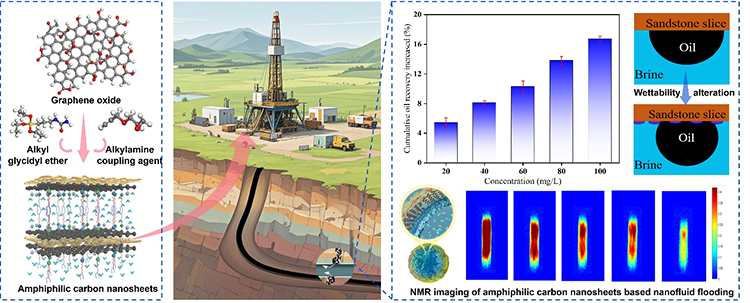
In the face of persistent inefficiencies in enhanced oil recovery (EOR), it’s becoming increasingly clear that conventional solutions are struggling to keep pace with industrial demands. To this account, new research paper published in Energy & Fuels and conducted by Dr. Bingjie Fu and Professor Rui Liu from Professor Wanfen Pu’s group at the Petroleum Engineering School, Southwest Petroleum University alongside with Dr. Shi Gao from the Oil Production Technology Institute of Petro at China Dagang Oilfield Company, developed amphiphilic carbon nanosheets (ACNs) to improve performance metrics and understand the underlying mechanisms that govern their behavior. The researchers began with the careful functionalization of graphene oxide using alkyl glycidyl ether, creating nanosheets that possessed both hydrophilic and hydrophobic properties—a delicate balance necessary for effective interaction at the oil–water interface. Advanced imaging tools confirmed what the team had hoped: the nanosheets were astonishingly thin—about 2 nanometers—yet expansive enough in lateral size to navigate the tight, tortuous channels of porous rocks. The authors found that even at low concentrations, the ACNs migrated swiftly to the oil–water interface, cutting interfacial tension to just 6 mN/m. To a casual observer, that might seem like a minor technical detail. But in practice, this shift fundamentally changes how easily trapped oil droplets can detach and move. High-speed visualization—almost cinematic in its clarity—captured the nanosheets clustering precisely where they were needed, at the contact points between oil droplets and pore walls, gradually coaxing the oil free. Afterward, the team knew that altering rock wettability was equally vital and through painstaking contact angle experiments, they observed a remarkable shift: oil-wet surfaces moved toward a more water-wet state, with contact angles dropping from a stubborn 138.6 degrees to a far more favorable 71.75 degrees. Electron microscopy provided visual confirmation, revealing nanosheets neatly coating the rock surfaces, reshaping their fundamental adhesive properties. Additionally, the authors put theory to the test and moved beyond the lab and into realistic core flooding experiments under high-temperature, high-salinity conditions. The results spoke volumes. Recovery rates jumped by 16.7% compared to standard brine flooding which is a clear demonstration that these nanosheets could perform under the same harsh environments that have defeated other technologies.
In conclusion, Professor Rui Liu and colleagues demonstrated that amphiphilic carbon nanosheets can dramatically improve oil displacement through both interfacial tension reduction and rock wettability alteration, and introduced successfully a material solution that directly addresses the two fundamental barriers limiting crude oil recovery. This achievement is particularly important at a time when the energy sector is under pressure to extract resources more efficiently while minimizing environmental impact. Indeed, the ability to recover an additional 16.7% of oil from reservoirs that were previously considered near depletion is a breakthrough with profound economic and strategic implications. From a practical standpoint, the application of ACNs presents a compelling case for rethinking how we approach enhanced oil recovery. Traditional chemical flooding agents—surfactants and polymers in particular—have long struggled to withstand the harsh realities of deep reservoir environments. High temperatures and salinity levels inevitably lead to their degradation, often requiring repeated injections to maintain any semblance of effectiveness. That cycle isn’t just inefficient; it’s expensive and environmentally problematic. What’s striking about these nanosheets is their remarkable resilience under exactly those conditions. Even after extended exposure to high thermal and saline stresses, they maintain their structural integrity and functionality, which is not something we can say for most conventional agents.
This durability does more than just improve operational efficiency. It also addresses the less talked-about but critically important issue of chemical residues accumulating in subsurface formations. Every time a degraded chemical cocktail is reinjected into a reservoir, we leave behind substances that don’t simply disappear. Over time, these residues could pose long-term environmental risks—an issue that’s often conveniently overlooked in commercial operations. By reducing the frequency of reinjection and minimizing the chemical footprint left behind, ACNs offer a path toward more responsible and sustainable recovery practices. We also believe what’s particularly exciting, at least from a broader scientific perspective, is how the findings from this study reach far beyond just oil recovery. The self-assembly behavior of these nanosheets at fluid interfaces and their remarkable ability to alter solid surface properties open up fascinating possibilities in other industries. Applications ranging from wastewater treatment to advanced separation processes and even high-performance material coatings could benefit from the same principles demonstrated here. In that sense, the study doesn’t just solve a specific industrial challenge; it lays down a foundation for material innovations that could have wide-ranging impacts.




Reference
Fu, Bingjie & Liu, Rui & Gao, Shi. (2024). Unlocking the Mechanism of Unique Interfacial Behavior and Highly Efficient Oil Displacement of Amphiphilic Carbon Nanosheets. Energy & Fuels. 38. 10.1021/acs.energyfuels.4c03442.