 Advances in Engineering Advances in Engineering features breaking research judged by Advances in Engineering advisory team to be of key importance in the Engineering field. Papers are selected from over 10,000 published each week from most peer reviewed journals.

Significance
A structure that is comprised of multiple hollow cylinders arranged in a particular pattern or configuration is referred to as a bundled hollow cylinder. The individual cylinders are typically of thin wall thickness and have a circular cross-section. They are arranged in such a way that they join together to form a larger structure with particular properties and shapes. The design of heat exchangers and chemical reactors, as well as biological systems like plant stems and blood vessels, all utilize bundled hollow cylinders. Other examples include composite materials used in the aerospace and automotive industries. Bundled hollow cylinders are useful in a wide range of engineering and scientific endeavors due to their distinctive properties of efficient fluid flow and high strength-to-weight ratio.
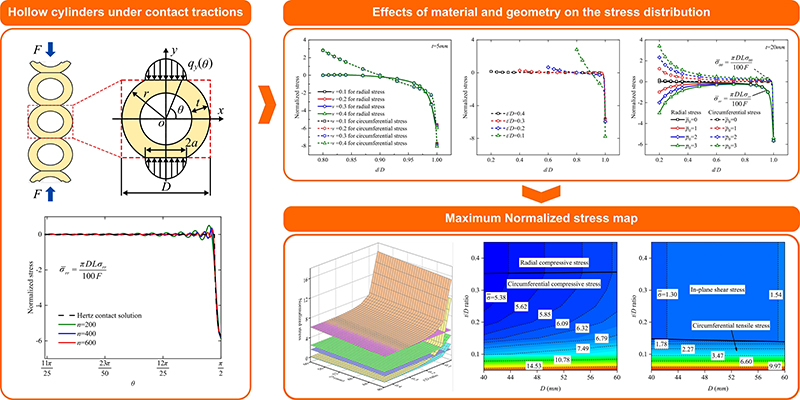
In a new study published in the peer-reviewed International Journal of Mechanical Sciences, Dr. Ge Qi and colleagues from the Jiangsu university established theoretical basis for structural rigidity and integrity by offering precise analytical solutions for stress. To fully comprehend failure reasons and enable flexible structure design with specialized functionalities, in-depth study of the mechanical behaviors of bundled hollow cylinders was conducted. In their study, the interaction between the hollow cylinder and its closest neighbors needed to be taken into consideration despite the various loading forms, such as hydrostatic pressure, humidity, and temperature for xylem vessels, pulsed laser radiation for optical fiber bundles, and various combinations of static and dynamic loadings for honeycombs.
Previous research on the elastic constants of bundled hollow cylinders, showed three main theoretical frameworks frequently used: thin ring theory (TRT), curved beam theory (CBT), and theory of elasticity (TOE). Of all these, TOE takes into account how the contact situation changes as a result of deformation, is thought to be more competitive in the analysis of thick-walled packing tubes. In TOE, it was assumed that the cylinder is homogenous, isotropic, and linearly elastic. The cylinder was considered infinitely long and has a constant wall thickness. The contact was assumed to be between a rigid flat surface and the outer surface of the cylinder and the deformation of the cylinder is assumed small.
The study separates the governing equations using displacement functions and derives precise formulas for the stress components. The Hertz contact at the interaction surface is taken into consideration in the analysis, and the Fourier series is used to solve for the unknown coefficients. In the Fourier series, the angle parameter Θ ranges from –π to π, and the contact pressure is considered non-zero in a limited region. The authors examined a hollow cylinder’s internal stress distribution in their study, and it is shown to be significantly non-uniform over both the radius and circumference. In order to investigate the effects of material and geometry on stress distribution, the researchers also carried out parameter analyses. Additionally, they presented brand-new maximum normalized stress maps that offer a useful way to comprehend how stress is distributed.
This study by Dr. Ge Qi and co-workers has a lot of scientific significance. It can be used in structural design for designing the efficient and robust structures such as pressure vessels, pipelines, and engine components. Engineers can determine material properties required to support the loads and make sure that the structure meets the safety requirements. It can also be uses in material science to study the mechanical behavior of materials under different loading conditions. By understanding the stress distribution, manufacturers can optimize the process parameters. Lastly if properly deployed, it can also be used to do failure analysis. Engineers can oversee the cause of failure and develop strategies to prevent it.
To conclude, this study makes use of analytical solutions to the stress fields in the bundled hollow cylinder. The formula proposed here is designed to analyze the tube under two symmetrical contact tractions, but it may also be expanded to analyze packing types that are hexagonal and cubic.

Reference
Qi, G., Liu, C. X., Feng, K., Ma, L., & Schröder, K. U. (2023). Analytical solutions of stress distribution within a hollow cylinder under contact interactions. International Journal of Mechanical Sciences, 2 39,107897.