Advances in Engineering Advances in Engineering features breaking research judged by Advances in Engineering advisory team to be of key importance in the Engineering field. Papers are selected from over 10,000 published each week from most peer reviewed journals.

Significance Statement
Headed deformed bars gain the strength of the bars though a combination of bearing by the head and bond by the bar deformations. With suitable detailing, these headed deformed bars can be developed with a shorter length than the straight hooked bars therefore occupying less space. These headed deformed bars have the capacity to be used in exterior beam-column joints in special moment frames with an aim of relieving steel congestion and bringing ease in construction.
The specifications for development of length as well as detailing requirements for headed deformed bars in tension include length equation, limits on bar yield strength, concrete compressive strength, concrete type, bar size, clear cover, net bearing area of the head, and bar clear spacing. These specifications were developed based on anchorage tests of headed deformed bars in CCT node specimens, lap splices in cast-in-place joints of precast members and pullout-cone specimens. When used in the beam-column joints, headed deformed bars are confined well by joint transverse and column longitudinal reinforcements, columns axial load, and members framing to the joint.
A revision of the previous provisions saw the clear bar spacing reduced from 4db to 3db when the headed deformed bars are applied in beam-column joints while other design parameters remained the same. However, this minimum clear bar spacing is still larger than the clear spacing normally used.
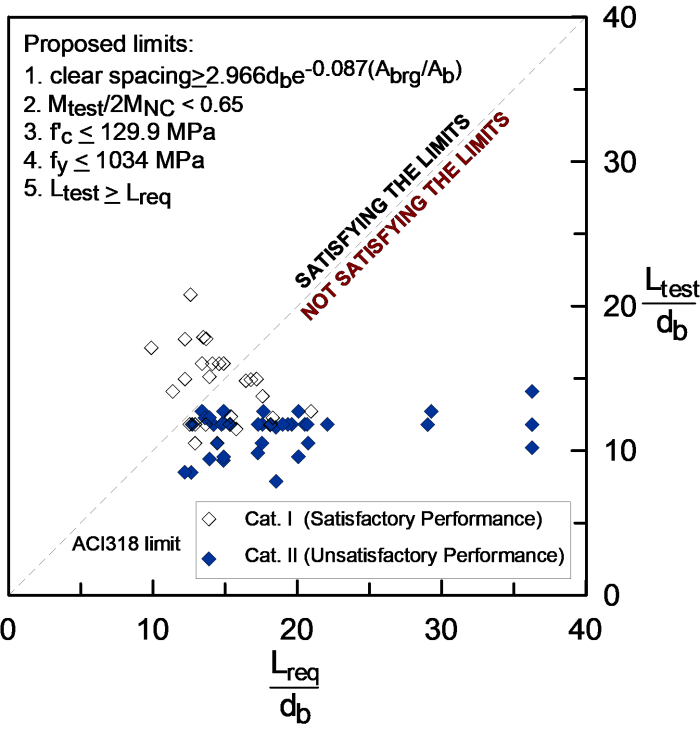
Researchers led by Professor Yu-Chen Ou from the National Taiwan University investigated the effect of design parameters on the anchorage performance in a bid to refine the code. Counting on the data collected, they evaluated the effects of major design parameters on the anchorage performance of the headed deformed bars and proposed design recommendations. Their work is published in peer-reviewed journal, KSCE Journal of Civil Engineering.
The authors assembled a test database on inter-story exterior beam-column joint specimens under cyclic loading. The database was to simulate seismic actions. All the samples used headed deformed bars to anchor beam longitudinal reinforcements. They collected 118 data points from 114 exterior beam-column joints. Three specimens had two transverse beams with continuous beam reinforcement framing perpendicularly to the joint. The other two specimens had a transverse beam with the headed bar reinforcement framing orthogonally to the main beam in the joint.
The authors observed that the axial load ratio had a positive effect on the anchorage performance of the deformed bars when the ratio was greater than or equal to 0.11. This was owing to the better confinement offered by the axial load. The performance also improved with increasing amount of joint transverse reinforcement parallel to the direction of applied shear. The reinforcement provided direct tensile resistance to the applied tension.
With increasing head bearing area ratio and clear bar spacing, anchorage performance increased. However, column moment had adverse effects on anchorage performance since it induced tension to bond portions and to head bearing of the deformed bars. All samples that fulfilled the ACI318 development length equation as well as the outlined design parameters had sufficient seismic performance.




Reference
Yu-Chen Ou, Hana Astrid Canseco, and Dimas P. Kurniawan. Anchorage Performance of Headed Deformed Bars in Exterior Beam-Column Joints Under Cyclic Loading. KSCE Journal of Civil Engineering.
Go To KSCE Journal of Civil Engineering