Advances in Engineering Advances in Engineering features breaking research judged by Advances in Engineering advisory team to be of key importance in the Engineering field. Papers are selected from over 10,000 published each week from most peer reviewed journals.

Significance Statement
Reverse osmosis desalination technology is of an interest in the field of water treatment plants and systems, especially in arid and water scarce regions. However, membrane scaling as a result of salt rejection and according supersaturation of sparingly soluble salts on the semipermeable reverse osmosis membrane defies the use of this technology. Gypsum is a common scale forming salt during desalination of natural waters as both, calcium and sulfate ions, are ubiquitously present.
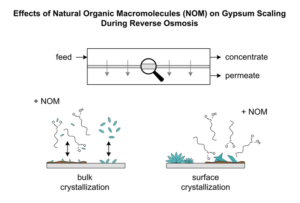
Gypsum scaling may occur by crystallization directly on the membrane surface or by bulk crystallization from the supersaturated feed solution. Both scaling mechanisms have been previously reported coupled with the determination of the prevailing mechanism. It’s also known that certain organic macromolecules which lead to membrane fouling may inhibit or favor gypsum scaling on reverse osmosis membranes. Hence, a profound knowledge of the interactions between organic macromolecules, gypsum scaling and scaling mechanisms would be of help to optimize scale prevention measures.
Jan Benecke and colleagues from Institute for Water Resources and Water Supply at Hamburg University of Technology (TUHH) in Germany tailored the operation of a bench-scale reverse osmosis desalination system to independently investigate the interactions between organic macromolecules such as bovine serum albumin, humic acid and sodium alginate with gypsum bulk and surface scaling mechanisms.
The research work which is now published in the journal, Separation and Purification Technology implemented a bench-scale reverse osmosis desalination system operating at two tailored degrees of concentration polarization. During permeability and retentate turbidity tests, the authors found that at the lower degree of concentration polarization, bulk crystallization of gypsum was predominant. However, at a higher degree of concentration polarization, gypsum surface crystallization occurred with the non-presence of gypsum bulk crystals. Results from scanning electron microscopy supported the predominance of each scaling mechanism.
Among the selected organic macromolecules, sodium alginate contributed mostly to permeability loss, which indicates strong membrane fouling, followed by humic acid and bovine serum albumin, respectively. At low concentration polarization and predominance of gypsum bulk crystallization, all macromolecules retarded the onset of bulk crystallization. However, it was also found that the presence of sodium alginate shifted the gypsum scaling mechanism from bulk to surface crystallization, indicating an enhancement of surface crystallization due to the deposited sodium alginate fouling layer. These conclusions were backed with scanning electron micrographs of the scaled membrane surface and complimentary results from crystallization jar tests. At high degree of concentration polarization, the coexistence of sodium alginate and humic acid slightly enhanced gypsum surface crystallization, whereas the coexistence of bovine serum albumin showed marginal effects. The authors suggest a correlation between the severity of macromolecular fouling and the enhancement of gypsum surface crystallization.
The study by Jan Benecke and colleagues enables an avenue for optimizing existing scale prevention technologies, given the ubiquitous presence of natural organic matter in natural waters. The results highlight the necessity for further research to comprehensively understand interactions between organic and inorganic membrane foulants in reverse osmosis desalination systems to develop more sustainable and green scale inhibition additives and techniques.



Journal Reference
Benecke, J., Rozova, J., Ernst, M. Anti-Scale Effects of Select Organic Macromolecules on Gypsum Bulk and Surface Crystallization during Reverse Osmosis Desalination, Separation and Purification Technology, Available online 30 November 2016 . http://doi.org/10.1016/j.seppur.2016.11.068.
Institute for Water Resources and Water Supply, Hamburg University of Technology, Am Schwarzenberg-Campus 3, 21073 Hamburg, Germany.
Go To Separation and Purification Technology