Advances in Engineering Advances in Engineering features breaking research judged by Advances in Engineering advisory team to be of key importance in the Engineering field. Papers are selected from over 10,000 published each week from most peer reviewed journals.

Significance Statement
Fuel cells are devices that produce electricity directly from the energy of a chemical reaction. There are many types of fuel cells used in different applications. These are usually classified according to their electrolyte type and temperature of operation. Solid oxide fuel cells use a solid ceramic electrolyte and are being operated at elevated temperatures typically above 800 degrees Celsius. Due to their high operation temperature, appropriate materials have to be selected. When compared with other types of fuel cells, Solid oxide fuel cells offer more advantages in industrial applications as they exhibit higher thermodynamic efficiencies, fuel flexibility, higher impurity tolerance levels and the capability to process the fuel directly within the fuel cell itself avoiding high cost external fuel reforming units.
There are certainly several types of conventional fuels that can be used in this high temperature range of operation of these all solid state ceramic fuel cells even without the need of expensive noble metal electro-catalysts such as platinum. So far, high fabrications costs have prevented these devices from reaching commercial maturity and thus several laboratories have undertaken research efforts to address issues of new high temperature materials and fabrication methods. Research efforts are also undertaken to lower the operation temperature to the range of 450-800°C that would relax material selection requirements. Generally, the fabrication methods adopted are based on the particular design of a Solid oxide fuel cell.
There are two major cell designs; one is based on planar and the other on tubular geometry. Flat plate Solid oxide fuel cells are chosen for operation in the lower temperature range due to their low fabrication costs that would allow the use of cheaper metallic interconnects.. Introduction of new materials and new innovative fabrication methods constitute the two strategies taken for this purpose. For the production of thin film electrodes and electrolytes in large scale, novel fabrication methods are needed. These electrodes need to be optimized to operate in the temperature range between 500 and 800 degrees Celsius and also for long term performance.
Sputtering, dip and spin coating, spray pyrolysis, electrophoretic deposition, slip casting, and plasma spraying are some of the deposition techniques that have been tested for planar geometry Solid Oxide fuel cell component fabrication. These techniques produce very thin layer of components (even less than 1 micrometer) and they also have more active precursor components which causes reduction of subsequent sintering temperatures. As thin electrodes (i.e. less than 5 μ) have low ohmic resistances, their operating temperatures can be kept low which leads to improved reliability and long term performance. The type of deposition method depends on its molecular precursors.
Deposition techniques directly control the parameters of the final particle size and morphology of the fabricated films by appropriately tuning their physicochemical characteristics involved during deposition. These techniques are preferred more as this control over film morphology could potentially eliminate subsequent steps of densification (sintering).
In all these techniques different mechanisms are operative during deposition which are usually classified as based on chemical, physical and ceramic powder processing methods.
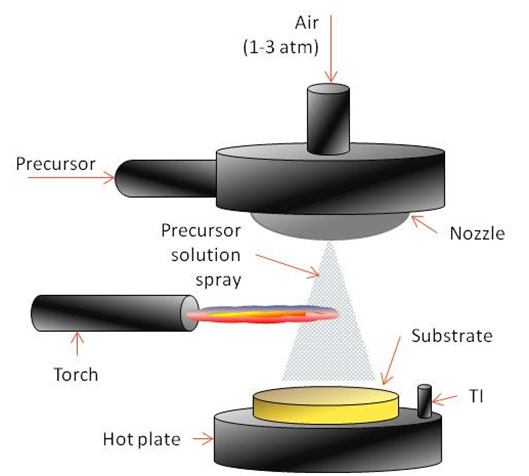
For example, in a plasma spraying method known as vacuum plasma spraying, the ceramic materials are melted by means of thermal energy and subsequently are deposited onto suitable substrates. . In spray pyrolysis, an aerosol made from a solution of appropriate metal ions is used as it controls the parameters to obtain a final product with desired characteristics and thus, it is very suitable for the production of mixed metal oxides.
Professor Nikolas Kiratzis from Western Macedonia University of Applied Sciences (former TEIWM) in Greece examined spray pyrolysis for Solid oxide fuel cells’ component fabrication. This method is also used exclusively for planar component geometries. A review has already been made on the versatility of this solution aerosol process. To control the initial droplet size, droplet velocity and droplet size distribution, a solution atomization technique is used. A two-fluid air-atomizing nozzle operating with air as a carrier gas is the cheapest set being used and here the solution can be fed by means of siphon effect or alternatively by a peristaltic or syringe pump.
Pressure and nebulizers are other pneumatic atomizers being used. The parameters that affect the initial droplet size are solution density, viscosity and surface tension. Generally, ultrasonic and electrostatic atomizers are advantageous over two-fluid or pressure atomizers as they produce droplets of smaller sizes. Generally, optimization is necessary to increase deposition rates.
This paper also reviewed the progress in Solution aerosol thermolysis (spray pyrolysis) technique and has found it suitable for the fabrication of Solid oxide fuel cells. In terms of selection of precursor materials and processing parameters spray pyrolysis offers greater flexibility.
Optimization methods should concentrate on the effect of substrate temperature and solution boiling point on final film morphology. Also solution concentration has not been seen thoroughly in the literature. The process also offers the possibility of in situ sintering which significantly promotes cost reduction.
Overall, this study shows that the application of Solution aerosol thermolysis technique provides many advantages as a component fabrication route for Solid oxide fuel cells.
Figure Legend: The technique of Solution Spray Pyrolysis.
Journal Reference
Kiratzis, N., E. Applications of the technique of solution aerosol thermolysis (SAT) in solid oxide fuel cell (SOFC) component fabrication, Ionics , Volume 22, 2016, Pages 751-770.
Technological Research Center (TRC)Technological Education Institute (TEI) of West Macedonia Kozani Greece.
Go To Ionics