 Advances in Engineering Advances in Engineering features breaking research judged by Advances in Engineering advisory team to be of key importance in the Engineering field. Papers are selected from over 10,000 published each week from most peer reviewed journals.

Significance
Inorganic nanotubes of tungsten disulfide possess excellent flexibility, high mechanical integrity, superior electrical transport features, and appreciable thermal stability. The tensile strength of multi-walled tungsten disulfide has been found to be in the range of 15 to 20 GPa, which is almost the theoretical maximum of the material. It has also been found that well-crystallized tungsten disulfide nanotubes have the capacity to resist high dynamic pressures as well as temperatures initiated by shock waves of up to 21 GPa.
Owing to these remarkable features, inorganic nanotubes of tungsten disulfide have been identified as potential candidates for the manufacture of a new group of complex materials including: metal composites, catalysts, and lubricants. The ability of these nanotubes to reinforce polymers and enhance their mechanical, thermal, and tribological features even when added in amounts of less than 1% has attracted much attention in academia and industry.
Inorganic nanotubes of tungsten disulfide have been previously embedded into polymethyl methacrylate (PMMA) electrospun fibers. It was found that the inorganic nanotubes aligned along the fibers, considerably improved the thermal and mechanical features of the polymer. The thermal integrity of the composites fiber-mesh was observed to improve by 23 °C in relation to that of pure PMMA. In addition, the tensile modulus of the meshes improved by more than 10 folds without affecting the tensile strength.
Various studies have indicated positive influence of tungsten disulfide nanotubes on a number of polymer features. However, the form and nature of the interactions of tungsten disulfide nanotubes with polymers have not been sufficiently captured. Therefore, Israeli researchers led by Professor Alla Zak at Holon Institute of Technology and Dr. Tsachi Livneh from the Nuclear Research Center, Negev, investigated these interactions.
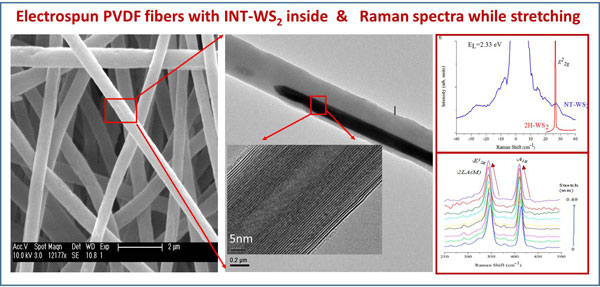
In their studies, the authors embedded inorganic tungsten disulfide nanotubes into sub-µm polyvinylidene fluoride-co-hexafluropropylene electrospun fibers. They then explored the Raman scattering spectroscopy from single nanotubes in the course of stretching of individual nanocomposite fibers. Their study was published in journal, Physical Chemistry Chemical Physics.
The research team recorded red shifts of up to 4.7cm-1 of the tungsten disulfide Raman bands before the tearing point of the fibers was reached. The shifts were correlated with approximately 2.8% of nanotube elongation. This observation points to the superior adhesion of the nanotube’s surface to the polymer, and to the effective load transfer from the polymer to nanotube.
The fact that the A1g and E12g bands did not show noticeable stretching-induced broadening and the absence of the E22g shear mode are consistent with the notion of the nanotubes being stretched within the fiber as a whole. This means that the load was successfully transferred from the outer layer to the inner tungsten disulfide concentric cylinders of the nanotube.
In a bid to unearth the nature of the interaction between the polymer and the nanofiller, they modelled the deformation of the composite fibers implementing an elastic lattice spring model. The results obtained were in very good agreement with authors interpretation.
Essentially, their studies will be of importance to scientists developing applications where improving thermal and structural polymer properties would be of value – either by improving existing materials or by reducing the amount of material required to match current physical capabilities.
Reference
Olga Grinberg, Shengwei Deng, Eyal Zussman, Tsachi Livneh, and Alla Zak. Raman scattering from single WS2 nanotubes in stretched PVDF electrospun fibers. Physical Chemistry Chemical Physics, issue 19 (2017), pages 18443-18451.
Go To Physical Chemistry Chemical Physics