Advances in Engineering Advances in Engineering features breaking research judged by Advances in Engineering advisory team to be of key importance in the Engineering field. Papers are selected from over 10,000 published each week from most peer reviewed journals.

Significance
Advances in construction techniques have enabled the use of steel frames filled with steel plates that improve the lateral stiffness and foundation capacity; particularly for seismic design of middle and high-rise buildings. To be precise, steel plate shear walls (SPSW) have in recent years become the primary lateral force resisting system (LFRS) credit to their advantages; i.e. high initial stiffness, good ductility, strong seismic resistance and simple connection. Generally, the SPSW presents a light weight system (reduced gravity load) that can effectively cater for adequate seismic design at reduced foundation cost. To date, numerous numerical and experimental studies have been carried out on several types of SPSW. Regardless, the structural damage and collapse of steel frames under the action of earthquake are gradually revealed. More so, the observed behavior of steel frames is quite different from the prediction of code design. This can be attributed to the fact that even though most of steel frame structures conform to the conceptual seismic design guidelines, there are variabilities in engineering design due to simplified processing and subjective decision making in the design procedure. Consequently, systematic evaluation of steel frame structures, comprehension of structural performance characteristics, and prediction of structural seismic performance at different hazard levels still require significant effort.
Recent research has revealed that fundamental period is an important parameter for determining the spectral acceleration of building structures, which can be used for determining the seismic response modification factor. As such, empirical methods and theoretical methods of fundamental period prediction based on the basic theory of engineering mechanics have been developed. Unfortunately, the applicability of such methods in engineering design has not been demonstrated. To this note, researchers from the Central South University, China: Rui Jiang, Professor. Liqiang Jiang, Dr. Yi Hu and Professor Lizhong Jiang, together with Professor Jihong Ye at the China University of Mining and Technology developed a simplified method for the period prediction of SPSW structures based on the basic theory of engineering mechanics. Their work is currently published in the research journal, The Structural Design of Tall and Special Buildings.
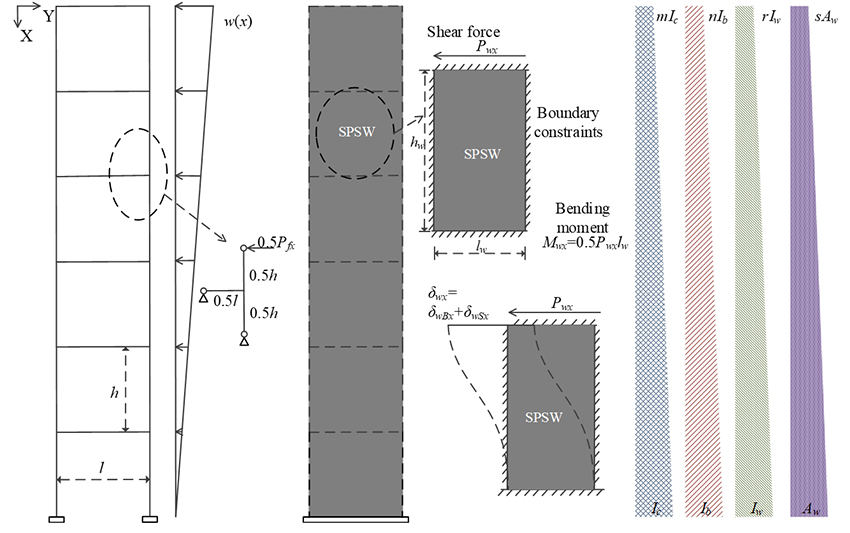
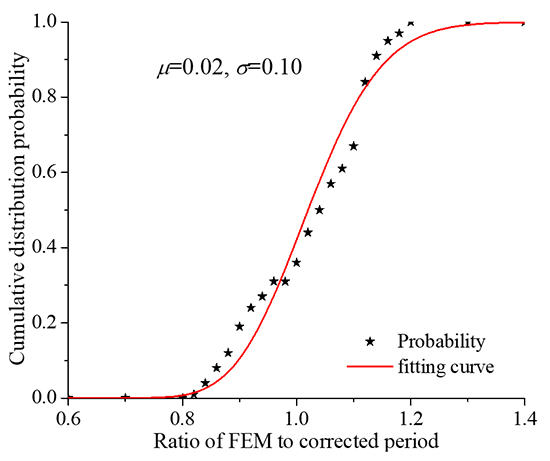
In their approach, the theoretical model of SPSW structure was developed based on an acknowledged methodology on steel frames and braced steel frames. The research team incorporated the shear-flexure deformation characteristic of the SPSWs and structural configuration into their model. The periods predicted by the theoretical method were compared with the FEM results in literatures, and a correction factor was proposed via fitting analyses. Lastly, the team evaluated the effectiveness and practicability of the proposed method by comparisons with several existing methods for SPSW structural period prediction.
The authors reported that the proposed approach had several advantages: i.e. first, it could be calculated by hand. Second, the finite element (FE) model and the vibration analysis were not necessary, thus it is good for engineering practice in comparison to other FE methods. Third, it considered the configurations of the steel frame as well as the SPSWs, thus the results were more accurate in comparison with the simple calculations proposed in the standards.
In summary, the study presented a simplified theoretical method for predicting the fundamental period of SPSW structures. The presented methodology considered not only the stiffness and configuration of the steel frame, but also the shear-flexure behavior of the SPSWs. Further, the effects of the amount of SPSWs, the bay length, and the stiffness of beams, columns and the SPSWs were captured by some parameters in the proposed method. In a statement to Advances in Engineering, Professor Liqiang Jiang, the corresponding author highlighted that a confidence interval estimation could be determined via their approach according to the demand of structural design.



Reference
Rui Jiang, Liqiang Jiang, Yi Hu, Lizhong Jiang, Jihong Ye. A simplified method for fundamental period prediction of steel frames with steel plate shear walls. The Structural Design of Tall and Special Buildings. 2020; volume 29: e1718.