Advances in Engineering Advances in Engineering features breaking research judged by Advances in Engineering advisory team to be of key importance in the Engineering field. Papers are selected from over 10,000 published each week from most peer reviewed journals.

Significance Statement
Ammonia is a promising candidate for energy storage that can replace typical fossil fuels in view of the ever-rising energy demand and the need to fix climate change issues. If obtained from renewable sources, ammonia can be a sustainable resource that can be capable of meeting most of the energy demands in isolated regions that are normally disconnected from the national grid. As opposed to other fuels such as hydrogen, shale gas, dimethyl ether, and biofuels, ammonia comes with a number of benefits for its storage, distribution, and delivery.
For example, ammonia is composed of a large hydrogen component but is not affected with the same issues in storage since it can be converted into liquid at low pressures. In addition, ammonia is a useful chemical in the production of fertilizers; therefore, there are already well-established infrastructures as well as experience for its handling, distribution, and storage.
Now, several researchers are still trying to use ammonia for power systems, particularly in internal combustion engines. Unfortunately, power obtained from these units is quite modest normally in the range of 0.1-1MW range. Therefore, responsive and lager power generators will be needed to satisfy the demands of the electrical grids. However, in view of the pressure to minimize carbon dioxide emission as well as finite fossil fuels resources, using green ammonia in gas turbines for power generation would be an interesting proposition. Unfortunately, there remains dearth of information relating to the implementation of ammonia in gas turbine combustors.
Cardiff University researchers, Hua Xiao, Agustin Valera-Medina, Richard Marsh, and Philip J. Bowen compared the performance of various detailed ammonia combustion mechanisms and distinguished which was capable of representing ammonia/methane combustion kinetics under the condition of conventional gas turbine combustor. Their research work is published in peer-reviewed journal, Fuel.
In a bid to explore the best-suited mechanism for ammonia-methane combustion in gas turbines, the authors compared five different detailed mechanisms to pinpoint their precision to represent the reaction kinetics under real gas turbine combustors. They also compared ignition delay time with recent literature findings indicating that the mechanisms of Tian and Teresa exhibited the best precision over a range of operation conditions. They also performed 1-dimensional simulation using the Chemical Reactor Network model, which then provided a quick estimation of the combustion mechanisms experiencing swirling combustion conditions.
Ignition delay time for diluted ammonia indicated that Tian’s and Teresa’s mechanisms gave the best results. Therefore, the authors used the Tians’ mechanism for ignition delay time predictions using ammonia/methane blends. NOx emission computations were done with a Chemical Reactor Network in a bid to simulate an ideal swirl burner of the gas turbine. The outcomes indicated that slightly fuel rich combustion had and advantage to lower NOx emission in gas turbines. Therefore, Tian’s mechanism was recommended as the best ammonia/methane combustion analysis.
The research team also used the Tian’s mechanism for additional analyses in order to determine the effects of pressure as well as temperature on NOx production. Results of their study indicated that high pressure could realize a considerable decrease of NOx emission while high inlet temperatures to the combustor promoted them.
More research probably is still needed for an in-depth insight into the ammonia chemistry so that the process can be refined to be suited for ammonia combustors. Thus, the group has embarked on a great variety of research topics related to ammonia combustion to unravel the unknown aspects of such a molecule, research that is available somewhere else.
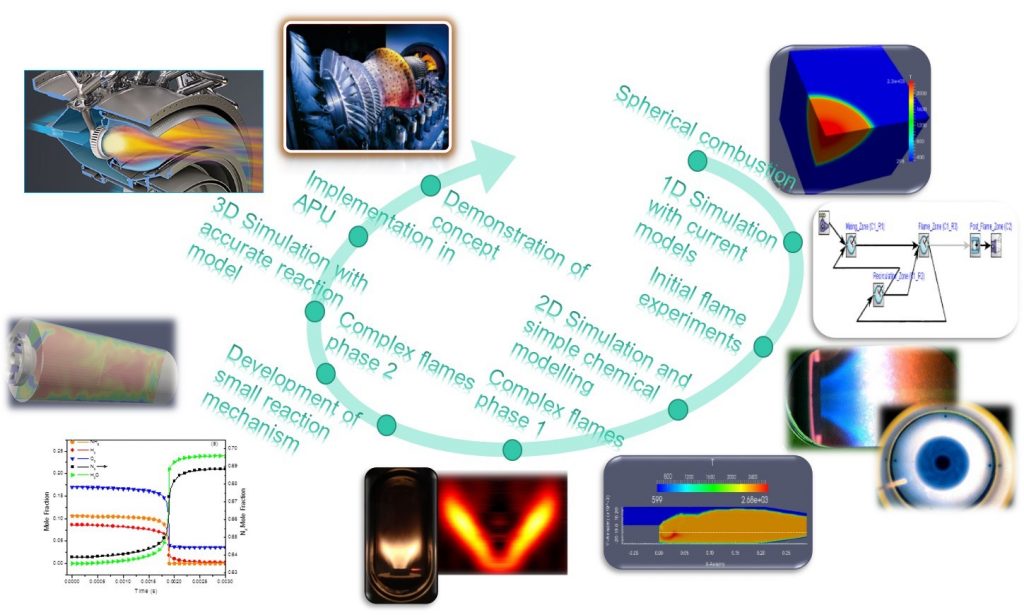
Video show: Rich Ammonia-Hydrogen Combustion in a Swirl Burner.
Reference
Hua Xiao, Agustin Valera-Medina, Richard Marsh, Philip J. Bowen. Numerical study assessing various ammonia/methane reaction models for use under gas turbine conditions. Fuel, volume 196 (2017), pages 344–351.
Go To Fuel