Advances in Engineering Advances in Engineering features breaking research judged by Advances in Engineering advisory team to be of key importance in the Engineering field. Papers are selected from over 10,000 published each week from most peer reviewed journals.

Significance Statement
The acquisition of optical power spectral densities is among the most fundamental and widely practiced procedures in optical test and measurement. Optical spectrum analyzers (OSA) are routinely employed in testing laser and LED light sources for spectral purity and power distribution, monitoring of optical communication networks, e.g. optical signal to noise measurement of dense wavelength division multiplex transmission systems, the readout of variety of optical sensors, and in the characterization of the transfer functions of passive and active photonic devices. Additionally, the spectral characteristics of different modulation formats can be analyzed, as well as the influence through nonlinear effects like Four Wave Mixing during the propagation through a fiber. Traditional, diffraction grating-based OSAs provide a spectral resolution on the order of 2 GHz (20pm). In recent years, such resolution is increasingly becoming insufficient. For example, spectrally efficient, modern optical communication formats, such as optical orthogonal frequency domain multiplexing, make use of a large number of sub-carrier tones that are densely packed. The frequency separation between adjacent sub-carriers may be as small as a few tens of MHz, hence the monitoring of such signals would benefit from an OSA of comparable resolution. The first step towards an increased resolution was the utilization of the nonlinear effect of stimulated Brillouin scattering (SBS). This process can amplify a small part of the optical signal. In principle it behaves like a narrow band optical filter. The Brillouin bandwidth in standard single mode fibers, and therefore the resolution of the spectrum analyzer, is typically 10MHz (80fm). An arbitrarily high spectral resolution may be obtained, at least in principle, through heterodyne interference of a signal under test with a local oscillator, detection with a photo diode and subsequent radio-frequency spectral analysis. The measured spectrum represents a convolution of the local oscillator with the signal. Therefore, the line width of the local oscillator directly defines the resolution. But the practical realization of such coherent OSAs is often challenging, as they may require highly stable and low-noise local oscillators and the possible detection range strongly depends on the characteristic of the photo diode and the properties of the electrical devices. Additionally, occurring false mixing products during down conversion needs to be filtered out, which limits again the measurement. The presented approach combines the narrow bandwidth filtering of stimulated Brillouin scattering with the high resolution of heterodyne detection. This enables an optical spectrum analyzer with ultra-high resolution over a spectral range which, in principle, is just restricted by the transparency range of the used Brillouin medium. The achieved resolution can be as low as 1kHz (8am), which is 2 million times better than a grating based OSA. The method operates with off the shelf telecom equipment and enables the high resolution measurement of optical signals without any bandwidth limitation. Therefore the method shows a high impact on the field optical spectrum analysis.
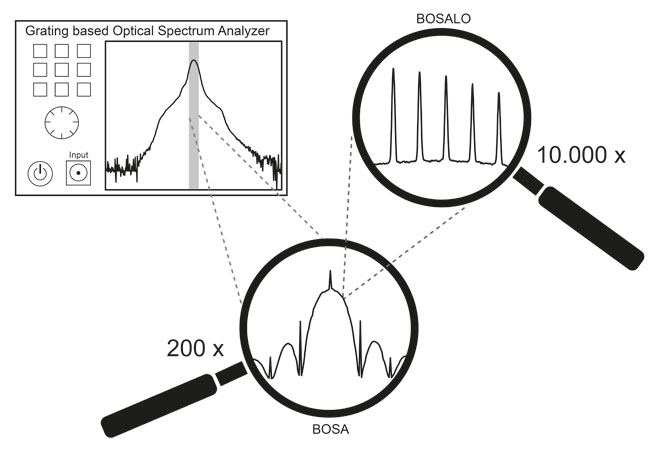
Figure Legend:Magnify the resolution of optical spectrum analysis. The resolution of a classical grating based OSA can be enhanced by 200x using a Brillouin based OSA, whose resolution can be enhanced by 10.000x using the presented method.
Journal Reference
Opt Express. 2015;23(20):26879-87.
Preussler S, Schneider T.
Institut für Hochfrequenztechnik, Technische Universität Braunschweig, Schleinitzstr. 22, 38106 Braunschweig, Germany.
Abstract
Spectral analysis is essential for measuring and monitoring advanced optical communication systems and the characterization of active and passive devices like amplifiers, filters and especially frequency combs. Conventional devices have a limited resolution or tuning range. Therefore, the true spectral shape of the signal remains hidden. In this work, a small part of the signal under test is preselected with help of the polarization pulling effect of stimulated Brillouin scattering where all unwanted spectral components are suppressed. Subsequently, this part is analyzed more deeply through heterodyne detection. Thereby, the local oscillator is generated from a narrow linewidth fiber laser which acts also as pump wave for Brillouin scattering. By scanning the pump wave together with the local oscillator through the signal spectrum, the whole signal is measured. The method is tunable over a broad wavelength range, is not affected by unwanted mixing products and utilizes a conventional narrow bandwidth photo diode. First proof of concept experiments show the measurement of the power spectral density function with a resolution in the attometer or lower kilohertz range at 1550 nm.
Go To Opt Express