Advances in Engineering Advances in Engineering features breaking research judged by Advances in Engineering advisory team to be of key importance in the Engineering field. Papers are selected from over 10,000 published each week from most peer reviewed journals.

Significance
In general physics, refractive index is defined as the ratio of the velocity of light in a vacuum to its velocity in a specified medium. In optics, the refractive index fields of several media, say air, transparent liquids and transparent solids, is often crucial when probing optical properties and deriving other physical information. Basically, light rays passing through a medium with an inhomogeneous refractive index field will be deflected toward the area of higher refractive index. This way, it should be possible to obtain information about the refractive index field from measurements of such deflection.
Consequently, several approaches have already been derived, but of concern here is the quantitative approach termed: the background-oriented schlieren (BOS) technique. This approach entails measuring the displacements of background dot patterns of a 2D image captured by a camera, which are caused by the deflection of the light rays when passing through an inhomogeneous refractive index field. Unfortunately, obtaining depth information of the refractive index field is quite cumbersome owing to the fact that the dot-pattern displacement results from the light ray deflected all along its path, requiring integration over the path.
In a recent publication, Dr. Hiroshi Ohno from the Toshiba Corporate Research & Development together with Kiminori Toya at Toshiba Corporate Manufacturing Engineering Center presented a study where they put forth a method for reconstructing an axisymmetric 3D refractive index field with the scalar potential. Their motivation was the fact that the scalar potential could be written as an integration of the refractive index field over the light ray path. Their work is currently published in the research journal, Optics Express.
To begin with, the arbitrary measured deflection angle vector, however, was generally written not only with a scalar potential but with a vector potential. The researchers then derived the Poisson’s equation with the aim being to extract a scalar potential from a measured deflection angle vector. The axisymmetric 3D refractive index field was able to be reconstructed using the Abel transformation of the scalar potential derived by applying the 2D Fourier transformation to the Poisson’s equation.
The Toshiba scientists demonstrated that by assuming that deflections of light rays passing through a refractive index field were sufficiently small and the paraxial approximation could be applicable to the light rays, the deflection angles could be derived with a scalar potential. In fact, the deflection angle vector defined as a vector that consists of two components of deflection angles in orthogonal directions could be calculated with spatial gradient of the scalar potential.
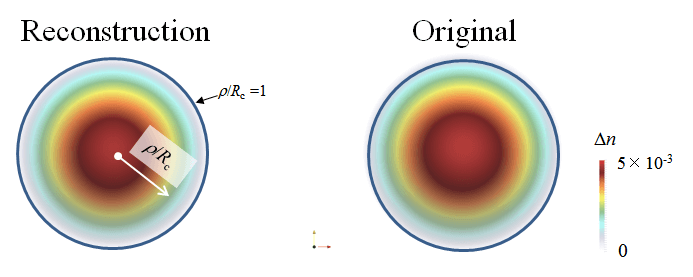
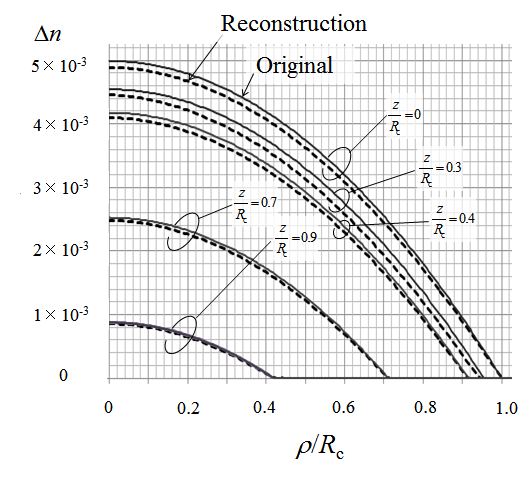
In summary, the study by Dr. Hiroshi Ohno and Kiminori Toya presented a technique to reconstruct an axisymmetric 3D refractive index field. They highlighted that the BOS technique coupled with the optical flow algorithm, could, in practice, be used to measure the deflection angle vector. Altogether, the presented scalar potential reconstruction method was validated through the reconstruction of a spherical refractive index fields where a deflection angle vector was accurately calculated.



Reference
Hiroshi Ohno, Kiminori Toya. Scalar potential reconstruction method of axisymmetric 3D refractive index fields with background-oriented schlieren. Volume 27, Number 5 |2019| Optics Express 5990.
Go To Volume 27, Number 5 |2019| Optics Express 5990