Advances in Engineering Advances in Engineering features breaking research judged by Advances in Engineering advisory team to be of key importance in the Engineering field. Papers are selected from over 10,000 published each week from most peer reviewed journals.

Significance
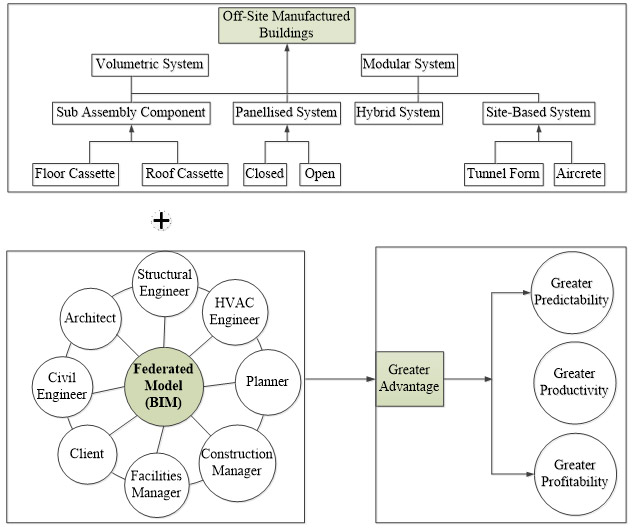
The construction industry is currently faced by a plethora of challenges that encompass high energy consumption, generation of enormous amounts of waste and significant emission of greenhouse gases. To this regard, many governmental reports have been released, most of which are entirely centered on the need to overcome these challenges. Such reports suggest the adoption of innovations such as, off-site manufacture and emerging Building Information Modelling (BIM). At present, a great deal of research work has focused on the impacts of off-site manufacture and BIM, independently applied on traditional construction techniques. Due to the factory-based nature of off-site manufacture, the benefits that can be ripped from BIM on off-site manufacture have been widely argued to be much greater than those of traditional construction. Unfortunately, evidence about impacts of BIM on off-site manufacture has been very sketchy with far too many publications skewed towards traditional construction.
In a recent research paper published in Journal of Building Engineering, Dr. Henry Abanda and Professor Joseph Tah at Oxford Brookes University in collaboration with Dr Franco Cheung, An Associate Professor at Birmingham City University investigated the implications of BIM systems on off-site manufacture and traditional construction methods, with emphasis on the technological potential of BIM for off-site manufacture. Their study focused on examining how BIM could support off-site manufacture and addressing the benefits of BIM and how BIM can be utilized to overcome barriers hampering the uptake of off-site manufacturing. Moreover, examining published quantitative benefits of BIM on off-site manufacture and traditional construction.
The researchers initiated their study by carrying out a thorough systematic appraisal of the available published literature regarding this matter. They identified qualitative and quantitative benefits of BIM on off-site manufacture, off-site manufacture and BIM on traditional construction. The researchers realized that despite the huge benefits inherent in off-site manufacturing, there are still so many challenges deterring its usage. The lack of knowledge about the clear benefits that can be ripped from adoption of BIM and off-site manufacturing, has been presented as the main inhibitor towards their uptake. Furthermore, the research team noted that most of the studies on the quantitative benefits of BIM were not holistic and seldom considered the whole project life cycle of offsite construction projects.
The study by Abanda, Tah and Cheung successfully presented a systematic appraisal of existing literature regarding the potential of BIM adoptability in off-site manufacture for buildings. It has been seen that the strengths of BIM in containing data in interoperable formats and managing huge projects are great assets in fostering collaborative practices in the construction industry which translates to immense benefits to both traditional and off-site manufacturing of buildings.



Reference
F.H. Abanda, J.H.M. Tah, F.K.T. Cheung. BIM in off-site manufacturing for building. Journal of Building Engineering volume 14 (2017) pages 89–102.
Go To Journal of Building Engineering