 Advances in Engineering Advances in Engineering features breaking research judged by Advances in Engineering advisory team to be of key importance in the Engineering field. Papers are selected from over 10,000 published each week from most peer reviewed journals.

Significance
Dielectric metasurfaces have emerged as a compelling alternative to plasmonic architectures for manipulating light at subwavelength scales, particularly in spectral regimes where losses severely constrain performance. Unlike metallic nanostructures, dielectric resonators can sustain strong electromagnetic responses while largely avoiding Ohmic dissipation, making them attractive for applications that demand high efficiency and spectral selectivity. Central to this promise is the ability of high-index dielectric particles to support Mie resonances, including magnetic dipole modes that are absent in natural materials at optical frequencies. When appropriately engineered, these resonances offer access to artificial magnetism, directional scattering, and tailored effective optical constants. Despite this conceptual maturity, translating dielectric resonances into scalable metasurfaces remains a formidable challenge. Most demonstrations rely on top-down nanofabrication techniques that provide exquisite control over geometry and placement but are inherently costly, slow, and limited in area. Bottom-up approaches, in contrast, offer scalability and materials efficiency, yet they introduce disorder in particle size, shape, and spatial arrangement. Such imperfections are widely assumed to wash out collective electromagnetic effects, especially those associated with narrow resonances and effective medium behavior. As a result, bottom-up dielectric assemblies have historically been regarded as unsuitable for realizing high-quality optical magnetism. Silicon occupies a particularly interesting position in this landscape. Its high refractive index supports strong multipolar resonances, while its compatibility with established processing routes makes it technologically appealing. However, silicon’s optical behavior is acutely sensitive to crystallinity, surface oxidation, and absorption above the bandgap. Achieving resonant silicon particles that combine low loss, structural uniformity, and compatibility with self-assembly is therefore nontrivial. Earlier studies demonstrated that silicon nanoparticles can exhibit magnetic resonances, but these effects were either confined to isolated particles or severely broadened when extended to disordered ensembles. To this end, new research paper published in Small Science and conducted by Dr. Megan Parker, Dr. Cynthia Cibaka-Ndaya, Dr. Alexander Castro-Grijalba, Dr. Maria Letizia De Marco, David Montero, Dr. Sabrina Lacomme, Dr. Antoine Azéma, Dr. Vasyl G. Kravets, Dr. Alexander Grigorenko, Dr. Virginie Ponsinet, Dr. Philippe Barois, Dr. Lucien Roach, and Professor Glenna Drisko from the University of Bordeaux in France together with Dr. Raul Barbosa and Professor Brian Korgel from The University of Texas at Austin, the researchers developed crystalline silicon@silica core–shell particles synthesized under supercritical conditions and assembled them into extended, semi-ordered monolayers via interfacial self-assembly. They demonstrated that these bottom-up metasurfaces exhibit a genuine magnetic Mie resonance with an unusually high quality factor in the infrared. Most importantly, they showed that optical magnetism can arise from effective medium behavior in disordered dielectric assemblies, overturning long-held assumptions about the necessity of perfect periodicity.
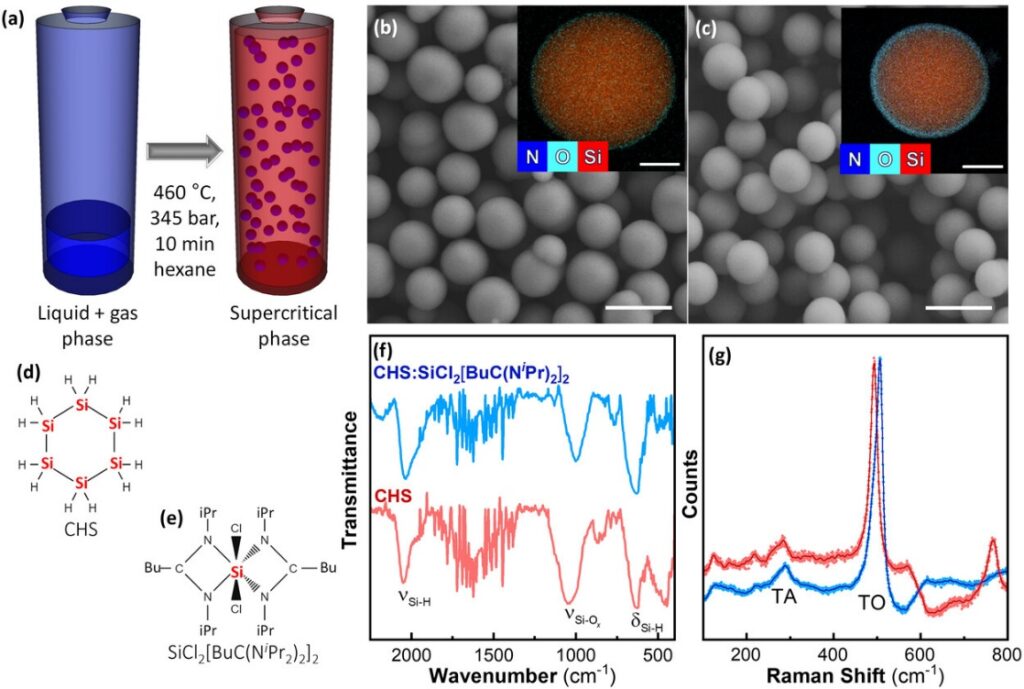
The research team performed synthesis of silicon particles under supercritical hexane conditions, where rapid thermal decomposition enables the formation of relatively large, spherical cores. By employing cyclohexasilane in combination with a silicon amidinate coordination complex, the authors achieve particles with enhanced crystalline character compared to earlier trisilane-based routes. This choice proves consequential: Raman spectroscopy reveals a marked shift toward higher bond order, indicating that the silicon cores approach crystalline behavior rather than remaining largely amorphous. Simultaneously, controlled oxidation during cooling produces a conformal silica shell of moderate thickness, yielding a core–shell geometry that both stabilizes the particles and moderates their optical response. These particles are subsequently functionalized and guided to self-assemble at an air–water interface. The assembly process exploits differential solvent miscibility to trap particles at the interface, where they spread laterally and form extended monolayers. Although the resulting films are not perfectly crystalline, quantitative spatial analysis shows that most particles adopt coordination numbers close to hexagonal packing, with short-range order extending over several interparticle distances. Importantly, this degree of order is sufficient to create a dense, continuous layer while still reflecting the intrinsic disorder expected of bottom-up fabrication.
The authors performed optical characterization which showed that the assembled films exhibit pronounced color selectivity, transmitting shorter wavelengths while reflecting longer ones. Polarization-resolved scattering measurements on dilute particle suspensions confirm the presence of multiple multipolar resonances, consistent with Mie theory for coated spheres. By fitting these spectra using realistic refractive index models that account for partial crystallinity and residual porosity, the authors establish that the particles combine high refractive index with relatively low absorption across the visible and near-infrared range. They found using variable-angle spectroscopic ellipsometry performed on the assembled monolayers that despite the structural disorder, the optical response can be accurately described using an effective medium model that treats the particle layer as a homogenized film with independent permittivity and permeability. Within this framework, a sharp resonance appears in the extracted magnetic permeability near the near-infrared region. The resonance exhibits a Lorentzian profile and a quality factor far exceeding previous reports for silicon-based metamaterials operating above the silicon bandgap.
This work carries significance well beyond the specific material system it investigates. At a fundamental level, it challenges the prevailing notion that disorder is inherently incompatible with sharp optical resonances in metasurfaces. By demonstrating a high-quality magnetic response in a semi-ordered, bottom-up assembled film, the study reveals that collective electromagnetic phenomena can emerge from statistical order rather than strict periodicity. This insight has implications for how metasurfaces are conceptualized, modeled, and ultimately manufactured. From a materials perspective, the results underscore the importance of crystallinity and internal particle architecture. The enhanced performance achieved through the use of cyclohexasilane-derived silicon cores highlights how subtle changes in precursor chemistry can profoundly influence optical behavior. Rather than relying solely on external patterning, the study shows that internal structural quality can serve as a powerful lever for tuning macroscopic properties. Technologically, the ability to generate optical magnetism using scalable, bottom-up methods opens new avenues for infrared photonics. Metasurfaces operating in this spectral range are relevant for sensing, thermal emission control, imaging, and integrated photonic circuitry. The reduced losses associated with dielectric resonances make them particularly attractive for applications where efficiency and signal fidelity are paramount. Moreover, the use of self-assembly suggests a pathway toward large-area fabrication that is difficult to achieve with conventional lithography.
Equally important is the methodological implication for effective medium theory. The successful extraction of meaningful permittivity and permeability values from a disordered monolayer suggests that homogenization approaches may remain valid even outside idealized periodic systems. This finding encourages broader exploration of complex, non-periodic architectures that were previously dismissed as analytically intractable.


Reference
Parker MA, Barbosa R, Cibaka-Ndaya C, Castro-Grijalba A, De Marco ML, Korgel BA, Montero D, Lacomme S, Azéma A, Kravets VG, Grigorenko AN, Ponsinet V, Barois P, Roach L, Drisko GL. Self-Assembled Silicon@Silica Metasurfaces with High-Quality Resonances in the Infrared. Small Sci. 2025;5(7):2500119. doi: 10.1002/smsc.202500119.
Go to Journal of Small Sci.