Advances in Engineering Advances in Engineering features breaking research judged by Advances in Engineering advisory team to be of key importance in the Engineering field. Papers are selected from over 10,000 published each week from most peer reviewed journals.

Significance
The boiling phenomenon is important as an elementary process in energy equipment that utilize vapor and also in the cooling control systems utilizing high heat-transfer rates of boiling. Technically, such critical applications (in the latter category) are favored by the capability of the boiling phenomenon to accommodate large heat fluxes with relatively small driving temperature difference. Nonetheless, the distribution of steam in a boiling mixture affects the heat transfer rate and may cause unfavorable conditions; for instance, in Light Water Reactor (LWR) nuclear power plants where the distribution of vapor in the LWR sub-channels can cause burn-out phenomenon at certain wall superheat known as Departure from Nucleate Boiling. Overall, due to its complex nature, better understanding and modeling of boiling process remains a major challenge in multiphase flow research. In the past, experimental approaches presented valuable insights with regard to understand the boiling phenomena at various scales. These techniques were however limited when it comes to special flow geometries and flow conditions in engineering applications. Recently, technological advances have yielded better simulation techniques that are efficient but demand data of high-quality and high resolution. In particular, Interface tracking simulation (ITS) has emerged as one of the most promising approaches to describe heat transfer of boiling phenomena and their underlying mechanisms.
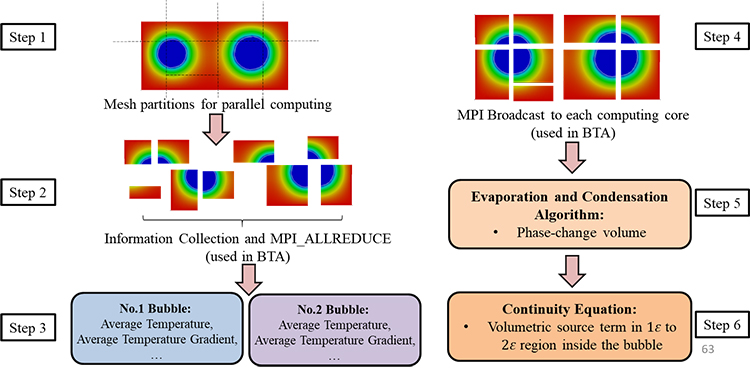
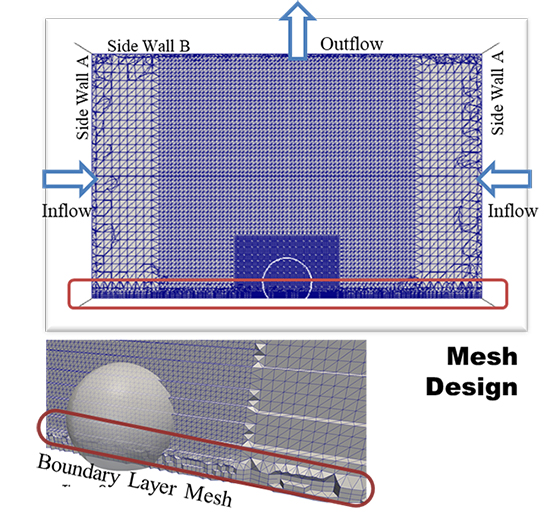
Advancing the ITS modeling is desirable and could unlock various benefits for engineering systems relying on two-phase heat transfer. To this end, researchers from the Department of Nuclear Engineering at North Carolina State University: Dr. Mengnan Li and Professor Igor A. Bolotnov developed a new evaporation and condensation model designed for large scale boiling simulation. The researchers focused on developing the model for simulations with local mesh refinement, unstructured mesh and highly scalable algorithm for parallel computing. Their work is currently published in the International Journal of Heat and Mass Transfer.
In their approach, verification of the evaporation and condensation model was performed by comparing the bubble growth rate with analytical solutions. Both pool boiling and flow boiling simulations were performed using the ITS evaporation and condensation model. The researchers then validated the bubble nucleation frequency in pool boiling simulation, against experimentally-based correlations. The bubble evolution and growth rate were compared with experimental data to validate the model performance under flow boiling condition.
The authors reported good agreement was found between the model prediction and the experimental measurements. Additionally, the researchers noted that compared to the structured-grid based solvers, which are challenging to apply to complex engineering geometries, the presented boiling model implementation was capable of conducting high-resolution boiling simulations in engineering geometries and resolving the detailed hydrodynamics and thermal information for quantities of interest at/around the interface.
In summary, the study Dr. Mengnan Li and Professor Igor Bolotnov demonstrated the successful implementation, verification and validation of the modeling capability of the evaporation process using a massively parallel unstructured grid flow solver, PHASTA. The study further showed the potential of the ITS boiling model in studying bubble dynamics and heat transfer mechanism in large scale engineering applications. In a statement to Advances in Engineering, the authors said that the newly presented boiling model will serve as one of the most important building blocks for high resolution boiling simulations in realistic engineering geometries. They are excited to continue the work exploring the boiling phenomenon with numerical approaches and their latest results just came out in Nuclear Engineering and Design [2].



References
[1] Mengnan Li, Igor A. Bolotnov. 2020 “The evaporation and condensation model with interface tracking” , International Journal of Heat and Mass Transfer, volume 150 (2020) 119256.
Go To International Journal of Heat and Mass Transfer
[2] Li, Mengnan, Joachim Moortgat, and Igor A. Bolotnov. “Nucleate boiling simulation using interface tracking method.” Nuclear Engineering and Design 369 (2020): 110813.