Advances in Engineering Advances in Engineering features breaking research judged by Advances in Engineering advisory team to be of key importance in the Engineering field. Papers are selected from over 10,000 published each week from most peer reviewed journals.

Significance statement:
In several key research areas, ranging from wet cleaning in mass production of silicon integrated circuits to single molecule detection in nanofluidics, understanding and controlling wetting behavior at the nano-scale play an extremely important role in modern technology. To date the main mechanism for a wetting transition from superhydrophobic (“lotus effect”) to superhydrophilic (complete wetting) is still under exploration.
Our study has revealed a missing piece of the puzzle in mapping the wetting transitions on nano-patterned surfaces. The striking deviation from classical models, found in our systematic investigations, clearly underlines a change in wetting property of the nanostructures. This unexpected change in surface wettability is attributed to the long overlooked atomic-scale surface perturbations that are introduced during the nano-fabrication process. With a novel application of optical reflectance spectroscopy, the wetting states and the wetting dynamics at the nanoscale have been directly probed.
Imec is headquartered in Leuven, Belgium, with additional R&D teams in the Netherlands (Holst Centre in Eindhoven), China, Taiwan and India, and offices in Japan and the USA. Imec performs world-leading research in nanoelectronics. We leverage our scientific knowledge with the innovative power of our global partnerships in ICT, healthcare and energy. We deliver industry-relevant technology solutions. In a unique high-tech environment, our international top-talent is committed to providing the building blocks for a better life in a sustainable environment. http://www2.imec.be/be_en/home.html
The mission of the Department of Physics and Astronomy of KU Leuven is exploring, understanding and modelling physical realities using experimental, observational, computational and mathematical techniques. Fifteen teams perform research at an international level. Publication of research results in leading journals and attracting top-level scientists are priorities for the department. New physics and innovation in the development of new techniques are important aspects of our mission. The interaction with industry (consulting, patents, …) and society (science popularisation) are additional points of interest. Furthermore, the department is responsible for teaching basic physics courses in several study programs.
ACS Nano, 2014, 8 (1), pp 885–893.
XiuMei Xu †*, Guy Vereecke †, Chang Chen †‡,Geoffrey Pourtois †§, Silvia Armini †, Niels Verellen†‡, Wei-Kang Tsai ⊥, Dong-Wook Kim ∥, Eunsongyi Lee ∥, Chang-You Lin ‡, Pol Van Dorpe †‡, Herbert Struyf †, Frank Holsteyns †, Victor Moshchalkov ‡,Joseph Indekeu ‡, and Stefan De Gendt †‡
† IMEC, Kapeldreef 75, Leuven 3001, Belgium and
‡ Department of Physics and Astronomy, Department of Chemistry, KU Leuven, Leuven 3001, Belgium and
§ Department of Chemistry,PLASMANT, University of Antwerp, B-2610 Wilrijk, Belgium and
⊥ Department of Material Science and Engineering,University of Southern California, Los Angeles, California 90089, United States and
∥ Department of Physics, Ewha Womans University, Seoul 120-750, Korea.
Abstract
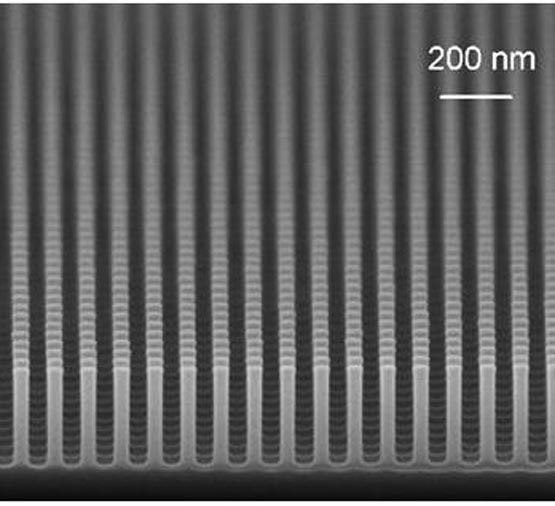
Spectacular progress in developing advanced silicon circuits with reduced size, along the track of Moore’s law, has been relying on necessary developments in wet cleaning of nanopatterned silicon wafers to provide contaminant free surfaces. The most efficient cleaning is achieved when complete wetting can be realized. In this work, ordered arrays of silicon nanopillars on a hitherto unexplored small scale have been used to study the wetting behavior on nanomodulated surfaces in a substantial range of surface treatments and geometrical parameters. With the use of optical reflectance measurements, the nanoscale water imbibition depths have been measured and the transition to the superhydrophobic Cassie–Baxter state has been accurately determined. For pillars of high aspect ratio (about 15), the transition occurs even when the surface is grafted with a hydrophilic functional group. We have found a striking consistent deviation between the contact angle measurements and the straightforward application of the classical wetting models. Molecular dynamics simulations show that these deviations can be attributed to the long overlooked atomic-scale surface perturbations that are introduced during the nanofabrication process. When the transition condition is approached, transient states of partial imbibition that characterize intermediate states between the Wenzel and Cassie–Baxter states are revealed in our experiments.
Copyright © 2013 American Chemical Society.