 Advances in Engineering Advances in Engineering features breaking research judged by Advances in Engineering advisory team to be of key importance in the Engineering field. Papers are selected from over 10,000 published each week from most peer reviewed journals.

Significance
Rapid advancement in technology today has led to the development of efficient biocompatible materials to be used in the medical field and other relating fields. This is aided by the ability to directly convert electrical energy into mechanical energy at sub-micron levels. A good example is the use of microelectromechanical systems (MEMS). Although motor neurons have limited voltage rating, most of the currently used actuator materials require high voltages and dielectric properties thereby making them unsuitable for biological uses. Therefore, there is a need to develop chemically inert, durable and biological friendly actuator materials.
There are several available principles complying with biocompatibility that can be utilized in developing such biocompatible materials. The principles are low voltage-based surface tension and its relationship to external fields and electrochemical reactions. An example is electrochemically controlled cantilever bending that utilizes the various changes in the surface tension of the metal-electrolyte interface and electrochemical redox reaction. They work mainly based on the principle that increasing potential results in a decrease in the strain and surface tension.
Carbon nanostructures exhibit better biocompatibility as compared to cantilevers. However, closed shell carbon nanostructures like carbon nanotubes have the disadvantage of limited dimensional change resulting from the rigid closed tubular structures. Different methods for addressing the difficulties such as the use of quasi-reversible electrochemical reactions have been developed. On the other hand, open-coil nanostructures such as carbon nanoscrolls (CNS) (Fig. 1) are seen as good solutions. Generally, open coil nanostructures are formed by bending graphene edges. For instance, rolling of edges witnessed in carbon nanoscrolls occurs when they are formed on the basal planes of highly ordered pyrolytic graphite (HOPG). Although there are several studies carried out on the physical properties and calculations of CNS models, there is still limited experimental investigations.
Recently, a group of scientists at J. Heyrovský Institute of Physical Chemistry from Academy of Sciences of Czech Republic: Dr. Pavel Janda, Dr. Hana Tarábková and Dr. Zdeněk Zelinger experimentally investigated the electrochemical controlling of periodic coiling and uncoiling of substrate-supported carbon nanoscrolls. The authors used atomic force microscopy (AFM) to monitor the electrochemical actuation of the nanoscrolls on the HOPG basal plane acting as an electrode. The work is published in the research journal, Physical Chemistry Chemical Physics.
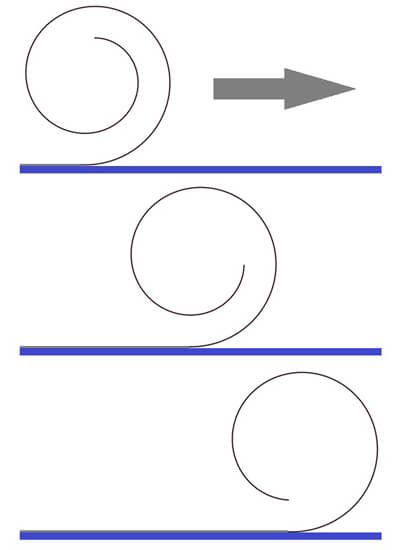
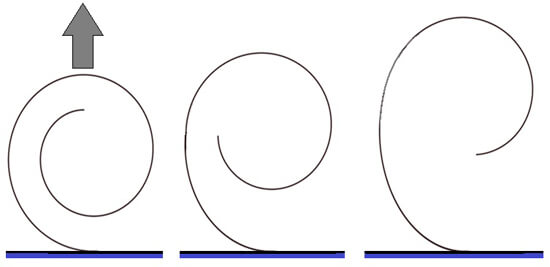
The authors successfully observed coiling and uncoiling movements (Figs 2 and 3) of the spontaneously formed carbon nanoscrolls at varied potential steps applied to the HOPG immersed electrolyte solution. Consequently, the applied potentials also resulted in reversible changes in the radial dimensions of the carbon nanoscrolls both in the axial and lateral directions [1]. This was attributed to the induced variations in the electric double-layer structure and surface tension. Additionally, the effects of the radial motion were intense on the scrolled tube-shaped nanostructure whereas the remaining sections of the HOPG like the lifted steps edges remained unaffected.
The study is the first to experimentally investigate the electrochemical controlling of the coiling and uncoiling of carbon nanoscrolls and therefore will advance electrochemical controlled applications aimed at developing mechanical nanoactuators and other materials. The efficiency of such products will also enhance their utility in their various fields of applications such as biocompatible materials in medical.



Reference
[1] H. Tarábková, Z. Zelinger and P. Janda, Electrochemically controlled winding and unwinding of substrate-supported carbon nanoscrolls. Phys. Chem. Chem. Phys., 2018, 20, 5900-5908
Go To Phys. Chem. Chem. Phys