Advances in Engineering Advances in Engineering features breaking research judged by Advances in Engineering advisory team to be of key importance in the Engineering field. Papers are selected from over 10,000 published each week from most peer reviewed journals.

Significance Statement
Chloride concentration in reinforced concrete RC structures leads to pitting corrosion in the steel reinforcement bars which significantly reduce its load bearing capacity. It is therefore important to determine chloride profiles in strain hardening cement-based composites in both cracked and uncracked states.
In a recent article by Paul et al. (2016) and published in journal, Construction and Building Materials made investigations on the performance of strain hardening cement-based composite SHCC containing polyvinyl alcohol PVA fiber under chloride exposure of both cracked and uncracked specimen.
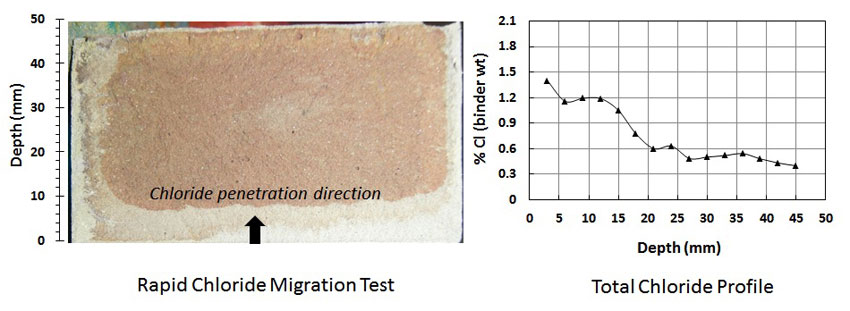
Chloride ion in concrete can either exist in free and bound forms which serves as a complex issue in determining the actual critical chloride ion concentration that causes corrosion. Movement of chloride ions in concrete is also dependent on migration of its concentrated solution hence it can be further said that actual movement of ions is dependent on an electrochemical potential gradient. The rapid chloride migration RCM test was used in this research which is based on movement of ions accelerated by the application of an external electric field. In rapid chloride migration testing, the chloride migration coefficient depends also on the applied voltage.
Chloride migration in concrete also depends on other factors such as water-cement ratio (w/c), type of aggregate used and permeability of the paste. Further research also proved that interfacial transition zone ITZ using lightweight aggregate sand also has major effect on chloride diffusivity.
Ingress of chloride via corrosive agents in cracked reinforce concrete structures due to easy permeability leads to excessive amount of chloride beyond the threshold level which results to breakage of corrosive protection layer of steel bars.
Despite positive researches made on mechanical behavior of strain hardening cement-based composite in designing reinforced concrete structures, no comparisons have been reported on influence of chloride penetration at different exposure conditions of specimens such as continuous versus cyclic wetting-drying and on amount of total versus free chloride at different depths in strain hardening cement-based composites specimen.
In their experiments, all reinforced specimens were loaded up to their ultimate load capacity to induce significant cracks. Some specimen types were unloaded and removed from materials testing machine and subsequently subjected to cyclic wetting and drying in unloaded conditions while others were kept in loaded state in special steel frames at the deflection level.
A total of 12 specimen were subjected to cyclic wetting and drying by sodium chloride solution for maximum of 52 weeks while 6 unreinforced FS2 beams, 3 for chloride content testing and three for visual observation of chloride penetration depth with silver nitrate AgNO3 after a maximum chloride exposure of 7 days.
All reinforced strain hardening cement-based composites, R/FS1 and R/FS2 and reinforced mortar specimen R/FM1 Specimens were drilled and powdered for both x-ray fluorescence and chemical chloride testing. For visual observation of chloride penetration, silver nitrate was applied to the remaining 3 specimens after 10mm depth notch was cut and removed with 3mm layer of chloride content testing which started first reading from the 13mm depth of specimen.
For rapid chloride migration testing, both cracked and uncracked core specimens with dimensions of 100mm diameter and 50mm thickness were tested for FS3. Uncracked specimen test was only conducted for FM2. 0.2 N KOH was used as anolyte and 0.2 N KOH of 10% sodium chloride was used as catholyte solution with all core specimens under applied voltage of 30V. Chloride diffusion coefficient Dcc was calculated from rapid chloride migration testing results.
Results from crack properties of strain hardening cement-based composites FS and mortar specimen FM showed that steel specimen R/FS2-C15D7@37W had the highest average crack width (μm), maximum crack width (μm) and total crack widths (mm) of 171, 460 and 2.22 respectively while R/FS1C15D3.5 @ 84W has the lowest at 24μm, 50μm and 0.41mm respectively.
X-ray fluorescence method showed that wider average crack widths in R/FS1 specimen showed higher chloride penetration than in smaller crack widths which may be due to chloride penetration parallel to steel bar because of damage in steel strain hardening cement-based composite interface.
Higher chloride concentration was also seen at the opposite face of exposed surface of concrete as significant higher chloride is found at opposite faces of R/FS1 and R/FS2 specimen and similar trend was observed in uncracked R/FS2 specimen (R/FS2@25W_UC).
Total chloride determined from x-ray fluorescent method was found to be slightly less than that determined by chemical analysis. Higher chloride was observed in mortar specimen at 29weeks than 62 weeks. Total and free chloride contents in mortar specimens were found to be lower than strain hardening cement-based composites specimens which may be due to presence of fibers in the former.
Results from silver nitrate solution illustrated penetration depth and widening time of sodium chloride solution showed 13mm as starting point of chloride and amount of chloride in the specimen increases. Lower chloride content was found in uncracked specimen for a longer period of chloride exposure in a reinforced specimen after 7 days of continuous chloride exposure in an uncracked specimen. Difference between the chemical total and free chloride content was found to be between 52% and 85%.
This study confirmed that mechanically-induced cracks in the strain hardening cement-based composites specimens leads to higher chloride migration than in uncracked strain hardening cement-based composites specimen which shows a lot of relevance in the construction industry.

Journal Reference
Suvash Chandra Paul1,2 , Gideon P.A.G. van Zijl2, Adewumi John Babafemi2,3, Ming Jen Tan1 . Chloride Ingress in Cracked and Uncracked SHCC under Cyclic Wetting-Drying Exposure. Construction and Building Materials, Volume 114, 2016, Pages 232–240.
[expand title=”Show Affiliations”]- Singapore Center for 3D Printing, School of Mechanical and Aerospace Engineering, Nanyang Technological University, Singapore.
- Department of Civil Engineering, Stellenbosch University, South Africa.
- Department of Building, Obafemi Awolowo University, Nigeria.
Go To Construction and Building Materials