 Advances in Engineering Advances in Engineering features breaking research judged by Advances in Engineering advisory team to be of key importance in the Engineering field. Papers are selected from over 10,000 published each week from most peer reviewed journals.

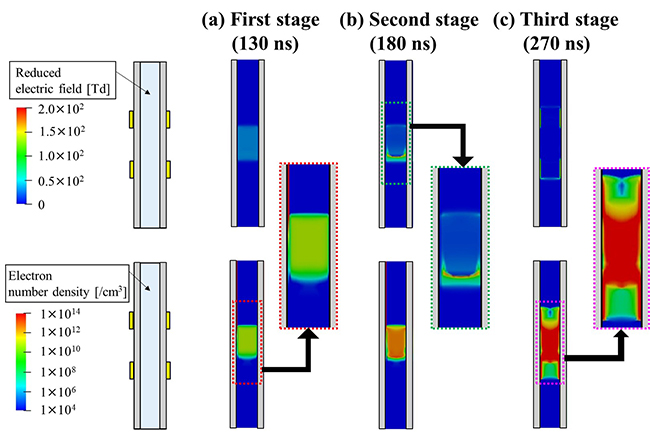
Three stage mode transitions and internal bullet propagation
Significance
Dielectric Barrier Discharge (DBD) in air has been the subject of many research studies. This physical phenomenon is nowadays well known, and many researchers have contributed to the comprehension and explanation of the micro-discharge mechanism. Recent research has shown that the discharge in a coaxial dielectric barrier discharge device develops in three stages: first, a Townsend-glow-type plasma spreads in the region between the electrodes; then, a plasma bullet (streamer type discharge) propagates axially and; lastly, the bullet transitions into a surface discharge at the dielectric surface. In recent times, the DBD has attracted great interest for the generation of low- temperature (cold) atmospheric pressure plasma which could be applied in various fields, such as surface treatment, medicine, air-pollution control, and material synthesis with assimilation of carbon dioxide. Typically, DBD are composed of a planar or cylindrical dielectric and corresponding shaped electrode(s). In essence, all the device types can feed a chemically reactive species to the downstream region of the device. Published literature has shown that in planar type DBD, discharge mode changes from streamer to glow depending on the applied voltage polarity.
In addition, comprehensive parametric studies with respect to applied voltage and dielectric properties by one-dimensional numerical simulation have been published; unfortunately, the nanosecond (ns)-scale dynamics of the reactor type discharges have not been elucidated yet and any reason for strong light emission near the electrodes remains unclear. A cross-examination of this approach reveals that one-dimensional analysis assumes a uniform axial distribution which is substantially limited in terms of revealing any details of the formation process of plasma inside the reactor type DBD. Therefore, multidimensional analysis is required to understand detailed plasma generation process in reactor type DBD. To address this, Toshiba Corporation (Japan) researcher, Dr. Yosuke Sato, Nagoya University (Japan) researchers, Dr. Kenji Ishikawa, Dr. Takayoshi Tsutsumi and Dr. Masaru Hori, proposed to employ numerical analysis in a quest to clarify the detailed plasma formation process in coaxial reactor type DBD on the nanosecond to microsecond timescale. Their work is currently published in the research journal, Applied Physics Express.
In their approach, the research team focused on the beginning phase of single discharge pulse. A self-consistent, multi-species, multi-temperature plasma fluid model was used to analyze the formation process of plasma inside reactor type DBD. The model was composed of continuity equations for each species, an electron energy conservation equation, bulk (gas and dielectric) energy equation, and Poisson’s equation for self-consistent electric fields. The drift-diffusion model was used to calculate flux terms for all species, as described previously in detail. The coupled set of nonlinear governing equations was solved by a commercial plasma solver package.
The authors reported that their approach showed the plasma generation process in the reactor type DBD was quite different from the planar DBD. In particular, the team reported that a Townsend-glow-like discharge is generated between the electrodes, and when the space charge due to the difference in positive and negative charged species densities reaches the same level as that of the bulk plasma, an electric field wave-front is formed and a streamer- (bullet-) like discharge develops in the axial direction. Finally, the team noted that when the electric wave-front reaches the dielectric surface, it transitions to a surface discharge emphasized by the accumulated charge, and the discharge propagates to the full electrodes.
In summary, the study presented an excellent and in-depth assessment of the formation process of helium plasma in the coaxial DBD using a plasma fluid model. Remarkably, the results showed that plasma forms in the reactor type DBD through three discharge modes. In a statement to Advances to Engineering, Dr. Yosuke Sato mentioned that from the fluid-based numerical analysis they conducted, the bullet propagation was obeyed by trapping with strong electric fields induced by grounded electrode underneath the dielectric barrier and by surface charge accumulated on the dielectric surface.





Reference
Yosuke Sato, Kenji Ishikawa, Takayoshi Tsutsumi, Masaru Hori. Numerical analysis of coaxial dielectric barrier helium discharges: three stage mode transitions and internal bullet propagation. Applied Physics Express 13, 086001 (2020).