 Advances in Engineering Advances in Engineering features breaking research judged by Advances in Engineering advisory team to be of key importance in the Engineering field. Papers are selected from over 10,000 published each week from most peer reviewed journals.

Significance
Aluminum alloys are desirable for making aircraft, naval and building structural members owing to their excellent machinability, low weight, and superior ductility. 6061-T651 aluminum alloy contains mainly silicon and magnesium. It combines the excellent mechanical features, for example, good weldability, high strength and good machinability, making it attractive for making aircraft parts. Unfortunately, the surfaces of aluminum alloys are easily corroded and worn out when used in a high corrosive and wear environment.
CoCrMo alloys have been extensively used in the fields of aerospace and cutlery where they are highly desirable owing to their high wear-resistance. These alloys have the potential to resist oxidation, corrosive fumes, and boiling nitric acids. Ti6Al4V is the most preferred of all titanium alloys due to its high strength, low density, and high resistance to corrosion in alkali, strong acid and seawater. This makes it desirable for aerospace and marine applications.
Cold sprayed CoCrMo and Ti6Al4V coatings on 6061-T651 aluminum alloy substrates can be ideal for repairing the worn-out surfaces of the aluminum alloy and enhance the corrosion and wear resistance of the alloy. Therefore, it is possible to combine both the good wear and corrosion features of CoCrMo and Ti6Al4V coatings with the favorable attributes of 6061-T651 aluminum alloy.
It is also important to consider the interfacial bonding strength between the substrate and the coating when characterizing the quality of the coating. Traditional methods have been applied in measuring the adhesive strength of the coatings. However, these methods have been limited by the requirement that appropriate adhesives must be used and that the bonding integrity of the coatings to the substrate cannot be determined if its value is more than the maximum glue strength.
Researchers led by Professor Erjia Liu from School of Mechanical & Aerospace Engineering, College of Engineering, Nanyang Technological University, Singapore, in collaboration with Dr. Iulian Marinescu at Rolls-Royce Advanced Technology Centre in Singapore systematically studied the adhesion strength, anti-corrosion features, and wear resistance of cold-sprayed CoCrMo and Ti6Al4V coatings on 6061-T651 aluminum alloy substrates. Their research work is published in the peer-reviewed journal, Surface & Coatings Technology.
The research team successfully coated the CoCrMo and Ti6Al4V coatings on the 6061-T651 aluminum alloy substrates through a high pressure cold spray process. They performed the shear bonding tests to characterize the coating adhesion strengths. They also performed the tribological and electrochemical measurements in order to evaluate the corrosion and wear behaviors of the both coated and uncoated samples. They also investigated the microstructure, phase composition, micro-hardness, and surface topography of the coated samples.
Through the microstructural analysis, the research team observed that the porosity level of the coatings was low and that they were strongly embedded on the substrates by physical trapping or mechanical interlocking. The sprayed coating particles were significantly deformed in the coatings implying that the spraying velocities were more than the particles’ critical velocities in the cold spraying process.
The research team recorded an average shear bonding strength of about 66.17 MPa between the CoCrMo coatings and aluminum alloy substrates. This was higher than that for the Ti6Al4V coatings, which was about 50.38 MPa. This could be hinged on the high impact energies of the sprayed CoCrMo particles.
The research team recorded a much higher wear resistance for the CoCrMo coated samples compared to both the uncoated and the Ti6Al4V coated samples. The study also recorded much lower corrosion current densities for the coated samples as opposed to the uncoated aluminum alloy substrates.
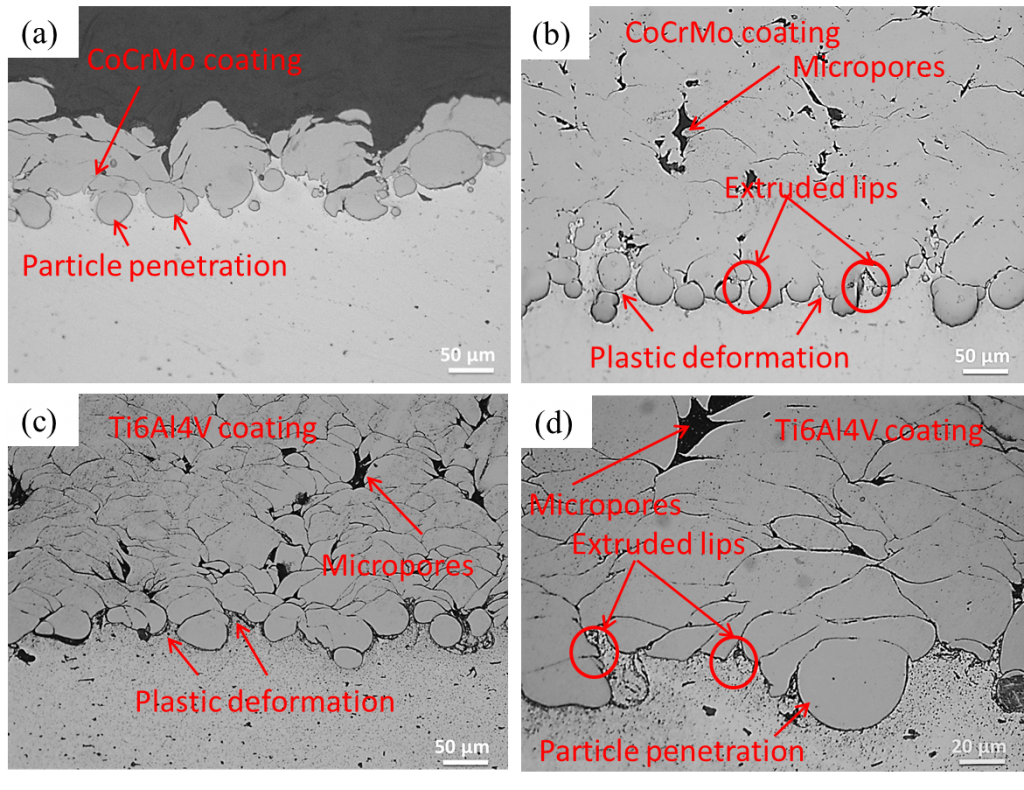
Optical micrographs of (a & b) CoCrMo coatings on 6061-T651 aluminum alloy substrates cold sprayed with (a) one pass of spraying and (b) 15 passes of spraying, and (c & d) Ti6Al4V coating on 6061-T651 aluminum alloy substrate presented at different magnifications.
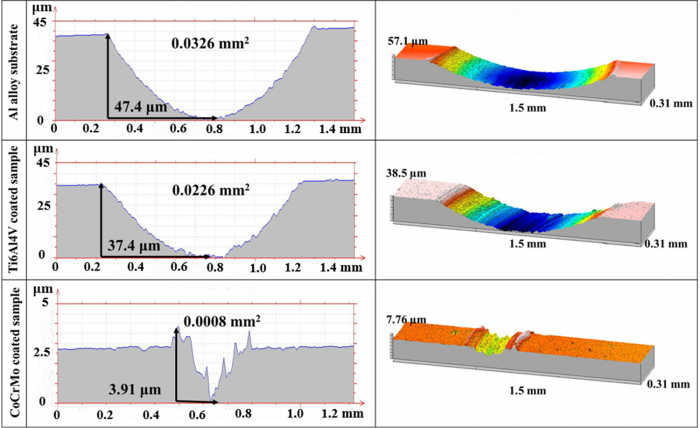
Cross-sectional profiles of wear tracks of uncoated and CoCrMo and Ti6Al4V coated samples and 3D profiles of corresponding wear tracks.





Reference
Wen Sun, Adrian Wei Yee Tan, Iulian Marinescu, Wei Quan Toh, Erjia Liu. Adhesion, tribological and corrosion properties of cold-sprayed CoCrMo and Ti6Al4V coatings on 6061-T651 Al alloy. Surface & Coatings Technology, Vol. 326 (2017) pp. 291–298.
Go To Surface & Coatings Technology