Advances in Engineering Advances in Engineering features breaking research judged by Advances in Engineering advisory team to be of key importance in the Engineering field. Papers are selected from over 10,000 published each week from most peer reviewed journals.

Significance
Hypersonic vehicles face a formidable array of thermal and chemical stresses that challenge the limits of material science and aerothermodynamics. When an object moves through the atmosphere at speeds exceeding Mach 5, it is enveloped in a thin, blisteringly hot shock layer. Within this layer, gas temperatures soar, molecular bonds rupture, and a complex cascade of nonequilibrium chemical reactions unfolds. The resulting atomic and molecular fragments—especially highly reactive species such as atomic oxygen and nitrogen—bombard the vehicle’s surface, initiating intricate gas-surface interactions that erode and ablate protective materials. Understanding and accurately predicting these interactions is not merely academic; it is essential for the design of thermal protection systems (TPS) that can endure the punishing environment of hypersonic flight. Despite etensive research, modeling the chemical kinetics and ablation dynamics within hypersonic shock layers remains deeply problematic. One of the core difficulties is that the physics are tightly coupled and evolve over extraordinarily short timescales. In flight, the shock layer is often in a state of strong thermochemical nonequilibrium, where vibrational and rotational energy modes are not equilibrated, and dissociation rates are highly sensitive to local conditions. These processes influence, and are influenced by, surface reactions that themselves produce gases which feed back into the shock layer chemistry. Capturing this tangled interplay in a predictive model requires high-fidelity data—data that are notoriously difficult to obtain. Ground-based shock tunnels and plasma facilities, while invaluable, either operate with fleeting test durations or lack the true hypersonic conditions necessary to replicate relevant chemistry. Furthermore, many of these facilities are massive, expensive to run, and logistically difficult to access for systematic experimentation.
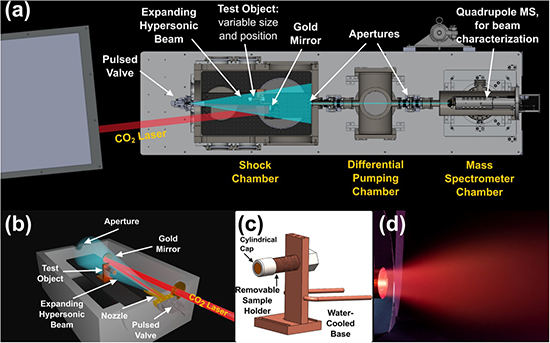
New research paper published in Aerospace Science and Technology and led by Professor Timothy Minton from the University of Colorado Boulder and conducted by Dr. Brian Riggs, Dr. Eric Geistfeld, Dr. Chenbiao Xu, Dr. Irina Gouzman, and Professor Thomas Schwartzentruber, and drawing on decades of experience with laser-driven hyperthermal beam sources—originally developed for simulating atomic oxygen erosion in low Earth orbit—the researchers reimagined this technology as a platform for producing a weak but chemically rich shock layer in the laboratory. Their goal was not to mimic the full aerodynamic envelope of hypersonic flight, but to create a stable, tunable, and accessible environment where critical gas-surface phenomena could be observed over long durations, with high repeatability and diagnostic flexibility. This vision gave rise to the Table-Top Shock Tunnel (TTST), a compact instrument capable of generating hypersonic molecular beams that form transient shock layers above test materials. The study aimed to validate this new tool, demonstrate its ability to reproduce key features of hypersonic ablation, and evaluate its potential as a low-cost, high-resolution alternative for materials testing and shock layer chemistry investigations.
The researchers systematically exposed disc-shaped Kapton samples to a hyperthermal O/O₂ beam generated by the laser-driven molecular source at varying distances from the nozzle throat, ranging from 20 cm to 65 cm. Each position represented a different regime of gas-surface interaction, shaped by the degree of gas compression and shock formation. By collecting data across these intervals, the team sought to trace the transition from free molecular to weakly shocked flow, capturing how subtle shifts in beam-sample distance could drastically alter surface response. After subjecting the samples to 50,000 pulses of the hyperthermal beam, the team measured both surface roughness and material loss. The results were revealing. At greater distances—particularly 50 to 65 cm—the Kapton surfaces developed sharply etched features, characterized by high-aspect-ratio needles and cones. Atomic force microscopy confirmed elevated surface roughness in these zones, suggesting that the impinging O atoms maintained their energy and directionality due to minimal gas-phase collisions. As samples were moved closer to the nozzle, the beam density increased, and the interactions became more complex. At 35 cm and below, the Kapton surfaces turned notably smoother, and the sharp features disappeared. The shift indicated that a significant fraction of O atoms underwent collisions in a compressed gas layer before reaching the surface, thereby losing energy and striking at a broader range of angles. This scattering effect, though reducing surface roughness, paradoxically enhanced overall mass loss—likely due to increased opportunities for multiple surface encounters by slower, yet still reactive, oxygen atoms. The authors showed that one sample exposed at 37 cm revealed an especially telling pattern. Its center was smooth, while the edges retained roughness, implying a localized formation of a weak shock layer that grew more pronounced toward the sample center where gas compression was greatest. Direct simulation Monte Carlo (DSMC) calculations mirrored these patterns, affirming that particle trajectories and energies aligned with the observed ablation textures. Interestingly, mass loss across all distances followed a steeper-than-expected d⁻².⁶ trend, diverging from the idealized beam expansion assumption. This deviation underscored the impact of transient gas dynamics—namely, the accumulation of reflected species above the sample, which appeared to amplify erosion through repeated, redirected collisions.
The significance of the new study by Professor Timothy Minton and colleagues is in its success in redefining the boundaries of what can be achieved in a laboratory setting when investigating the harsh chemistry of hypersonic flight. Traditionally, researchers have been constrained by the scale, cost, and limitations of large shock tunnel facilities—platforms that often sacrifice flexibility and diagnostic access in pursuit of brute-force realism. What this work demonstrates is that a compact, laser-driven apparatus like the TTST can meaningfully replicate key aspects of shock-layer behavior, especially the nonequilibrium chemical environments that directly govern material ablation. This is not a scaled-down version of an existing solution—it’s a shift in perspective, one that emphasizes precision, repeatability, and sustained access over fleeting high-energy pulses. Moreover, by showing that even a tabletop system can create weak but chemically rich shock layers, the researchers open new avenues for materials testing, especially for emerging thermal protection candidates that need to be screened under specific conditions before committing to large-scale trials. The ability to control beam composition, fluence, and exposure geometry, while simultaneously capturing high-resolution surface data, allows scientists to explore subtle gas-surface dynamics that would otherwise be lost in the noise or logistical constraints of large facilities. Moreover, because the TTST enables repeated experiments under tightly controlled conditions, it provides the kind of consistent dataset needed to validate the increasingly sophisticated models used in aerothermodynamic simulations. Additionally, the work addresses a persistent mismatch between experimental capability and modeling ambition. High-fidelity computational tools require accurate boundary conditions and reaction rates, especially in regimes far from equilibrium. Without empirical data, such models remain unanchored. The TTST provides a bridge between abstract theory and the physical world, offering a source of ground truth for validating state-to-state chemistry models, surface reaction kinetics, and even rarefied flow behaviors.


Reference
Brian E. Riggs, Eric Geistfeld, Chenbiao Xu, Irina Gouzman, Thomas E. Schwartzentruber, Timothy K. Minton, Table-top shock tunnel (TTST) for studies of shock layer chemistry and rapid and low-cost testing of materials for hypersonics, Aerospace Science and Technology, Volume 165, 2025, 110416,