Advances in Engineering Advances in Engineering features breaking research judged by Advances in Engineering advisory team to be of key importance in the Engineering field. Papers are selected from over 10,000 published each week from most peer reviewed journals.

Significance Statement
Proper utilization of daylighting in office blocks can minimize lighting internal loads, which could translate to a drop in carbon-dioxide emission. Daylighting also comes with numerous psychological and physical benefits. A comfortable daylighting in offices and schools can really improve the occupants’ performance and productivity.
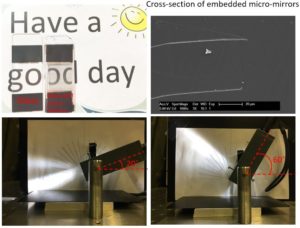
A complex fenestration system containing light-redirecting micro-mirrors redirects daylight into the rear of a room, reflects direct radiation from the sun during summers but not during winters, and maintains a clear view through the glazing. The system is composed of primary one-dimensional parabolic reflective micro-mirrors and a set of secondary reflective surfaces. During summers when the incident elevation angle is high, the incoming radiation is focused on the secondary surfaces where it is reflected out. In contrast, during winters the incident radiation is focused on the parabolic surface to enter the rear of the room. Therefore, seasonal thermal control is realized through the multifunctional fenestration system with primary and secondary micro-mirrors. It is found that glazing with embedded micro-mirrors can contribute to around 20% energy saving in thermal loads compared with conventional glazing.
Researchers, Jing Gong, Dr. André Kostro, and Ali Motamed led by Dr. Andreas Schueler from Ecole Polytechnique Fédérale de Lausanne in Switzerland explored the feasible configuration of embedded micro-mirrors with panels into a glazing in a bid to enhance daylighting quantity and quality. Simulations were performed in four aspects. The impacts of micro-mirrors on the static and dynamic illuminance in an interior space were studied. Assessment of the uniformity of daylight was performed using the luminance ratio. The evaluation glare was conducted by Daylight Glare Index (DGI). Directivity of daylight through vector-to-scalar ratios was investigated. Their work is published in journal, Solar Energy.
They recorded an average annual illuminance of 550lux for the rear of the office (the region from 4m deep to 8m deep) with micro-mirrors applied to a south-facing double glazing of 2.9m (width) 1.6m (height). In simple terms, this is equivalent to about 450kWh per year of electrical consumption. When compared to an office block with low-e glazing, they recorded an average of 250lux increase in illuminance of the micro-mirrors in the whole glazing, which translates to approximately 200kWh of electricity consumption. The authors found that micro-mirrors integrated above 1.5m from the floor level gave the best glare protection.
The authors, in their work, managed to show that embedded micro-mirrors would reduce the illuminance which exceeds the useful level (2000 lux) near window and enhance the brightness in rear space. They found that the risk of glare could be lessened with a sightline parallel to the window by using micro-mirrors at a position higher than the occupant’s sitting position.
The study on daylight performance can help optimize geometrical configurations and parameters of micro-mirrors for a given locale, and gives a reasonable installation configuration.




Reference
Jing Gong, André Kostro, Ali Motamed and Andreas Schueler. Potential advantages of a multifunctional complex fenestration system with embedded micro-mirrors in daylighting. Solar Energy, volume 139 (2016), pages 412–425.
Solar Energy and Building Physics Laboratory, Station 18, École polytechnique fédérale de Lausanne (EPFL), CH1015 Lausanne, Switzerland.
Go To Solar Energy