Advances in Engineering Advances in Engineering features breaking research judged by Advances in Engineering advisory team to be of key importance in the Engineering field. Papers are selected from over 10,000 published each week from most peer reviewed journals.

Significance
The current globalization of cloud services has elicited the need for high-speed optical links for data center interconnects over a single fiber. Such advances can be credited to advanced modulation formats, in combination with coding and digital signal processing that have enabled technologies to handle such enormous quantities of data traffic. Normally, the limiting connection distance obligated by inter-data center connects is basically up to 80 kilometers single-mode fiber. Similar coherent systems are presently viable to offer efficient data transmission, however, their applicability may cease in the near future. This is due to the fact that they may not be able to adapt to the stringent requirements on cost, power, and footprint. To this end, direct detection schemes have emerged as potential low-cost solutions by upscaling from and leveraging the ecosystem of short-reach transceivers for a wavelength division multiplexing link. Unfortunately, presently undertaken complexity comparison studies on the main direct detection schemes have only considered short reach scenarios of not more than 10 kilometers.
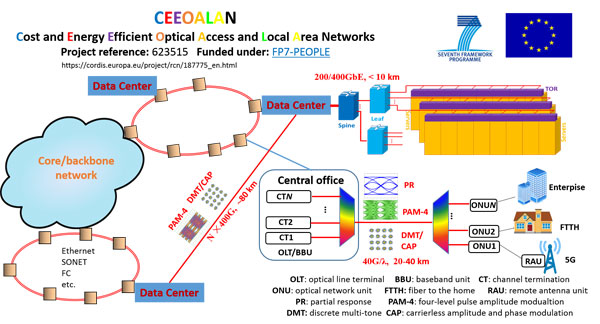
Jinlong Wei at Huawei Technologies Düsseldorf GmbH in Germany in collaboration with Christian Sánchez at Aston University and Ilias Giacoumidis at Dublin City University & SFI CONNECT Research Centre conducted pioneering detailed analysis and fair comparison of the transceiver complexity of a 56 Gb/s multi-band carrierless amplitude and phase (CAP) and discrete multi-tone (DMT) for 80 kilometers intensity modulation and direct detection dispersion compensation fiber-free single-mode fiber link. They managed to reveal the major parameters that impact the system complexity for the two direct detection links and advice on the important implementation rules. Their work is currently published in the research journal, Optics Letters.
The research team initiated their experiments by setting up the 56 Gb/s multiband CAP and DMT systems which was comprised of transceiver digital signal processing and optics.The researchers then used the digital-to-analogue convertor output to drive the Mach–Zehnder modulator. After transmission over a dispersion compensation fiber-free 80 km single-mode fiber, combined variable optical attenuator and a pre-amplifier, erbium-doped fiber amplifier, were then used to load optical noise onto the received signal. Eventually, the detected signal was converted into a digital signal by an analogue-to-digital converter with the same sampling rate of digital-to-analogue convertor, before undergoing offline signal processing.
The authors observed that the time domain square-root raised cosine-matched filters and IFFT/FFT took the majority of the complexity for the multi-band CAP and DMT, respectively. Additionally, IFFT/ FFT implementation was noted to be more efficient when compared with time domain square-root raised cosine filter implementation, from a complexity point of view. The multi-band CAP was also seen to depict a strong complexity sensitivity to the sub-band count.
Wei, Sánchez and Giacoumidis study presented a thorough and detailed analysis with fair comparison of digital signal processing complexity that has been conducted for a 56 Gb/s multi-band CAP and DMT over 80 kilometers dispersion compensation fiber-free single-mode fibers. The analysis reported helped conclude that the two schemes actually bring about comparable complexity with similar optical signal-to-noise ratio performance. Therefore, the choice of the multi-band CAP sub-band count and finite impulse response filters and the DMT and inverse fast Fourier transform size makes substantial impact on the system complexity/performance, and trade-off must be considered.
IFFT/ FFT – inverse faster Fourier transform and fast Fourier transform



Reference
J. L. Wei, C. Sanchez, and E. Giacoumidis. Fair comparison of complexity between a multiband CAP and DMT for data center interconnects. Volume. 42, No. 19 / October 1 2017 / Optics Letters.
Go To Optics Letters