Advances in Engineering Advances in Engineering features breaking research judged by Advances in Engineering advisory team to be of key importance in the Engineering field. Papers are selected from over 10,000 published each week from most peer reviewed journals.

Significance
Thin walled bars that are normally applied in several metal construction applications are placed in a group of members, the cross-section resistance of which is affected by distortional or local stability loss. This is based on the concept that the cross-section of such a bar is made of slender plate members. Metal thin-walled members can undergo various forms of instability, such as overall, distortional, and local buckling. Every mode of instability is characterized by varying half-wavelengths of buckling and displacement.
The cross-section of thin-walled members is normally composed on slender-plate elements that can be modelled as plates. In view of the currently binding Eurocode, the concept of local and distortional buckling, irrespective of differences in buckling lengths, can be accounted through reduction in cross-section resistance. The approach of reduced thickness and effective width is normally applied.
The overall stability loss is found by a reduction factor computed on the grounds of the non-dimensional slenderness of the member. To approximate effective widths, local buckling critical stress should be found for each plate assuming that they are simply supported. The effective width of the flange, which is on the side on potential stiffening of the free edge, is applied indirectly to approximate distortional buckling critical stress. In view of this approach, the effective stiffener thickness is established. When both parameters have been stablished, the effective cross-section can be obtained.
Reference to the above, it is critical to establish correctly the local buckling critical stress. This provides for a basis of determining the effective widths of each plate, overall non-dimensional slenderness of the member, and distortional buckling critical stress. Andrzej Szychowskl from Kielce University of Technology in Poland presented an approach for determining the design ultimate resistance and local buckling critical stress of thin-walled cross-sections. He applied a more accurate model implying that they considered the effect of the mutual elastic restraint of component plates as well as the effect of longitudinal stress variation. The research work is published in peer-reviewed journal, Archives of Civil Engineering.
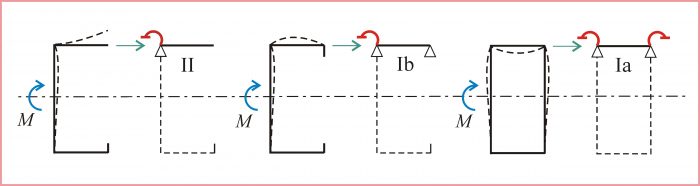
The author identified the critical plate by comparing critical stress in the cross-section component plate subjected to a given stress condition. They then modelled the critical plate indicating the lowest critical stress, as guided by the boundary conditions, as a cantilever or an internal member elastically restrained in the restraining plate. They then presented the application of the critical plate method in examples and compared the analytical computation results with a few experimental findings.
The index of fixity could be established on the account of assumed form of forced restraining plate deformation while considering the effect of the compressive stress in its plane. Plate buckling coefficients for the critical plates that were elastically restrained as described in the study and exposed to longitudinal stress variation could be established on the grounds of the author’s studies.
In a bid to determine the design ultimate resistance of the thin-walled cross-section, the effective width method could be implemented. The author determined the relative slenderness on the basis of suitable critical stress. For a critical plate, this stress considers the index of fixity as well as longitudinal stress variation. In the case of the restraining plate, on the same edge, constant stress distribution and simple support along the entire length could be assumed.

Reference
Andrzej Szychowski. Computation of thin-walled cross-section resistance to local buckling with the use of the critical plate method. Archives of Civil Engineering, Volume LXII issue 2, 2016.