Advances in Engineering Advances in Engineering features breaking research judged by Advances in Engineering advisory team to be of key importance in the Engineering field. Papers are selected from over 10,000 published each week from most peer reviewed journals.

Statement of Significance
The design of microfluidic systems that involves more than one fluid is very complex. In this context the computational modelling of immiscible fluids describing transitions accurately and efficiently, in a variety of geometries and flow conditions and, in principle without relying on simplifying assumptions, can play a fundamental role.
All models presented in this paper refereed to microfluidic chips already tested experimentally in the bubble logic context. For all models a qualitative comparison of the behaviors in simulations with the experimental observations reported in the literature has been done successfully for different configurations, fluids regimes (water-air and water-oil) and flow rates. The Phase-Field method used in the 2D simulations has proved to reach a good trade-off between the results precision and the minimization of the computational time.
A number of advantages can be envisaged for the availability of a library of microfluidic models. It would be possible to evaluate the dynamics in the devices preliminarily under different operating conditions and, to optimize and parameterize the geometries and the input flows according to defined specifics. Moreover, it could be of interest to compare the performance of already existing models and to design a new one by their combination, when it would be possible. In both cases the simulation campaigns will thus allow the qualitative acquisition of spatial-temporal information related to the microfluidic processes occurring in the micro-channels, which are often difficult to be accessed experimentally (flow velocity, volume fraction, viscosity, concentration, etc) and that could allow the establishment of simpler theoretical and analogue electrical models, without the priory assumption of the system linearity.
The simulations of nonlinear spatio-temporal dynamics play a fundamental role for the processes understanding and simplification, and very often this class of simulations is not easy available to wide audience. In this context the focus of this paper was not only the definition of CFD models of logic gates but the attempt to establish a workbench easy accessible for the study of the two-phase microfluidic processes to bring students closer to the microfluidic field, and overcome the need to costly laboratory equipments. The implemented models are not too long to be simulated in a standard personal computer, different suggestions are proposed to overcome the limit of the Phase-Field computation. The CAD models for all the logic gates will be available in the authors website (http://www.dees.unict.it/mbucolo/index.php/resources).
Microfluidics and Nanofluidics, June 2014.
Princia Anandan, Salvina Gagliano, Maide Bucolo.
Dipartimento di Ingegneria Elettrica Elettronica e Informatica, University of Catania, Viale A.Doria 6, 95125 , Catania, Italy.
Abstract
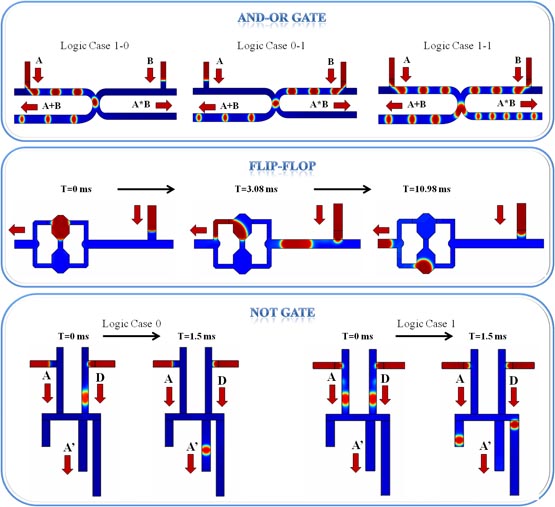
The recent advancements in bubblelogic computation based on two-phase microfluidics bring into light the possibility that the use of bubbles in microfluidic devices can carry on-chip process control. In this paper, four computational models implementing two different AND–OR logic gates, one logic NOT, and a Flip-Flop are presented. More specifically, the numerical approach used combines the Navier–Stokes equation with the phase-field method. All reported models are based on generally accepted and already experimentally tested chip designs. A parametric T-junction model has been designed to be connected to the logic gate models as a droplet generator. The wider framework on the logic gate behavior in different operating conditions reveals the relevance of these models in the microfluidics chip design. Moreover, the advantage of using a simulation platform for the investigation of electrical circuits equivalent of microfluidic processes is illustrated. In this context, the focus of this paper was not only the definition of CFD models of logic gates, but the attempt to establish a workbench easily accessible for the study of the two-phase microfluidic processes.