Advances in Engineering Advances in Engineering features breaking research judged by Advances in Engineering advisory team to be of key importance in the Engineering field. Papers are selected from over 10,000 published each week from most peer reviewed journals.

Significance Statement
In most of the industries like thermal power plants, energy saving is a costly problem. Heat exchanger uses at least two fluids that are different in temperature in order to exchange the energy between them. The heat energy flows from the high temperature fluid to the relatively low temperature fluid across the heat exchanger interface such that making one fluid cooler while the other hotter. Mostly these fluids do not mix together, but come in indirect contact with the heat exchanger interface.
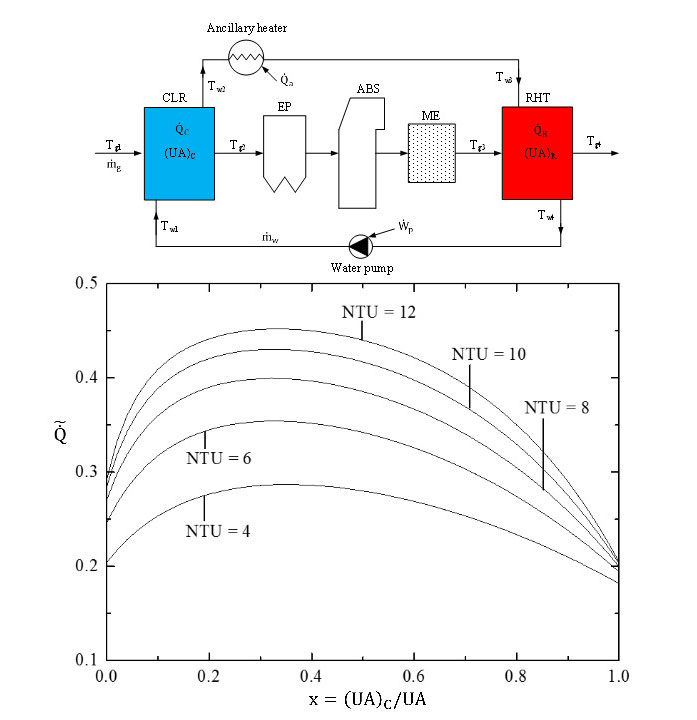
In coal-firing thermal power plants, more care needs to be taken in the heat exchanger design of the boilers. This is because mineral ashes borne in the flue gas that are formed during combustion get deposited on the heat exchanger surfaces, which lowers the heat transfer and flow access performance. Through the post boiler section of thermal power plant, the flue gas experiences the electrostatic precipitator for capturing ash particles for collection prior to reaching the absorber through which desulfurization process occurs. In order to improve the ash collection efficiency, desulfurization performance and flue gas diffusion at the stack, and depress acid condensation leading to heat exchanger surface corrosion, the heat transfer surface allocation optimization for the cooler and reheater in FGD (Flue Gas Desulfurization) equipment is strongly recommended for better performance of the heat exchangers (cooler and reheater). Dr. Jaedal Lee and Dr. Yongsung Kim from Doosan Heavy Industries & Construction Co., Ltd., in Korea, have focused on the optimal design of the cooler and reheater by implementing constructal design, which is able to reach maximal heat transfer density in search for the best allocation ratio of the cooler to the total heat exchanger size. Their work is now published in peer-reviewed journal, International Journal of Energy Research.
FGD (Flue Gas Desulfurization) system is introduced in this paper for maximizing the heat exchangers included in it. The heat exchangers are composed of the cooler and reheater, which are called non-leakage GGH. The term “Non-leakage” is added to GGH (Gas-to-Gas Heater) because the flue gas is not leaked into the atmosphere with FGD process. In this paper, the authors showed how the heat exchanger size is optimally configured in the FGD equipment such that the thermal performance is maximized. SOx and NOx are the major emissions in coal-firing thermal power plants that are severely considered to be harmful to human health and atmosphere environment. FGD equipment exists for removing SOx in the absorber for which appropriate flue gas temperatures are manipulated by the heat exchangers. Wet scrubbing with lime or limestone in the absorber is dominant among the various processes as this method removes high degree of sulfur-dioxide.
As stated above, the heat exchangers participate in decreasing the flue gas temperature in the cooler and increasing it in the reheater. For this, a single water stream circulates through the heat exchangers so that its temperature is experienced reversely compared with the flue gas temperature. There is an ancillary heater to raise the water stream temperature prior to the reheater inlet just in case thermal performance in the reheater deteriorates. The water pump is installed in order to circulate the water stream without experiencing water evaporation in the loop and cavitation in the impellers.
For optimal design configurations, constructal design is employed by the authors. This design strategy uses more degrees of freedom for efficient flow architectures. To generate greater performance the team of authors has shown several ways. The allocation of heat transfer area varies with the degrees of freedom and the number of heat transfer units. To maximize the overall heat transfer rate, various opportunities have been reported by the authors. They focused on the thermal performance of heat transfer density and how it is achievable in the cooler and reheater of the FGD equipment.
At the cooler outlet, two design candidates are documented; one with maximum allowable flue gas temperature, the other without maximum allowable gas temperature. The balanced and unbalanced counter flows are considered in this paper. The authors have concluded that if more degrees of freedom are allowed, then the performance can be improved.


Journal Reference
Lee, J., Kim, Y., Constructal allocation of heat transfer area in Flue Gas Desulfurization equipment for coal-firing power plants, International journal of Energy Research, Volume 40, 2016, Pages 529-536.
Doosan Heavy Industries & Construction Co., Ltd., Changwon, Gyeongnam, Korea
Go To International Journal of Energy Research