Advances in Engineering Advances in Engineering features breaking research judged by Advances in Engineering advisory team to be of key importance in the Engineering field. Papers are selected from over 10,000 published each week from most peer reviewed journals.

Significance
In day-to-day engineering and industrial applications, plates/plate elements are required to withstand a wide range of in-plane and out-of-plane loading conditions. Under such conditions, the compressive buckling resistance becomes of primary concern to the designer. In particular, most engineering applications use moderately thick-to-thick plates thereby introducing intricacies in the approximation of the member’s buckling capacity. Consequently, it also increases the likelihood of inelastic buckling. As such, the elastic and inelastic buckling phenomena in metal plates has become a popular research area. Considerable amount of information regarding the latter is available as it has been analytically, empirically and numerically investigated for almost two centuries.
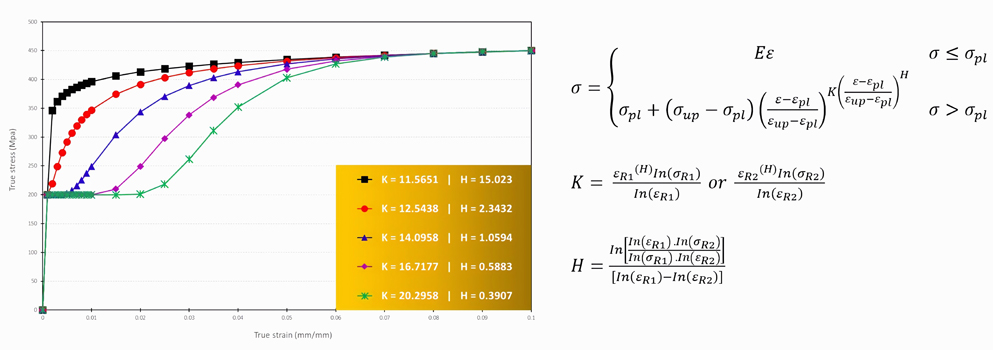
Current stress-strain models are mainly in the form of a power-law relationship, which expresses the strain as a function of the stresses. However, approximation of the true stress-true strain relationship of metallic materials using the simple power-law expressions has been observed to be inadequate for accurately predicting the stress-strain behavior beyond a limited strain range. Worse off, the more advanced stress-strain models are characterized by increased complexity due to requirement of a large number of constituent parameters.
In view of this, scientists at University of Alberta: Dr. Onyekachi Ndubuaku, Professor J.J. Roger Cheng, and Professor Samer Adeeb, in collaboration with Michael Martens at TransCanada Pipelines Ltd. and Dr. Xiaoben Liu at China University of Petroleum, developed a novel facile true stress-true strain equation with the capability to accurately approximate the stress-strain relationship of metallic materials over the full range of strains. Of crucial significance, their proposed model is characteristically unlike existing stress-strain models as it is essentially defined by a Product-Log function using two constitutive model parameters, and can capture a reasonable approximation of the yield plateau in the stress-strain curve. Their work is currently published in the research journal, Construction and Building Materials.
Briefly, the research method applied commenced with the characterization of material properties based on parameterization of the stress-strain curves using a simple and novel mathematical expression. Next, the researchers developed idealized stress-strain relationships using the proposed material mode. They then engaged in extensive parametric numerical analyses purposed to investigate the effect of the material stress-strain properties on the buckling capacity of flat plates.
The authors observed that for the stress-strain curves with a yield plateau, the results of the parametric study showed a minimal influence of the material properties on the buckling capacity of the plates whereas a significant effect of the strain-hardening properties was observed in plates with round-house curves. Additionally, the proposed stress-strain model was shown to be remarkably useful for capturing the relevant intricacies associated with material nonlinearity when predicting the buckling capacity and post-buckling behavior of uniformly-compressed flat plates.
In summary, Dr. Onyekachi Ndubuaku and his colleagues presented a simple finite element method that was successfully used to assess the effects of parametric variation of material stress-strain properties on the ultimate strength and strain capacity of simply-supported flat plates subjected to uniform axial compression. Altogether, the proposed stress-strain model proves to be very versatile in approximating the shape of the stress-strain curve over the entire range of strains, even for materials with a distinct yield point and yield plateau.


Reference
Onyekachi Ndubuaku, Xiaoben Liu, Michael Martens, J.J. Roger Cheng, Samer Adeeb. The effect of material stress-strain characteristics on the ultimate stress and critical buckling strain of flat plates subjected to uniform axial compression. Construction and Building Materials, volume 182 (2018) page 346–359.
Go To Construction and Building Materials