Advances in Engineering Advances in Engineering features breaking research judged by Advances in Engineering advisory team to be of key importance in the Engineering field. Papers are selected from over 10,000 published each week from most peer reviewed journals.

Significance
Demand for Terahertz (THz; 100 GHz-10 THz) devices and systems is on the rise globally. There is also a strong need for applications of the same in efficient practical systems at reduced costs. At present, several techniques can be employed to generate and detect the Terahertz radiation where the application defines the approach to be utilized. Continuous-wave photomixing is the technique of choice where large tunability, large bandwidth and good frequency resolution are required. Previously, such photomixers operated at 800nm but the advent of the 1550nm systems ousted the former. Unfortunately, 1550nm operated photoconductors have a detrimental drawback in that they are very difficult to design due to several partially conflicting requirements. Therefore, there is need to develop a device that can satisfy these requirements and allow for their concurrent maximization.
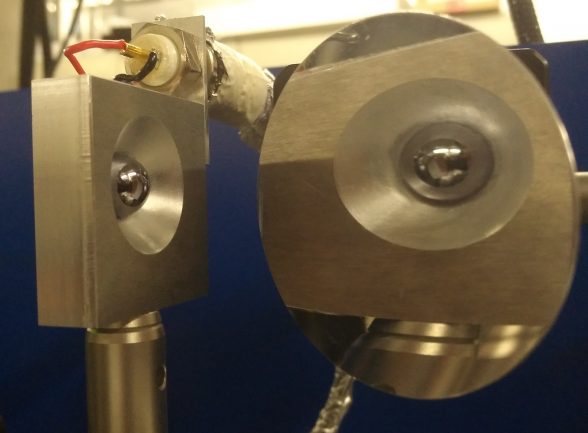
A.D.J. Fernandez Olvera and Professor Sascha Preu at TU Darmstadt in Germany in collaboration with Professor Hong Lu at Nanjing University in China and Professor Arthur C. Gossard at University of California, Santa Barbara, USA developed ErAs:InGaAs homodyne detectors and ErAs:InAlGaAs photoconductive Terahertz sources with excellent device parameters and Terahertz performance under continuous-wave operation. They employed ErAs:In(Al)GaAs devices in a THz system with a peak dynamic range of 78 dB and a bandwidth of ∼3.65 THz at an integration time of 300ms and only 26 mW laser power on each device. Their work is published in the research journal Optics Express.
To begin with, the research team designed ErAs:In(Al)GaAs photoconductors comprising a superlattice layer structure designed to achieve the desired parameters, namely high resistivity, low carrier lifetime, high absorption of 1550 nm laser signals, and high carrier mobility. Next, the superlattice material was grown at the optimum growth temperature for InGaAs. The researchers then proceeded to demonstrate the superior capabilities of the material system by employing ErAs-based photoconductors as both source and receiver for the continuous wave 1550nm Terahertz system. Eventually, they characterized and qualified the ErAs:InGaAs receiver.
The research team observed excellent peak dynamic range of 78 dB and (extrapolated) bandwidth of 3.65 THz using a system with photoconductors for both emission and detection. They compared its performance to a state-of-the-art commercial system using a p-i-n diode as source and a photoconductive receiver. While the dynamic range of the state-of-the-art commercial system under the same predefined laser driving conditions was larger at 100 GHz, it was already smaller at 2 THz. The measured Terahertz photocurrent of the receiver increased linearly with source DC bias without any noticeable saturation within the examined biasing range of the photoconductive source, allowing for further increase of the dynamic range with even more powerful emitters in the future.
The study has reported the highest dynamic range ever to be achieved using a continuous wave system operating at 1550nm and employing only photoconductive elements. Additionally, the 3.65 Terahertz extrapolated bandwidth is on the level of the largest bandwidths reported to date with any 1550nm continuous-wave Terahertz system. Altogether, the ErAs:InAlGaAs-based photoconductive source is superior to the p-i-n diode based commercial device at high Terahertz frequencies, offering larger bandwidth at the expense of lower dynamic range at low frequencies.
Funding
The authors acknowledge funding by the Deutsche Forschungsgemeinschaft, Project PR1413/3-1 (REPHCON) and from the European Union’s Horizon 2020 research and innovation programme under the Marie Skłodowska-Curie grant agreement No 675683 (CELTA).



Reference
A.D.J. Fernandez Olvera, H. Lu, A. C. Gossard, S. Preu. Continuous-wave 1550 nm operated terahertz system using ErAs:In(Al)GaAs photoconductors with 52 dB dynamic range at 1 THz. Volume 25, Number 23 | 13 Nov 2017 | Optics Express 29492
Go To Optics Express