Advances in Engineering Advances in Engineering features breaking research judged by Advances in Engineering advisory team to be of key importance in the Engineering field. Papers are selected from over 10,000 published each week from most peer reviewed journals.

Random electromagnetic phenomena are not peripheral artifacts of physical systems; they are intrinsic to a wide range of natural and engineered environments, from cosmic background radiation to thermal noise and wireless communication channels. Despite their ubiquity, the manipulation of randomness has historically been treated as a circuit-level problem, addressed through electronic noise generation, filtering, or stochastic signal processing. In contrast, the electromagnetic wave domain itself—where randomness is carried, scattered, and transformed—has remained largely inaccessible to direct, programmable control. This disconnect has limited the ability to shape stochastic electromagnetic processes at their physical origin rather than at their electrical endpoint. Metasurfaces have emerged over the past decade as a powerful platform for electromagnetic wave manipulation, enabling compact, planar control over wavefronts, polarization, and spectral content. Digital and programmable metasurfaces, in particular, have introduced a level of flexibility that allows electromagnetic responses to be dynamically reconfigured in time. Most existing work, however, has focused on deterministic behavior: a known coding sequence produces a predictable field distribution. While this paradigm has enabled remarkable advances in beam steering, frequency conversion, and nonreciprocal wave control, it implicitly assumes that the desired electromagnetic outcome is ordered and repeatable.
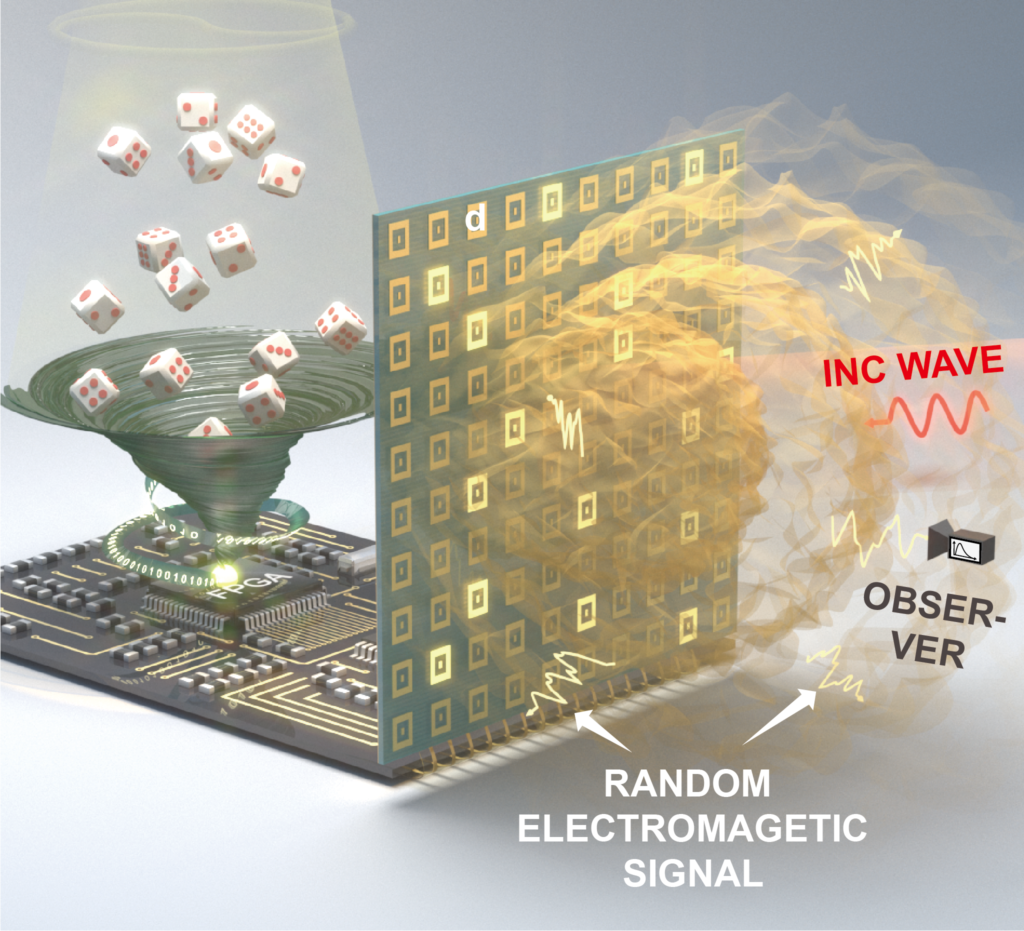
However, many practical systems rely not on determinism but on controlled randomness. Communication channels are inherently stochastic, radar environments are clutter-dominated, and secure information transfer increasingly depends on unpredictable signal structures. Conventional random metasurfaces have demonstrated static random scattering patterns, but these structures lack temporal dynamics and cannot reproduce the statistical signatures of real stochastic processes. Crucially, they offer no systematic way to tune probability distributions, temporal correlations, or spectral bandwidth in a principled manner. To this end new research paper published in Advanced Materials Technologies and conducted by Dr. Jia Cheng Li and Professor Tie Jun Cui from the State Key Laboratory of Millimeter Waves at Southeast University, the researchers developed a dynamically random coding metasurface that enables direct generation and control of stochastic electromagnetic signals in the wave domain. They introduced a probabilistic analytical framework linking random coding rules to field statistics, temporal correlation, and spectral characteristics. New mutation, inheritance, and shift coding models were experimentally validated, demonstrating tunable stochastic behavior without sacrificing randomness. This approach establishes metasurfaces as programmable platforms for engineered electromagnetic randomness rather than purely deterministic devices.
The research team implemented a dynamically random coding metasurface composed of a two-dimensional array of independently addressable meta-atoms and each element was designed as a 1-bit programmable unit capable of switching between two reflection phase states separated by π. This binary architecture, while intentionally simple, allowed large-scale collective behavior to emerge from many locally random events. A field-programmable gate array controlled the temporal evolution of the coding states, enabling rapid and repeated updates across the entire metasurface. Rather than imposing fixed patterns, the coding states were generated according to stochastic rules. In the simplest case, each meta-atom was assigned either state with equal probability at every time step, producing a uniform random code distribution. Measurements of the scattered electromagnetic field revealed that the resulting in-phase and quadrature components followed normal distributions, while the field amplitude obeyed Rayleigh statistics. These outcomes were not incidental; they reflected the central-limit behavior of many independent random contributions interfering in the far field. Importantly, these statistical properties were invariant with respect to observation angle, demonstrating that randomness was not confined to specific scattering directions.
The authors also monitored the scattered field over time, they quantified time autocorrelation and power spectral density, linking decorrelation speed directly to spectral bandwidth. Uniform random coding produced nearly instantaneous decorrelation and a flat spectral profile reminiscent of white noise. This established a baseline against which more structured stochastic behaviors could be engineered. They also explored three additional strategies that introduce structure into the temporal evolution of the metasurface while deliberately preserving randomness at the signal level. The first of these, mutation-based coding, allows each meta-atom to retain its current state most of the time, punctuated by occasional, probabilistic flips. This seemingly minor modification has a clear physical consequence: the scattered field decorrelates gradually rather than abruptly, and its spectral content shifts toward lower frequencies. In effect, the electromagnetic response begins to “remember” its recent past, albeit imperfectly and transiently.
Inheritance-based coding pushes this idea further. Instead of allowing every meta-atom to evolve independently, a subset of the previous spatial pattern is explicitly carried forward at each update, while the remaining elements are randomized anew. The result is a longer-lived temporal memory embedded directly in the wave domain. Experimentally, this means as slower decorrelation and a noticeably narrower spectral bandwidth, consistent with the increased persistence of spatial features across time.
Furthermore, the shift-based strategy introduces a different form of temporal linkage. Here, entire portions of the coding pattern are spatially translated before being refreshed. This operation produces a near-linear decay in temporal correlation, reflecting the deterministic motion imposed on an otherwise random field. Importantly, despite their distinct mechanisms, all three strategies produced experimental results that closely followed theoretical expectations, which reinforced the idea that stochastic electromagnetic behavior can be shaped using simple and physically transparent rules. One important observation is that none of these strategies reduced the intrinsic randomness of the signal. High entropy was consistently maintained, which indicates that temporal structure does not inherently compromise stochastic richness. When coding operations were combined, the metasurface showed even finer control over spectral shaping, which highlights the modular and composable nature of the framework.
In a nutshell, the reported study by Dr. Jia-Cheng Li and Professor Tie-Jun Cui demonstrates that randomness need not be treated as an uncontrollable byproduct of electromagnetic systems. Instead, it can be engineered deliberately, with mathematical rigor and experimental fidelity. The implications extend well beyond conceptual interest. In wireless communication, such controlled randomness offers a physically grounded route to realistic channel emulation. In cryptography, dynamically random electromagnetic fields provide a compelling basis for secure, hardware-level key generation. Radar and sensing systems, meanwhile, stand to benefit from programmable clutter and noise environments that more faithfully resemble real operational conditions.
REFERENCE
Li, Jia & Cui, Tie. (2025). Controlling Stochastic Electromagnetic Process by Dynamically Random Coding Metasurface. Advanced Materials Technologies. 10. 10.1002/admt.202401888.
Go to Advanced Materials Technologies