Advances in Engineering Advances in Engineering features breaking research judged by Advances in Engineering advisory team to be of key importance in the Engineering field. Papers are selected from over 10,000 published each week from most peer reviewed journals.

Significance Statement
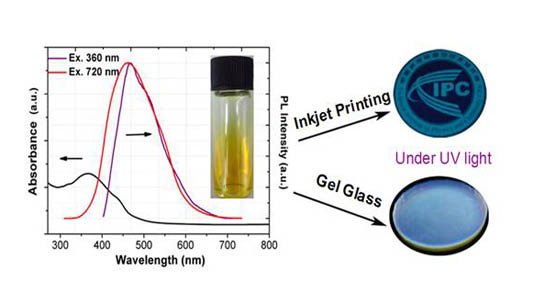
Fluorescent materials play great roles in science and industry. Large-scale synthesis method with low price, high yield is highly desired for the widespread of applications. Generally, fluorescent materials are utilized in the form of dry powders, diluted solutions or films. Herein, we report a novel form of carbon dots which demonstrate liquid-like behavior in the absence of solvents at room temperature. The carbon dots fluid can be prepared in large scale by a one-step method using tetraethylenepentamine as coordinating solvent and citric acid anhydrous as carbon precursor. The reaction finished in 3 minutes with several gram yields in a normal lab flask. The carbon dots fluid can be dissolved in a range of polar solvent, from methylene dichloride to water and can be excited from UV to near infrared light. The quantum yield (excitation at 360 nm) in methylene dichloride and water is 41% and 17%, respectively. Benefit from the inherent fluidity, the carbon dots fluid can be easily made into luminescent inks with a concentration as high as 90 wt% and inkjet printed by a commercial printer. Efficient emission is observed from the printed graphical art under both UV and infrared excitation. In addition, the carbon dots fluid can be homogeneously embedded in sol-gel derived organically modified silicate glass. The as prepared glass doped with 0.1 wt% carbon dots fluid has 61% quantum yield under 360 nm excitation and show obvious Up-Conversion Luminescence. Given the down and up-conversion luminescence and flow ability, carbon dots fluid would usher in a new era for its applications in the area of security, flexible and solid state optical and photonic devices.
Nanoscale. 2014 Apr 7;6(7):3818-23.
Wang F, Xie Z, Zhang B, Liu Y, Yang W, Liu CY.
Key Laboratory of Photochemical Conversion and Optoelectronic Materials, Technical Institute of Physics and Chemistry, Chinese Academy of Sciences, Beijing 100190, P. R. China. [email protected].
Abstract
Room temperature liquid-like nanoparticles have emerged as an exciting new research and development area, because their properties could be tailored over a broad range by manipulating geometric and chemical characteristics of the inorganic core and organic canopy. However, related applications are rarely reported due to the multi-step synthesis process and potential toxicity of cadmium based nanomaterials. In this study, we prepared inexpensive and eco-friendly carbon dot fluid by the direct thermal decomposition method. The carbon dot fluid can be excited from UV to near infrared light, and can be prepared as highly concentrated luminescent ink or incorporated into sol-gel derived organically modified silicate glass, suggesting that it has great application potential in the field of printable electronics, solid state lighting and so on.