Advances in Engineering Advances in Engineering features breaking research judged by Advances in Engineering advisory team to be of key importance in the Engineering field. Papers are selected from over 10,000 published each week from most peer reviewed journals.

Significance Statement
Methanol produced by the process of hydrogenation of carbon dioxide is a route to recycle the captured carbon dioxide from fossil fuels. This is a convenient fuel to transport as a hydrogen-rich source and it is also applied as a chemical feedstock to manufacture key chemical components. Generally, methanol is manufactured from synthesis gas using a Cu/ZnO/Al2O3 catalyst. On the other hand, isotope labeling experiments revealed that carbon dioxide is main carbon source for production of methanol and carbon monoxide is responsible for the active oxidation state of copper. Finding catalysts that utilize carbon dioxide and hydrogen as sources to produce methanol selectively is desirable, however, this remains a challenge.
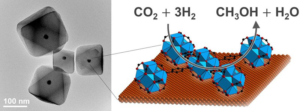
Researchers led by professors Omar Yaghi, and Gabor Somorjai, from the University of California Berkeley and Lawrence Berkeley National Laboratory reported a catalyst composed of copper nanocrystals encapsulated within a metal-organic framework for the hydrogenation of carbon dioxide to methanol with 100% selectivity and high activity. Their work is now published in peer-reviewed journal, Nano Letters.
Carbon dioxide hydrogenation to methanol reaction is known to be structure sensitive in that the catalytic properties are linked with the dimensions as well as composition of the metal oxide- metal interface. Metal-organic frameworks are important in this instance for interfacing with other active metals owing to their nanosized metal oxide secondary building units and tunability of their composition. This allows for investigating the effects of a catalytic interface.
In their setup, an ordered array of Zr oxide secondary building units were precisely placed on the copper surface leading to high interfacial contacts between copper nanocrystals and Zr oxide secondary building units. The Zr oxide secondary building units were spatially spaced by organic linkers to ensure the accessibility of reactants to active sites.
The synthesis procedure for copper nanocrystals capped with polyvinylpyrrolidone using polyol process enabled the researchers to study systematically the change in the catalytic attributes as a function of various metal-organic frameworks and other supports. The pre-synthesized copper nanocrystals were added to a solution composed of metal-organic framework precursors. Besides the exclusion of oxygen to avoid the surface oxidation as well as acid-mediated dissolution of copper nanocrystal, they realized that the selection of metal precursors affected the encapsulation process.
Copper catalyst for the carbon dioxide hydrogenation to methanol was done over various types of metal-organic frameworks. The authors found UiO-66 to be the best promoter for copper catalyst resulting in high selectivity and high production of methanol from carbon dioxide. From XPS analysis, the presence of a combination of multiple copper oxidation states derived by high interfacial contact area between copper nanocrystals and Zr oxide secondary building units of the metal-organic framework lead to the high turnover frequency of methanol production. This was the first finding that metal oxide clusters in metal-organic framework can have strong-metal support interaction as typically observed in bulk metal oxides.




Reference
Bunyarat Rungtaweevoranit1,2, Jayeon Baek1,2, Joyce R. Araujo1,3, Braulio S. Archanjo3, Kyung Min Choi1,2, Omar M. Yaghi1,2,4, and Gabor A. Somorjai1,5. Copper nanocrystals encapsulated in Zr-based Metal-Organic frameworks for highly Selective CO2 hydrogenation to Methanol. Nano Letters, volume 16 (2016), pages 7645-7649.
[expand title=”Show Affiliations”]- Department of Chemistry, University of California−Berkeley, Kavli Energy NanoSciences Institute, Berkeley, California 94720, United States.
- Materials Sciences Division and Chemical Sciences Division, Lawrence Berkeley National Laboratory, Berkeley, California 94720, United States.
- Materials Metrology Division, National Institute of Metrology, Quality, and Technology, Duque de Caxias, Rio de Janeiro 25250−020, Brazil.
- King Abdulaziz City for Science and Technology, Riyadh 11442, Saudi Arabia.
- Chemical Sciences Division, Lawrence Berkeley National Laboratory, Berkeley, California 94720, United States.
Go To Nano Letters