Advances in Engineering Advances in Engineering features breaking research judged by Advances in Engineering advisory team to be of key importance in the Engineering field. Papers are selected from over 10,000 published each week from most peer reviewed journals.

Significance
Ultrafast pump–probe measurements are often built around repetition. A laser pulse perturbs a material, a delayed probe records one part of the response, and many such events are averaged until a reproducible dynamical trace appears. That strategy has been remarkably powerful when the response is effectively the same from one excitation event to the next. It becomes less straightforward when the material itself does not return along a single deterministic path. In systems where fluctuations, metastability, local disorder, mobile ions, or heterogeneous strain influence the response, averaging can erase precisely the behavior that carries physical meaning. The difficulty is separating fluctuations that belong to the sample from fluctuations introduced by the apparatus. A small drift in probe intensity, instability of the pump pulse, limited photon counts, or insufficient temporal sampling can all imitate or obscure variations in the material response. Single-shot approaches can avoid some of the averaging problem, but they often record only one delay time after a given pump event, or they divide the probe signal across many temporal slices so that the information from each slice becomes weak. The scientific gap addressed here lies in extracting correlations within apparently random nonequilibrium trajectories while still using a stroboscopic measurement architecture.
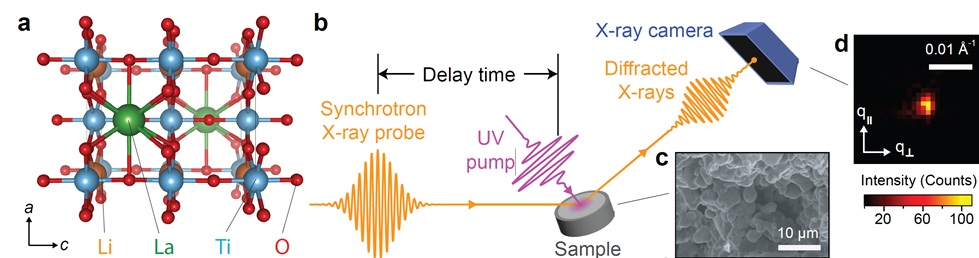
In a recently published research paper in Nature Communications, Dr. Jackson McClellan, Professor Alfred Zong, Dr. Kim Pham, Dr. Hanzhe Liu, Dr. Zachery Iton, Dr. Burak Guzelturk, Donald A. Walko, Haidan Wen, Professor Scott Cushing & Professor Michael Zuerch from University of California and from California Institute of Technology developed nonequilibrium noise correlation spectroscopy as a statistical method for extracting correlations from stochastic pump-induced trajectories in stroboscopic time-resolved measurements. They applied it to the c-axis lattice response of a single LLTO grain measured by synchrotron X-ray micro-diffraction after above-bandgap photoexcitation. The technically distinct element is the use of two-time correlation analysis on repeated local lattice-parameter scans to quantify persistence between neighboring excitation events. This enabled them to infer a trajectory-switching probability and an associated activation barrier linked to lithium-ion motion.
The researchers’ experimental strategy used synchrotron-based time-resolved X-ray micro-diffraction to monitor the c-axis lattice parameter of LLTO after ultraviolet excitation. The sample was prepared as a sintered polycrystalline pellet, and the X-ray beam size was comparable to the scale of individual grains. That design choice mattered scientifically because it avoided averaging over a powder ensemble and allowed the stochastic lattice motion of a single grain to be examined directly. The pump laser operated at 1 kHz, while the X-ray probe recorded diffraction at delay times from before excitation to tens of microseconds afterward. Each delay point averaged about one thousand pump–probe pairs, and the full delay scan was repeated ten times with almost no waiting between scans. The authors found photoexcitation produced a sudden c-axis expansion larger than 0.1%, followed by a slower recovery over tens of microseconds. However, the individual scans were not smooth replicas of that mean behavior. After time zero, the lattice parameter displayed abrupt discontinuities and streaks of similar values. Before photoexcitation, the fluctuations were much smaller. This contrast was central to the interpretation, since instability of the X-ray measurement would be expected to affect all delay times in a similar way. The researchers also examined pump laser power fluctuations and found that they were far too small to account for the observed c-axis variations. A separate fluence-dependent measurement showed a linear lattice displacement with pump power, arguing against a hidden nonlinear amplification of small pulse-energy changes.
The team noticed stochastic response had two important statistical signatures. First, the scan-to-scan variation was strongest soon after excitation and decreased at longer delays. The standard deviation across scans followed a temporal form similar to the averaged lattice expansion and relaxation, yet the relaxation time associated with the standard deviation was substantially shorter than that of the mean response. Simulations showed that this relation could be reproduced when the initial lattice expansion and the relaxation time were negatively correlated. In physical terms, larger initial expansion was associated with faster recovery, consistent with transient c-axis lattice stiffening rather than a softening response. Second, the streaks in the time traces implied that neighboring pump-induced trajectories were not independent. To quantify that behavior, the researchers computed Pearson correlation coefficients between lattice-parameter values recorded at different delay positions within the repeated scans. Because each microsecond delay increment corresponded to roughly one thousand elapsed pump shots in the acquisition scheme, correlations between nearby delay indices reflected persistence across neighboring excitation events. The resulting two-time correlation analysis revealed enhanced positive correlation near the diagonal, and the averaged autocorrelation decayed exponentially with a characteristic length of about 1,500 ± 300 pump shots.
A simple stochastic simulation helped give this number physical meaning. The researchers modeled individual photoinduced lattice trajectories using the phenomenological form that described the averaged response, but allowed the initial expansion amplitude to switch only with a small probability. With a switching probability of about 0.09 ± 0.02% per pump shot, the simulation reproduced the observed correlation matrix, histogram distribution, and exponential correlation decay. Interpreting that probability through an activated process at the estimated photoinduced lattice temperature gave an energy barrier of 0.4 ± 0.1 eV. That value falls close to the reported energy range for lithium-ion migration in LLTO, supporting the interpretation that photo-assisted lithium displacement can slightly alter the metastable lattice structure after individual pump events.
The study is important because it shows that fluctuations in the photoinduced lattice response can carry measurable information about microscopic ionic and structural dynamics. Conventional averaging would retain the photoinduced expansion and recovery of the LLTO lattice, but would largely suppress the correlated variations between successive excitation events. By analyzing how deviations persist across repeated pump shots, the researchers connected stochastic lattice trajectories to an energy scale associated with lithium motion. The paper therefore changes the interpretation of pump–probe variability in this solid electrolyte: the irregularity is not simply experimental inconvenience, but a measurable signature of coupled ionic and structural dynamics.
For LLTO, the new findings support a picture in which photoexcitation does more than transiently heat the lattice. Ultraviolet excitation can drive lattice vibrations and thermal expansion, but harmonic phonon excitation alone would not account for persistent changes in the temporally averaged lattice structure. The analysis points instead toward interaction between excited lattice modes and lithium-ion motion, allowing the system to enter slightly different metastable structures from one pump event to another. The negative relation between expansion amplitude and relaxation time is especially informative, because it links the stochastic structural response to a transiently stiffer lattice state rather than to a slowing near a softened structural instability.
The methodological contribution is equally significant, but it should be described within the demonstrated scope. The researchers showed that a highly stable, high-flux synchrotron X-ray probe can recover correlations from averaged stroboscopic data when the experiment is designed around local measurement, low instrumental noise, appropriate repetition rate, and statistical reconstruction. This does not replace single-shot dynamics; rather, it provides another route for identifying persistence and switching in systems where individual trajectories are hidden inside repeated measurements. The approach is particularly suited to microscopic regions whose local dynamics would be lost in ensemble averages. In ionic conductors, lattice deformation and ion mobility are not separable in a simple static sense, and this paper gives an experimental route to observe their coupling through correlated noise in the transient response. Its strongest message is restrained but valuable: under photoexcitation, a solid-state ionic conductor can display stochastic lattice dynamics with measurable memory, and that memory carries an activation scale consistent with lithium migration.


Reference
McClellan J, Zong A, Pham KH, Liu H, Iton ZWB, Guzelturk B, Walko DA, Wen H, Cushing SK, Zuerch MW. Photoinduced correlations in stochastic dynamics of a solid-state ionic conductor. Nat Commun. 2026 . doi: 10.1038/s41467-026-72663-7.
Go to Nature Communications