Advances in Engineering Advances in Engineering features breaking research judged by Advances in Engineering advisory team to be of key importance in the Engineering field. Papers are selected from over 10,000 published each week from most peer reviewed journals.

Significance Statement
Self-Consolidating Concrete (SCC) is one of the best innovations in the concrete industry over the past 20 years. This research used fundamental rheology theory and aggregate packing models to help understand and control dynamic segregation, a common and tricky problem limiting the wide applications of self-consolidating concrete.
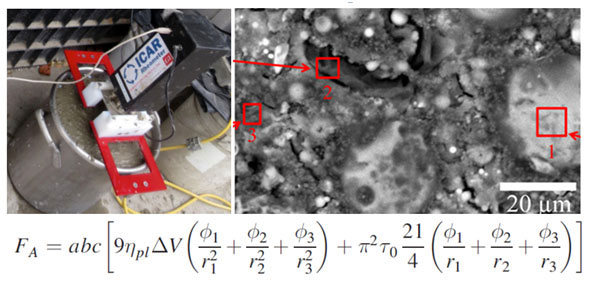
Segregation is a common problem in self-consolidating concrete, which is sensitive to mix proportions such as superplasticizer dosage, as well as the size, volume, and gradation of the aggregate. Dynamic segregation, when coarse aggregate lags behind during the flowing process, is distinguishable from static segregation, when coarse aggregate settles in concrete at rest. In the research reported in this paper, a flow trough and a concrete rheometer were used to study the effects of various aggregate properties and concrete rheology on dynamic segregation of self-consolidating concrete. An equation for the drag force was found useful to understand how various mix proportions and concrete rheology affecting dynamic segregation. Higher paste volume, lower superplasticizer percent by weight of cement, lower slump flow, smaller coarse aggregate, and better gradation may increase dynamic stability. Smaller aggregate size has more significant effect than other aggregate properties. Mixtures with dynamic yield stress less than 50 Pa exhibited severe segregation from both flow trough and visual stability index (VSI) tests. Mixtures with static yield stress of 250 Pa or higher had satisfactory dynamic stability, while mixtures with static yield stress of 100 Pa or lower showed severe dynamic segregation. No clear correlation was observed between concrete plastic viscosity and dynamic segregation.



Journal Reference
Journal of Materials in Civil Engineering, Volume 28, Issue 1 (January 2016).
Lin Shen1; Hamed Bahrami Jovein2; Qian Wang3
[expand title=”Show Affiliations”]- Assistant Professor, Dept. of Civil and Environmental Engineering, Univ. of Hawaii, Manoa, HI 96822 (corresponding author). E-mail: [email protected]
- Graduate Student, Dept. of Civil and Environmental Engineering, Univ. of Hawaii, Manoa, HI 96822. E-mail: [email protected]
- Assistant Professor, Dept. of Civil and Environmental Engineering, Manhattan College, Riverdale, NY 10471.
Abstract
Segregation is a common problem in self-consolidating concrete (SCC), which is sensitive to mix proportions such as superplasticizer dosage, as well as the size, volume, and gradation of the aggregate. Dynamic segregation, when coarse aggregate lags behind during the flowing process, is distinguishable from static segregation, when coarse aggregate settles in concrete at rest. In the research reported in this paper, a flow trough and a concrete rheometer were used to study the effects of various aggregate properties and concrete rheology on dynamic segregation of self-consolidating concrete. An equation for the drag force was found useful to understand how various mix proportions and concrete rheology affecting dynamic segregation. Higher paste volume, lower superplasticizer percent by weight of cement, lower slump flow, smaller coarse aggregate, and better gradation may increase dynamic stability. Smaller aggregate size has more significant effect than other aggregate properties. Mixtures with dynamic yield stress less than 50 Pa exhibited severe segregation from both flow trough and visual stability index (VSI) tests. Mixtures with static yield stress of 250 Pa or higher had satisfactory dynamic stability, while mixtures with static yield stress of 100 Pa or lower showed severe dynamic segregation. No clear correlation was observed between concrete plastic viscosity and dynamic segregation.
Go To Journal of Materials in Civil Engineering