Advances in Engineering Advances in Engineering features breaking research judged by Advances in Engineering advisory team to be of key importance in the Engineering field. Papers are selected from over 10,000 published each week from most peer reviewed journals.

Significance
Modern concrete is widely used due to its excellent workability, mechanical properties and potential long-term performance. Unfortunately, modern concrete is apt to early age cracking. Early age cracking poses serious ramifications to the durability of concrete. Research has revealed that early-age cracking is primarily due to volumetric deformations, which are closely related to temperature and humidity field changes in modern concrete. As a result, much has been done to assess and analyze the temperature and humidity of early-age cement-based materials. A thorough review of such studies shows that relative humidity experiments under the conditions of a large temperature change and a large temperature change rate, and a coupled model considering the effect of temperature change rate on relative humidity are generally lacking in literature.
Overall, it is evident that the volumetric deformation caused by temperature and humidity changes in modern concrete are large and the hydration, temperature and humidity have an obvious coupled effect. Therefore, it is imperative that an in-depth assessment focusing on both empirical and theoretical analysis on the coupled effects of hydration, temperature and humidity in early-age cement-based materials should be undertaken. To this end, researchers at the College of Civil and Transportation Engineering at Hohai University in China: Dr. Haitao Zhao, Kaidi Jiang, Rui Yang and Yimin Tang in collaboration with Prof. Jiaping Liu at the College of Materials Science and Engineering, Southeast University studied the coupled effects of hydration, temperature and relative humidity in modern concrete. Their work is currently published in International Journal of Heat and Mass Transfer.
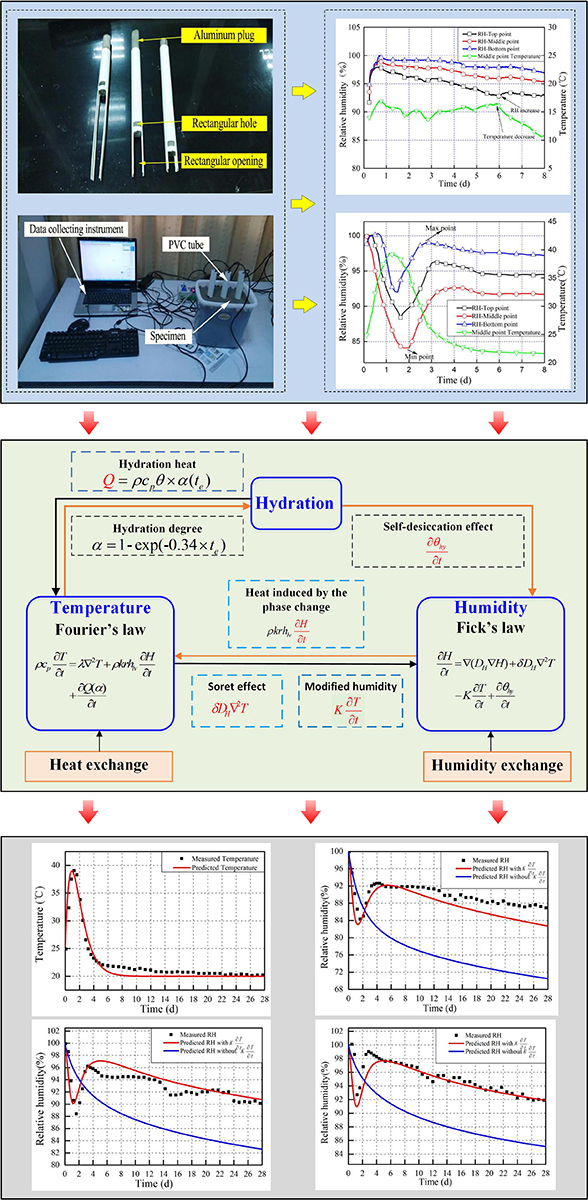
In their approach, experiments on temperature and relative humidity were conducted where several test procedures were applied. A coupled model of early-age cement-based materials, defined by coupled governing equations and humidity diffusion coefficient was presented. Further the team assessed the water consumption in binding material and self-heating in the binding material hydration process.
The test results showed that the coupled phenomenon of temperature and relative humidity could be clearly observed and divided into three stages. In addition, the researchers reported that relative humidity rapidly decreased with large temperature increase and large temperature increase rate, and then sharply increased with large temperature decrease concurrent with the large temperature decrease rate in the second stage. Finally, the relative humidity was seen to decrease again throughout the remainder of the test.
In summary, the study by Dr. Haitao Zhao, Professor Jiaping Liu and their colleagues proposed a coupled hygro-thermo-chemical model based on the experimental results and theoretical derivation presented. The proposed model could accurately predict the temperature and humidity field of early-age cement-based materials via comparison of the measurement data and predicted values. Additionally, the coupled model demonstrates that apart from self-desiccation and moisture diffusion, the early change in relative humidity is significantly affected by the large temperature change and the large temperature change rate in the early age.


Reference
Haitao Zhao, Kaidi Jiang, Rui Yang, Yimin Tang, Jiaping Liu. Experimental and theoretical analysis on coupled effect of hydration, temperature and humidity in early-age cement-based materials. International Journal of Heat and Mass Transfer 146 (2020) 118784