 Advances in Engineering Advances in Engineering features breaking research judged by Advances in Engineering advisory team to be of key importance in the Engineering field. Papers are selected from over 10,000 published each week from most peer reviewed journals.

Significance
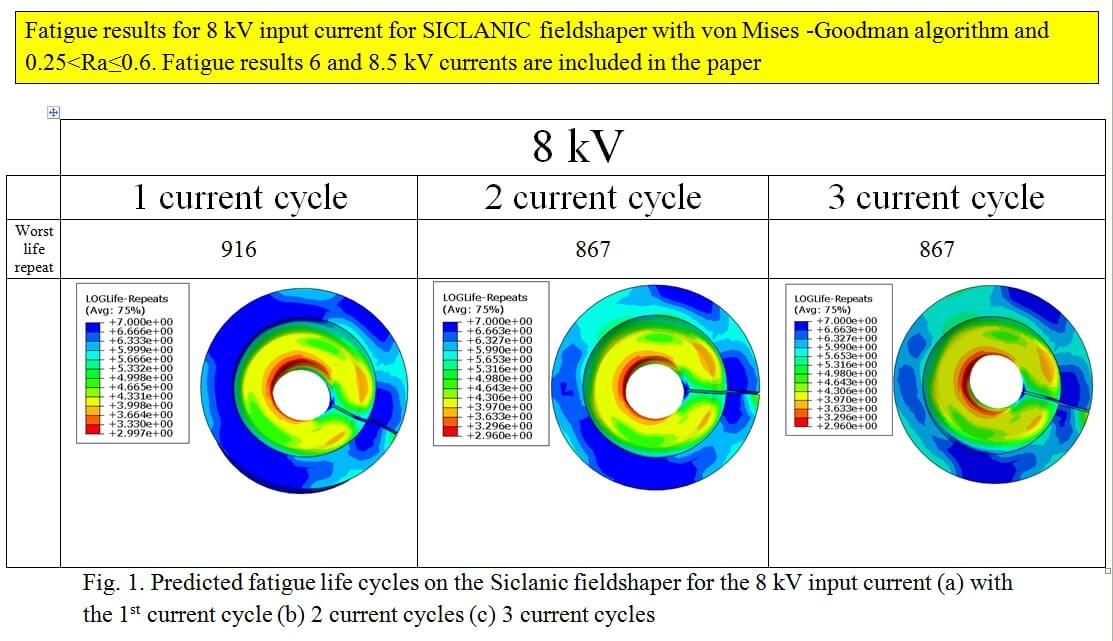
Fatigue predictions and tool design are important when operating under high frequency pulse currents with large amplitudes during electromagnetic forming/welding processes. This can be attributed to the fact that the fieldshapers used in electromagnetic forming and welding processes are prone to have fatigue damage. During each shot, impulse current passes through the coil that induces an eddy current cycle and a cyclic Lorentz force on the fieldshaper. Thus, the failure of the fieldshapers during service is associated with the cyclic loading conditions during a decaying high frequency electric current pulse. Repetition of the current pulse that causes the damage and ultimately results in a failure which is analogous to that occurs during a fatigue problem. Various studies have endeavored to correlate the electric fatigue behavior with generalized Coffin-Manson law. Unfortunately, up to date, damage originating from the electrical loading has not yet been considered. Recent technological advances have led to the development of a novel material of promising qualities such as Cu-Ni-Si alloys (e.g. Siclanic), however, the fatigue phenomenon of fieldshapers fabricated from such material have not yet been systematically investigated either.
Recently, a team of researchers led by Dr Mohamed Rachik from Compiègne University of Technology in France cross-examined a fatigue case study for Siclanic fieldshaper using a strain-based fatigue analysis so as to better comprehend the scenario of the damage caused in electromagnetic pulse forming and welding (EMPF/EMPW) tools. They purposed to introduce a fatigue damage problem of fieldshaper used for EMPF/EMPW applications. Their work is currently published in the research journal, International Journal of Fatigue [1].
The research technique employed commenced with the researchers obtaining the material properties and Wöhler curve of Siclanic using both monotonic and fatigue tests, respectively. Next, in order to obtain the required stress history during the EMPW process, the researchers performed Multiphysics electromagnetic-mechanical simulations on the test pieces. Lastly, fatigue analysis was performed using fe-safe software.
The authors observed that the Multiphysics simulations showed that the work-pieces deformation had a negligible influence on the stresses development on the tools. Additionally, they noted that the radial component of the Lorentz force contributed to the large stress development and the effective stress was significantly high at the location opposite to the slot. Generally, the circumferential Lorentz force component was seen to be negligible in the fieldshaper.
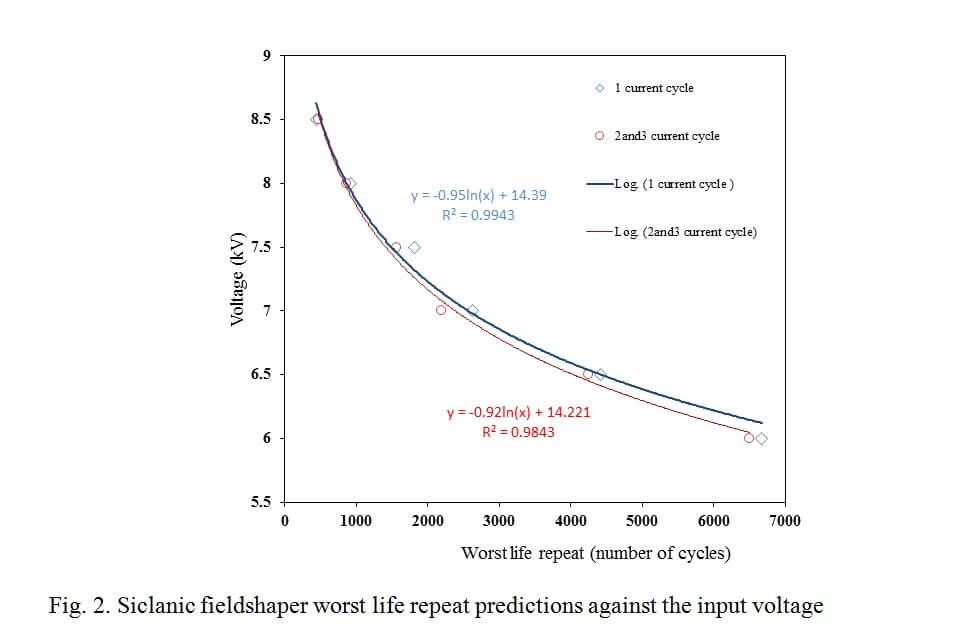
The study demonstrated a thorough investigation of the recently developed and promising Siclanic material, for use in EMPF/EMPW applications without compromising the electrical conductivity for its mechanical properties and vice versa. Overall, their work showed that the predicted damage locations using the fatigue analysis concurred with the experimental observations of the failed fieldshapers used in service and with the first crack formation that corresponded to the element location of the worst life repeat predicted from fe-safe calculation. Altogether, the study provides a clear understanding of the fatigue damage due to electromagnetic loading and establishes a linear correlation to predict the life cycle for an input electric current.



Reference
Saadouki, T. Sapanathan, P.H. Pelca, M. Elghorba, M. Rachik. Fatigue damage in fieldshapers used during electromagnetic forming and welding processes at high frequency impulse current. International Journal of Fatigue, volume 109 (2018) pages 93–102.
doi: 10.1016/j.ijfatigue.2017.12.019
Go To International Journal of Fatigue