 Advances in Engineering Advances in Engineering features breaking research judged by Advances in Engineering advisory team to be of key importance in the Engineering field. Papers are selected from over 10,000 published each week from most peer reviewed journals.

Significance
Polarization in PZT95/5 does not remain fixed when pressure and electric field shift the relative stability of its low-temperature rhombohedral ferroelectric state and its orthorhombic antiferroelectric state, because the polarization pattern changes together with the tilt pattern of the oxygen octahedra rather than through a purely polar rearrangement. In this system, the ferroelectric FERL phase carries polarization along [111]p and couples to an a− a− a− tilt pattern, whereas pressure drives the material toward the AFEO phase, where antiparallel polarization develops along [110]p together with an a−a−c0 tilt mode. That dual reorganization gives the transition a structural character that cannot be captured well if one follows polarization alone. In a recent research paper published in Journal of Alloys and Compounds, Dr. Yujuan Peng, Dr.Yixuan Jiang, and Professor Xingzhe Wang from Lanzhou University together with Dr.Changjun Qi from the Lanzhou Jiaotong University and Dr. Guian Man from the Southern University of Science and Technology, addressed this problem. The difficulty was not simply that PZT95/5 can switch between FE and AFE states. The harder point was that the transition pathway includes an intermediate state and proceeds through coupled changes in ferroelectric polarization, antiferroelectric polarization, and oxygen-octahedral tilting. Earlier descriptions had already established thermodynamic pictures for these materials, and prior discussions of antiferroelectricity had brought in ideas such as sublattice polarization, soft modes, and polarization-gradient effects. The field still lacked a phase-field description that connected microscopic domain evolution with macroscopic electromechanical response while explicitly treating octahedral tilt as a coupled evolving variable.
That gap matters for two related reasons. One concerns ferroelectric domain switching itself. In perovskites, adjacent polarized ions share the octahedral framework, so the tilt field is mechanically and structurally tied to the wall geometry. Domain walls are boundaries across which polarization rotates, and in this material they also involve readjustment of the octahedral network. The other concerns FE–AFE conversion. In these lead-zirconate-based materials, the intermediate ferrielectric state carries a mixed character, and the paper frames that state as part of the actual transition route rather than as an incidental detail. Once that is accepted, the switching problem becomes a multi-order-parameter problem by construction.
To address this challenge, the research authors reconstructed the phase-field model in a thermodynamically consistent formulation, introducing ferroelectric polarization and antiferroelectric polarization as independent order parameters while accounting for their coupling with oxygen octahedral tilting. This enabled an accurate characterization of the synchronous evolution of angular patterns during the FER-AFEO phase transition, a breakthrough unachieved by all previous models. On this basis, the corresponding micro-force balance equations for the three coupled order parameters were established, allowing the configurational evolution of both polarization and tilting to be analyzed within a unified framework. In addition, the coupling effects between different order parameters and stress were fully incorporated into the model, which further refined the analytical dimensions of the phase-field approach. This modeling strategy holds profound scientific significance, as it embeds the phase transition pathway directly into the dynamic processes themselves. The research team also incorporated the tilt field explicitly into the driving-force balance equations, thereby describing the laws governing domain motion and phase evolution under electrical and mechanical loading conditions.
The research team built the calculation around a multi-order-parameter phase-field model in which FE polarization, AFE polarization, and oxygen octahedral tilt evolve together through generalized Ginzburg–Landau equations derived from the system enthalpy. They combined Landau-type local terms with gradient, elastic, and electrostatic contributions, and then solved the coupled problem in a 100 × 100 nm² domain using finite elements. That setup did more than provide a numerical scheme. It allowed them to test, within one framework, how local wall structure, external loading, and phase stability reshape one another. Starting from randomized initial conditions at room temperature, they obtained a stable R1/R2 ferroelectric multidomain state with coincident polarization walls and reverse tilt boundaries. The wall geometry already revealed the role of the tilt field. The 109° walls formed at the same locations in both descriptions, but the tilt wall was about twice as thick as the polarization wall, around 10 nm. That difference carries a clear physical meaning: the octahedral framework needs coordinated angular accommodation across more unit cells than the polarization field requires for its own reversal. A wall in this material is, in that sense, a wider structural object than a purely polar map would imply.
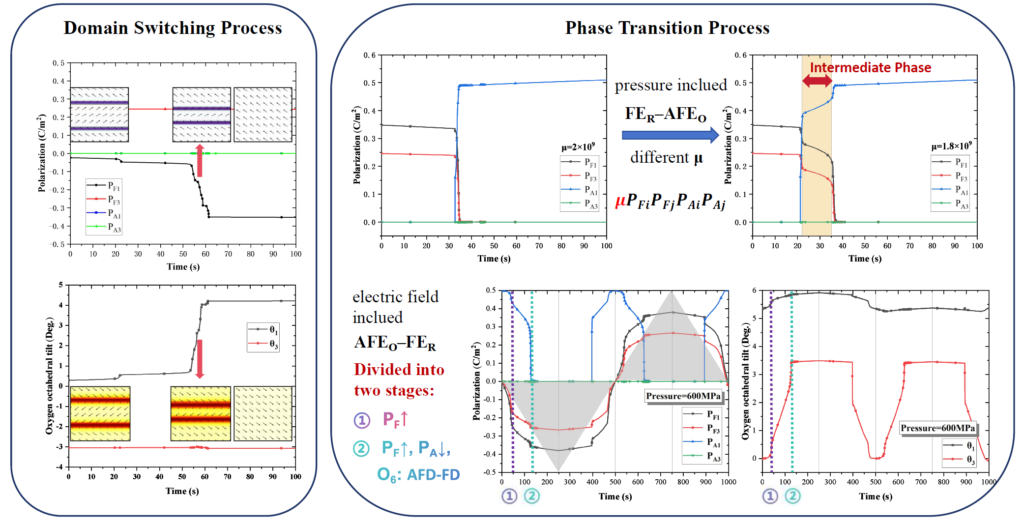
Under a quasi-static electric field applied along [111]p, the multidomain ferroelectric state did not rotate uniformly into a field-parallel state. The R1 domains opposed to the applied field flipped into R2, the two R2 regions expanded, and the wall pair moved toward merger until a single-domain configuration formed. The tilt field moved with that process rather than lagging behind it. The electric field does not couple directly to octahedral tilt, however, once polarization walls began to migrate, the corresponding tilt walls translated synchronously and disappeared at the same stage. The nearly linear change in polarization and tilt during the main switching interval matches constant-speed wall motion, which gives the wall migration process a very definite dynamical character.
The pressure-loading calculations sharpened that picture. Pre-pressure along different directions changed the electric field required for switching because it altered the tilt state and, through it, the gradient energy associated with the walls. Pressure along [001]p produced the widest tilt wall and the highest gradient energy, so switching demanded the highest electric field. Pressure along [110]p produced the smallest wall-to-wall contrast and the lowest gradient energy, so the wall moved most readily. This is a strong example of design logic operating inside the material: the loading direction matters because it selects a different wall-structure cost before switching even begins.
The pressure-induced FERL–AFEO transition and the electric-field-induced AFEO–FERL transition revealed the intermediate state from another angle. Biaxial pressure deepened the AFE wells in the energy surface and shifted the stable state toward AFEO. When the FE–AFE polarization coupling coefficient was reduced, the pressure-driven transformation passed through an intermediate phase where FE and AFE polarizations coexisted. In the reverse direction, under an alternating electric field, the AFEO–FERL transformation proceeded in two stages: AFEO–FiE and FiE–FERL. During the first stage, FE polarization rose rapidly while AFE polarization remained largely intact; during the second, AFE polarization fell away and the tilt pattern evolved from a−a−c0 toward a− a− a−.
A phase transition in this material cannot be read correctly as a simple exchange between one polarization pattern and another. That matters beyond the particular case of PZT95/5 because it changes how one thinks about controllability in antiferroelectrics. The switching threshold is not set only by the direction of an applied electric field or by the nominal identity of the starting phase. It also depends on how pressure reshapes the wall profile and the gradient-energy burden carried by the tilt field. The authors’ results make the wall structure a dynamic mediator between loading condition and macroscopic response. For materials used in pulsed-power and electromechanical conversion settings, that is a more exact way to connect operating condition with structural trajectory.
Under pressure, the FE–AFE polarization coupling strength changes whether the system crosses directly or pauses in a mixed FE/AFE state. Under electric loading, the AFEO–FERL conversion separates into two linked stages with distinct behavior of FE polarization, AFE polarization, and octahedral tilt. That staged picture gives the intermediate phase a mechanistic identity. It is not determined merely by polar/antipolar polarization arrangements, but is instead defined by combining the competing thermodynamic energetics of ferroelectric and antiferroelectric phases, while accounting for the structural changes in oxygen octahedral tilting. Also, by formulating FE polarization, AFE polarization, and tilt within one thermodynamically consistent phase-field framework, the authors strictly follow the core philosophy of the modern definition of antiferroelectricity. This achieves a unified description of antipolar order, polar order, and lattice distortion in antiferroelectric systems, avoiding the traditional limitation of oversimplifying antiferroelectric phase transitions as “nonpolar-to-polar transformation”. This method can simultaneously describe three core characteristics: antipolar dipole modulation, antiphase domain walls (translation boundaries), and field-induced antiferroelectric–ferroelectric phase transition. It is especially suitable for the quantitative study of domain structure evolution, phase selection, and electromechanical coupling under quasi-static electric fields, and can fully reproduce the sequential order-parameter evolution, domain-wall motion, and lattice cooperative response of antiferroelectrics under electric fields. The coexistence of FE and AFE polarization, the staged evolution under field, and the shift in tilt mode from a−a−c0 to a− a− a− connect the observed transition sequence to a definite microstructural pathway. From the perspective of multi-order-parameter coupling, this work reinterprets the antiferroelectric–ferroelectric phase transition as a structural transformation involving the synergistic evolution of multiple order parameters. The cooperative effects of antiferroelectric–ferroelectric coupling strength, electric-field direction, and oxygen octahedral tilting collectively determine the phase-transition pathway, critical field, and domain structure morphology. This is highly consistent with the frontier understanding of incommensurate modulation and domain-wall topology in the modern antiferroelectric field, providing a theoretical tool that better conforms to the physical nature for understanding external-field-driven antiferroelectric phase transitions.





Reference
Yujuan Peng, Changjun Qi, Guian Man, Yixuan Jiang, Xingzhe Wang, New insights into ferroelectric domain switching and the emergence of intermediate phase during FE-AFE phase transition, Journal of Alloys and Compounds, Volume 1044, 2025, 184370,
Go to Journal of Alloys and Compounds