 Advances in Engineering Advances in Engineering features breaking research judged by Advances in Engineering advisory team to be of key importance in the Engineering field. Papers are selected from over 10,000 published each week from most peer reviewed journals.

Significance
Coastal protection combines sea dikes with vegetated foreshores that help reduce wave energy before it reaches the structure. As waves pass through vegetation, drag and inertia forces dissipate part of their energy. Predicting this effect is challenging because vegetation resistance changes with wave conditions, vegetation characteristics, and foreshore slope. Macroscopic numerical models can represent these effects, but accurate prediction depends on a reliable treatment of the vegetation drag coefficient. Wave overtopping makes the problem more complex. Overtopping depends on wave conditions, crest height, foreshore shape, and dike geometry, but most prediction methods were developed for regular or random waves. Tsunami-like solitary waves behave differently and are strongly nonlinear. Existing solitary-wave models also generally do not include vegetation, and some require run-up height or overflow depth, which are only known after the wave reaches the structure. This makes them less useful during preliminary design. At the same time, vegetation density alone does not determine attenuation. Patch length and location, together with foreshore and dike slopes, also affect wave breaking, run-up, and reflection. Practical prediction methods that combine these factors remain limited.
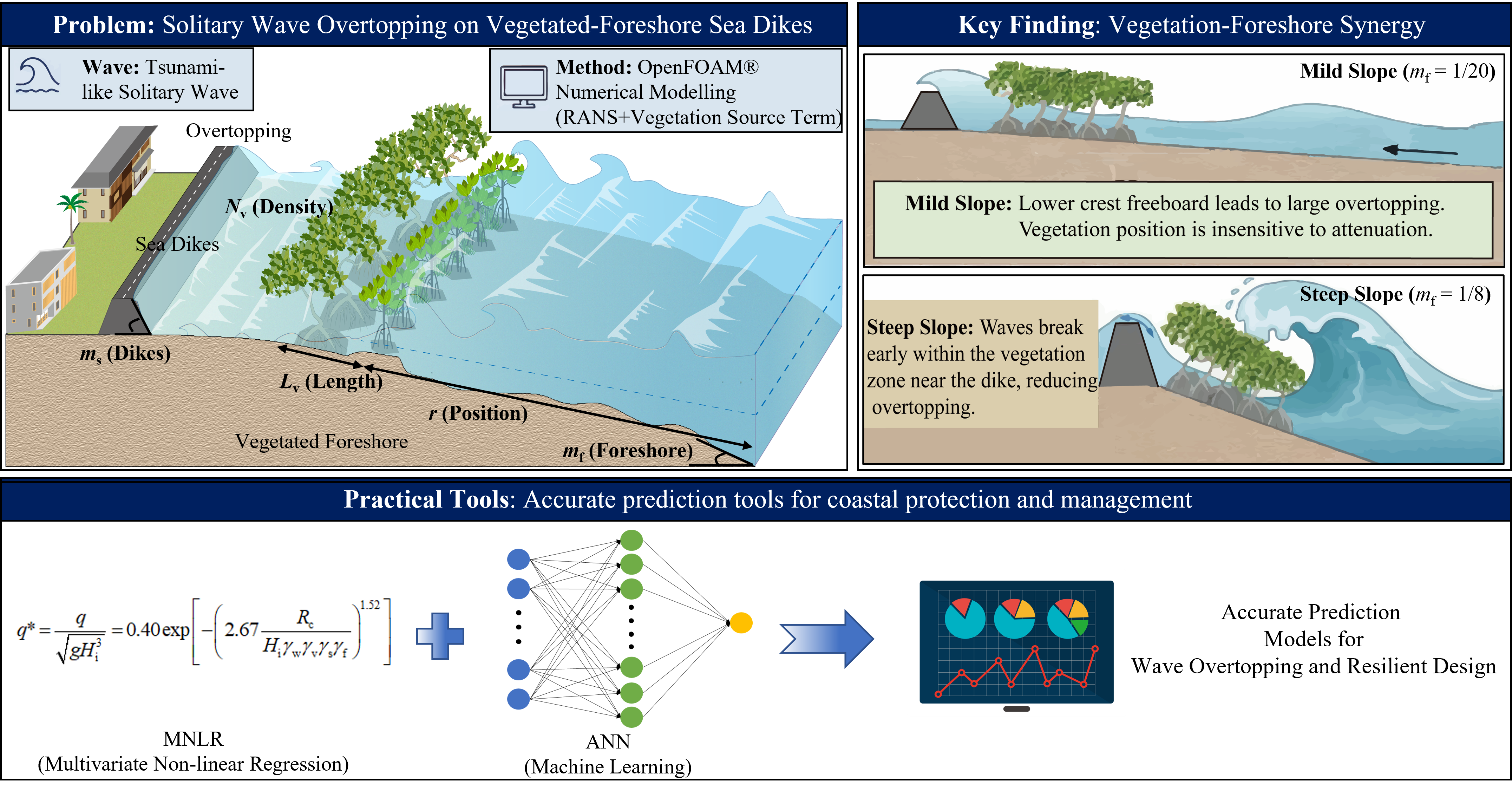
In a recently published research paper in Coastal Engineering, PhD candidate Quanlin Qiu, Associate Professor Yanxu Wang, Professor Zegao Yin and postdoctoral researcher Xiutao Jiang from Ocean University of China, working together with Guilin Yang from Sichuan Chuantou Pingshan Shulou Pumped Storage Development Co., Ltd., investigated how these factors interact during tsunami-like solitary-wave overtopping. They also developed predictive approaches for estimating overtopping discharge under the studied conditions. The researchers developed a two-dimensional OpenFOAM model based on the incompressible Reynolds-averaged Navier–Stokes equations, with the air–water interface resolved using a volume-of-fluid formulation. Vegetation was represented through drag and inertia source terms, together with vegetation-related turbulence production and dissipation. The drag coefficient was calculated using a formulation developed by this team that explicitly accounts for vegetation–slope interactions. The team tested mesh and time-step convergence and validated the model against laboratory measurements of solitary-wave propagation through rigid vegetation and solitary-wave overtopping of a bare dike. The simulated wave transformation closely followed the experiments, and the bare-dike overtopping validation produced a coefficient of determination (R²) of 0.98. The authors then used the model for a broad parametric investigation of relative wave height, foreshore and sea-dike slopes, vegetation density, patch length, and patch position. Increasing vegetation density produced an approximately exponential decline in mean overtopping discharge. At the highest tested density, the reduction reached 83.4% under the stated high-wave condition. The additional benefit became smaller as density increased from moderate to high levels. Longer vegetation patches also reduced overtopping by extending the distance over which wave energy could be dissipated.
The team found foreshore slope strongly affected how well the vegetation worked. On steeper foreshores, solitary waves broke earlier and formed high-velocity turbulent bores. Because vegetation drag increases with flow velocity, these bores lost more energy as they passed through the vegetation. Longer vegetation patches increased this effect by extending the interaction distance, making attenuation stronger on steep foreshores than on mild ones. Patch location also influenced overtopping. Its effect was small on mild foreshores, but on moderate and steep slopes, vegetation placed closer to the dike was more effective at intercepting the run-up bore before it reached the crest. Sea-dike slope became more important at larger relative wave heights: gentler dikes increased the run-up distance and energy dissipation, whereas steeper dikes reflected more of the lower-energy waves. The new findings provide a practical basis for designing sea-dike systems with vegetated foreshores. Engineers can account for vegetation-induced overtopping reduction when selecting dike dimensions and crest elevation, allowing vegetation and hard infrastructure to be considered together during preliminary design. The study also provides guidance for restoration and planting where foreshore space is limited. Because very high stem density gives smaller additional gains, design does not need to focus only on maximizing density. Vegetation width and location can be adjusted together, and where space allows, a wider vegetation zone can reduce overtopping without requiring very dense planting. This gives engineers more flexibility to balance hydraulic performance, cost, and ecological needs.
The regression and neural-network models provide a faster way to estimate overtopping from wave, vegetation, freeboard, and slope conditions without running a new CFD simulation for each case. The Multivariate Nonlinear Regression (MNLR) and Artificial Neural Network (ANN) models achieved R2 values of 0.91 and 0.97, respectively. They can be used to compare vegetation layouts, examine dike geometries, and estimate required crest heights during preliminary design or resilience assessment. The ANN captures complex relationships between the input parameters and the dimensionless overtopping rate, while the MNLR model provides a simple equation for engineering calculations.





Reference
Quanlin Qiu, Yanxu Wang, Zegao Yin, Xiutao Jiang, Guilin Yang, Tsunami-like solitary wave overtopping on vegetated-foreshore sea dikes: Characterization and prediction, Coastal Engineering, Volume 206, 2026, 104970,
Go to Journal of Coastal Engineering