Advances in Engineering Advances in Engineering features breaking research judged by Advances in Engineering advisory team to be of key importance in the Engineering field. Papers are selected from over 10,000 published each week from most peer reviewed journals.

Significance
Narrow-linewidth semiconductor lasers are important in applications that require high spectral purity and low phase noise, including precision spectroscopy, atomic clocks, coherent lidar, and gravitational-wave detection. Self-injection locking narrows the linewidth by feeding light from a high-quality-factor resonator back into the semiconductor laser, helping stabilize its frequency. Micro-ring resonators are attractive for integrated systems because they are compact and can provide high quality factors. Their coupling geometry is fixed during fabrication, so the coupling efficiency must be determined during design.
The coupling geometry directly influences the locking behaviour of the complete laser. The self- and cross-coupling coefficients affect the resonator linewidth and quality factor, the strength and phase of optical feedback, the locking band, and the degree of linewidth narrowing. The feedback mechanism also differs between the two main configurations: resonant backscattering provides feedback in the all-pass geometry, whereas multiple-beam interference at the drop port provides it in the add-drop geometry. An effective design approach must link the local coupling behaviour of the micro-ring resonator to these laser-level properties.
Calculating the coupling is challenging because the interaction occurs between a straight waveguide and a curved ring waveguide. Their directions are different, and the spacing between them changes continuously along the coupling region. Conventional supermode analysis is better suited to parallel waveguides, so the curved geometry requires a different treatment. Three-dimensional FDTD and finite-element simulations can model the structure accurately, but they become computationally expensive for the relatively large, high-Q rings used in self-injection locking. Repeating these simulations across many waveguide dimensions, ring radii, and coupling gaps can make the design process very slow. In a recently published research paper in Optics Communications, Dr. Zihan Jiang, Dr. Yiwei Zhang, Dr. Yuhong Wang, and Professor Chunqing Gao from Beijing Institute of Technology developed a physics-based design method for coupling-aware micro-ring resonators, combining extended supermode analysis with machine-learning-assisted eigenmode prediction.
Briefly, the researchers formulated the distributed-feedback laser and micro-ring resonator as coupled internal and external cavities and expressed the returning optical field through the frequency-dependent complex response of the resonator. This treatment makes the coupling region part of the locking dynamics itself. Simulated tuning curves showed that stronger laser–external-cavity coupling expands the locking range, and that the feedback phase can be adjusted to establish the required positive-slope steady state. For the all-pass geometry, mode splitting enters the stabilization behaviour; increasing the normalized splitting reduces stabilization performance. In the add-drop geometry, the response depends directly on the self-coupling coefficient. Lower power transmission through the coupling region produces a steeper locking band and eventually moves the system outside the conditions required for reliable locking to the resonator. The derived linewidth expressions likewise identify a specific coupling transmission at which linewidth narrowing is maximized.
The key device problem was then reduced to calculating those coupling coefficients. Jiang and colleagues extended supermode analysis from parallel waveguides to the curved, nonparallel interaction between the bus waveguide and the ring. Their physical construction treats the supermode propagation direction as the vector combination of the propagation directions of the individual waveguide modes. Because the ring direction changes continuously, the resulting supermode follows a curved trajectory with a cylindrical wavefront. The coupling region is divided into short elements, even- and odd-supermode propagation is evaluated along that trajectory, and the accumulated phase difference is integrated to recover the total self-coupling and cross-coupling coefficients. This geometrical choice has a direct physical consequence: defining the local separation perpendicular to the appropriate supermode propagation direction allows each segment to be represented by a common cross-sectional eigenmode problem despite the continuously changing ring geometry.
Eigenmode evaluation remained the most computationally intensive step, so the team trained a multilayer perceptron to predict the effective refractive indices of the coupled modes. The training database covered a broad range of Si3N4 waveguide geometries in SiO2 and included the even and odd supermodes of both TE0 and TM0 polarization states. The loss function explicitly emphasized the difference between the even- and odd-mode effective indices because this quantity directly determines the subsequent coupling calculation. The predicted values agreed with numerical simulations at better than 99%, and the trained model reduced repeated eigenmode evaluation from hours to milliseconds.
The complete analytical–machine-learning method was then benchmarked against three-dimensional FEM across micro-ring geometries spanning small to relatively large radii and for both TE0 and TM0 coupling. A frequency-dependent correction factor accounted for mode mismatch between the straight and curved waveguides. The calculated coupling behaviour remained in close agreement with FEM, but with computation times of about a second and memory requirements many orders of magnitude lower than those of the full three-dimensional simulations.
The authors then applied the new method to the design of an add-drop resonator for a self-injection-locked laser and found the selected geometry produced the intended coupling and resonator characteristics, with negligible differences between the proposed method and FEM for that structure. Fabrication and experimental testing subsequently demonstrated self-injection locking with a measured locking band of 2.3 GHz and the characteristic transitions associated with entering and leaving the locked state. For integrated self-injection-locked laser sources, the new method by Professor Chunqing Gao and team provides a practical way to select resonator geometry around a required optical feedback condition before tape-out. This is useful when several geometric variables must be explored simultaneously, since large design spaces can be screened without committing each candidate structure to a full three-dimensional electromagnetic calculation. The same capability can support tolerance studies in which small changes in gap, curvature, or waveguide dimensions are examined to determine how fabrication variations are likely to alter resonator behaviour.
Large-radius, high-Q micro-ring devices are another direct engineering target. Rapid coupling calculations allow multiple resonator geometries to be assessed before detailed numerical verification, helping designers identify suitable parameter ranges during the earlier stages of optical layout and device development. The formulation is also relevant to resonators that depart from simple circular rings. Racetrack and pulley-type structures contain coupling geometries that extend beyond the parallel-waveguide configuration. A treatment that follows changing propagation direction can therefore be used when engineering these devices for controlled power transfer, resonator loading, or mode selectivity. The authors likewise identify integrated filters, coupled micro-ring systems, Mach–Zehnder interferometers, and optical neural-network weight banks as structures containing related nonparallel or asymmetric coupling regions. Because the calculation includes both TE0 and TM0 supermodes, it can also support photonic designs in which polarization behaviour is an important design variable. Within the method described by Beijing Institute of Technology researchers, the same supermode representation can be extended to higher-order guided modes, providing a route for analysing devices that intentionally manipulate several modal channels.
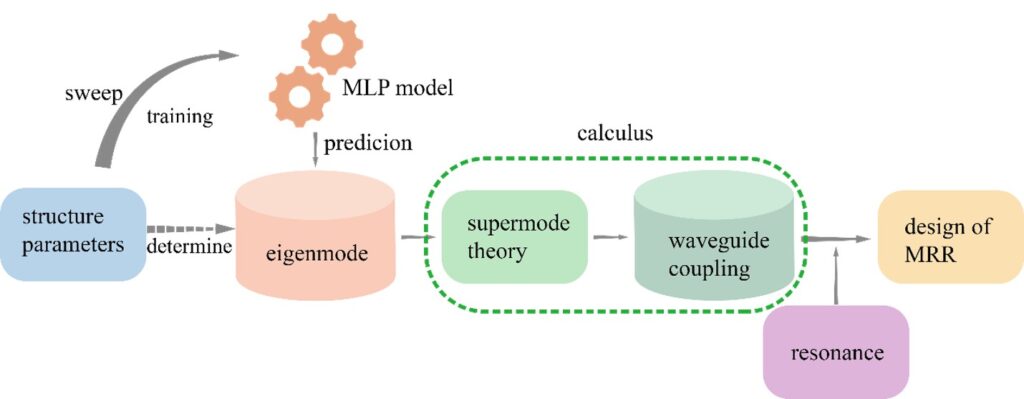
Overall workflow of the proposed MRR design method. An MLP model first analyzes the optical modes of a given micro-ring structure. The resulting modal information is then used in the proposed straight-to-bent waveguide coupling model to calculate its transmission property. Combined with the resonance model of the self-injection-locked laser, these results are used to determine whether the micro-ring structure satisfies the design requirements.
Reference
Zihan Jiang, Yiwei Zhang, Yuhong Wang, Chunqing Gao, A design method of micro-ring resonators accelerated by machine learning for self-injection locked lasers, Optics Communications, Volume 601, 2026, 132739,
Go to Optics Communications