Advances in Engineering Advances in Engineering features breaking research judged by Advances in Engineering advisory team to be of key importance in the Engineering field. Papers are selected from over 10,000 published each week from most peer reviewed journals.

Significance
Magnetic random access memory is built around the magnetic tunnel junction, in which two ferromagnetic layers separated by an ultrathin insulating barrier produce different resistance states when their magnetizations are parallel or antiparallel. In the spin-transfer-torque version of this technology, the written state is changed by a spin-polarized current that transfers angular momentum to the free magnetic layer. The main difficulty is the need to satisfy two requirements that tend to pull the device in opposite directions. Reliable data retention requires a large thermal stability factor, which is usually obtained by increasing the effective perpendicular magnetic anisotropy of the free layer. A larger anisotropy helps the stored magnetic state resist thermal fluctuation. At the same time, however, stronger anisotropy reduces the effectiveness of the spin current in driving magnetization reversal. That increase is not a minor device-level inconvenience, because a large current can place additional electrical stress on the thin MgO tunnel barrier. Dual-free-layer magnetic tunnel junctions offer a more refined way to approach this problem. If the layers are coupled too strongly, they behave almost like one thicker free layer and reverse coherently. If they are coupled too weakly, one layer may reverse without producing the desired full switching of the magnetic state. Between these limits, however, the two layers may reverse sequentially, allowing one layer to initiate reversal before the other follows.
The unresolved issue is therefore not whether two free layers can be placed in a magnetic tunnel junction, but how their coupling controls the actual reversal path. In a recently published research paper in Advanced Electronic Materials Professor Shujun Ye and Professor Koichi Nishioka from Beijing Institute of Technology developed a theoretical analysis of spin-transfer-torque switching in magnetically coupled dual free layers with unequal perpendicular magnetic anisotropy. They derived switching conditions that separate weak, intermediate, and strong coupling regimes and classify the resulting reversal modes into FL1-only, sequential, simultaneous incoherent, and coherent switching, as shown in Figure 1.
Ye and Nishioka analysis treated the free layer as two ferromagnetic layers, FL1 and FL2, separated by a thin MgO spacer. Both layers have their easy axes along the out-of-plane direction and are assigned the same saturation magnetization, but FL1 is given lower effective perpendicular magnetic anisotropy than FL2. That asymmetry matters because it makes FL1 more susceptible to spin-transfer-driven reversal. It also allows the model to test whether the motion of the softer layer can initiate or assist the reversal of the more stable layer.
Magnetic coupling is represented through a positive coupling energy, Jcpl, with the associated coupling field determined by the layer magnetization and thickness. In the calculations, the researchers varied Jcpl while keeping the basic layer structure and material assumptions fixed.
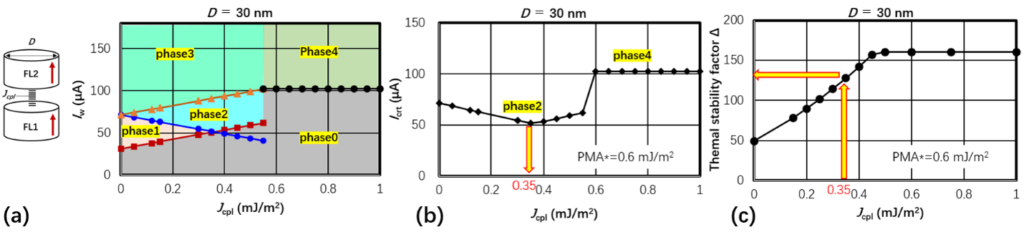
The authors solved the Landau-Lifshitz-Gilbert equations under spin-transfer torque led to a classification of the reversal behavior into four switching phases. Under weak coupling, FL1 can reverse while FL2 remains unchanged (Phase1). With a higher write current, FL1 reverses first and FL2 follows (Phase2). At still higher current, the two layers begin reversing at the same time but remain magnetically incoherent (Phase3). Under strong coupling, FL1 and FL2 reverse coherently (Phase4). This classification is not only descriptive; it follows from threshold current densities for each layer, which depend on the effective anisotropy fields and the coupling field. The critical write current showed a clear dependence on Jcpl. As coupling increased from zero, the critical current first decreased, reached a minimum, and then rose again until it saturated in the strong-coupling regime. Across the anisotropy values examined, the minimum critical current remained close to half of the strong-coupling value and occurred in the sequential switching regime, not the coherent regime.
The team performed switching-time analysis and found a moderately coupled dual free layer required less write current than a strongly coupled one over both long and short switching-time ranges. The reason lies partly in the unequal spin-current amplitudes of the two layers. Because FL1 has the smaller effective anisotropy field, the spin current acts more effectively on it, so FL1 reverses more readily and can complete much of its motion before FL2 has moved far from its original direction. In this way, the softer layer does more than switch first; it changes the magnetic condition under which the second layer begins to reverse. The energy-surface analysis gives the clearest physical explanation for the current reduction. The magnetic energy contains the anisotropy energy of each free layer together with the coupling term between their magnetization directions. Under moderate coupling, the switching path develops two energy peaks: one associated with FL1 reversal and another associated with FL2 reversal. Between them lies an intermediate magnetic state that lowers the effective barrier for completing the second step. Strong coupling removes this separated pathway and produces a single coherent barrier. The lower effective switching barriers in the separated reversal process explain why sequential or incoherent switching can operate at lower current than coherent reversal.
The authors’ findings are most directly relevant to the engineering design of perpendicular STT-MRAM cells, where the free-layer stack must be tuned to satisfy both write efficiency and retention requirements. The more useful engineering target is a controlled magnetic coupling strength that allows FL1 to reverse first and then assists the reversal of FL2. In that regime, the write current can be substantially reduced while the coupled structure still preserves a high thermal stability factor.
This has practical meaning for MTJ stack design and the magnetic coupling energy between FL1 and FL2 becomes a design parameter. Since the total coupling can include magnetostatic and interlayer exchange contributions, engineers can use layer thickness, spacer quality, interface design, and magnetic geometry to adjust the coupling field.
For scaled memory devices, the reported current reduction is especially important. The calculations show that an optimized coupling strength can bring the critical write current to about half of the strong-coupling coherent-switching value. Lower write current would reduce electrical stress on the MgO tunnel barrier and may support better write endurance in dense STT-MRAM arrays. At the same time, the calculated thermal stability factors at the minimum-current coupling condition remain high, including values above 128 for 30 nm devices. This suggests that current reduction does not have to come at the expense of data retention, provided that the coupling is selected within the proper regime.
The findings of Ye and Nishioka also provide a practical interpretive tool for device optimization. Instead of treating switching behavior as a single threshold event, the free-layer reversal can be classified into FL1-only, sequential, simultaneous incoherent, and coherent modes. This classification can guide how experimental MTJ stacks are evaluated: a low write current is most meaningful when it corresponds to complete sequential reversal rather than partial switching. In this sense, the work gives MRAM engineers a clearer design logic for using dual free layers in low-current, thermally stable STT-MRAM cells.
Reference
S. Ye and K. Nishioka, “Analysis of Magnetic Switching in Magnetically Coupled Dual Free Layers Within Magnetic Tunnel Junctions (MTJ) for STT MRAM.” Advanced Electronic Materials 12, no. 5 (2026): e00692. https://doi.org/10.1002/aelm.202500692
Go to Journal of Advanced Electronic Materials