Advances in Engineering Advances in Engineering features breaking research judged by Advances in Engineering advisory team to be of key importance in the Engineering field. Papers are selected from over 10,000 published each week from most peer reviewed journals.

Significance
Cross-laminated timber is an engineered wood product that is typically made of an uneven number of rigidly and orthogonally connected layers. This material possesses out-of-plane and in-plane features making it interesting for many applications such as shear walls, beams, folded panels, and floor elements. In view of the properties and resistances as a structural element, cross-laminated timber is differentiated between in-plane and out-of-plane loading.
For the case of cross-laminated timber under out-of-plane loading, test arrangements, characteristic values and design procedures are currently agreed. However, for cross-laminated timber diaphragms under in-plane loading, some attributes are still not agreed on, therefore leading to conservative regulations such as compression and tension in direction of the top layers.
In order to benefit from high capacities of cross-laminated timber in-plane, an in-depth understanding of all the required mechanical features that are dictated by the geometrical layup of these elements, and the development and verification of practical test arrangements to establish these features are necessary.
Consolidated understanding of the cross-laminated timber features under in-plane shear is important for conventional structural applications including floor diaphragms, cantilevered walls, and deeps beams, in all these cases potentially featuring notches and holes. The existing technical approvals as well as assessment documents for cross laminated timber products have differing regulations to establish their load-carrying capacities in-plane.
The orthogonal structure of cross-laminated timber diaphragms under shear can lead to three possible shear failure mechanisms; gross shear, torsion, and net-shear. Torsion resistance has been investigated comprehensively, but establishing in-plane gross- and net-shear strength is still challenging.
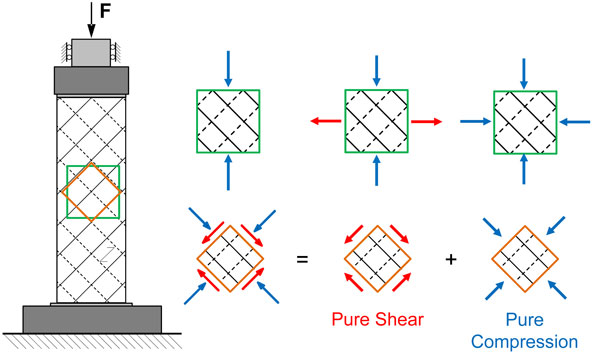
Philipp Dietsch, Michael Schulte-Wrede, Heinrich Kreuzinger and Mike Sieder at Technical University of Munich in collaboration with Reinhard Brandner and Julia Dröscher at Graz University of Technology reported a test arrangement and an evaluation procedure for cross-laminated timber diaphragms under shear stress. The proposed method is based on an elementary compression test; the test results that assumed gross-shear failures, were investigated implementing theoretical methods from plate theory. Their research work is published in Construction and Building Materials.
The proposed shear test configuration was successfully applied to the full spectrum of potential arrangements. The results demonstrate its functional and operational efficiency as well as reliable shear failures of all tested cross-laminated timber diaphragms.
The authors observed that all the samples with layers of boards bonded at their narrow faces failed in gross-shear, which was then followed by a net shear failure. All samples without narrow face bonding were observed to fail in net-shear. Therefore, the authors proposed this robust and reliable test arrangement for adoption in EN 16351 or in a suitable test and/or product standard.
The design method, which was originally developed for establishing shear properties from cross-laminated timber elements in gross-shear failure, was amended slightly and adopted for computing in-plane shear attributes also for cross-laminated timber elements in net-shear. The authors propose to incorporate the presented design approach, by taking into account all three potential failure mechanisms of cross-laminated timber diaphragms under shear stress, in Eurocode 5 or in any other timber design standard.


Reference
Reinhard Brandner, Philipp Dietsch, Julia Dröscher, Michael Schulte-Wrede, Heinrich Kreuzinger, Mike Sieder. Cross laminated timber (CLT) diaphragms under shear: Test configuration, properties and design. Construction and Building Materials, volume 147 (2017), pages 312–327.
Go To Construction and Building Materials