Advances in Engineering Advances in Engineering features breaking research judged by Advances in Engineering advisory team to be of key importance in the Engineering field. Papers are selected from over 10,000 published each week from most peer reviewed journals.

Significance Statement
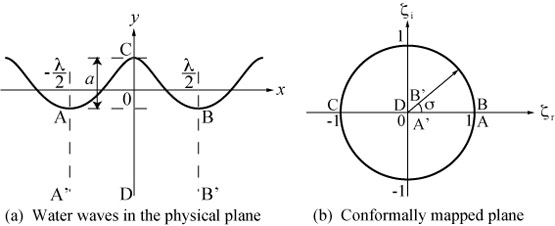
The water wave problem has a long history and, in particular, its nonlinearity has attracted a lot of researchers in the field of engineering and science. For systematic understanding of nonlinear motion of water waves, some approximate theory such as Stokes’ theory or the long wave theory have been developed. Among them, the author focused on Davies’ approximate theory which is valid for all waves, from small amplitude waves to the highest one. The basic idea of this theory is to conformally map the flow domain onto the unit disk in another complex plane as shown below, and to approximate the boundary condition on the water surface in the mapped plane such that a solution can be analytically obtained.
In this paper, the author made clear the connection between Davies’ approximate solution and the fully nonlinear solution from the point of view of singularity of a solution using complex function theory. In particular, the author generalized Davies’ surface condition which enables us to control some dominant singularities of a solution, and pointed out that the secondary singularity is essential for some nonlinear phenomena such as the nonmonotonic variation of wave speed with wave steepness.
Journal Reference
Journal of Engineering Mathematics, April 2014, Volume 85, Issue 1, pp 19-34.
Sunao Murashige.
School of Systems Information Science, Future University Hakodate, Hakodate, Hokkaido, Japan.
Abstract
Davies’ surface condition is an approximate free-surface condition on gravity waves progressing in permanent form on water of infinite depth. It is known that this condition preserves essential features of finite-amplitude waves including the highest one. This paper proposes a new surface condition that generalizes Davies’ idea of approximation and covers a fully nonlinear condition. Analytic continuation of the proposed surface condition allows us to explore singularities of solutions that dominate the flow. The results of singularity analysis elucidate the connection between Davies’ approximate solution and the fully nonlinear solution. In addition, it is shown that the nonmonotonic variation of wave speed with wave steepness can be predicted using a linear sum of a relatively small number of singularities. This suggests that a suitable choice of a parameter in the proposed surface condition can move singularities away from the flow field without changing their structure and may reduce numerical difficulties due to singularities for large-amplitude waves.