Advances in Engineering Advances in Engineering features breaking research judged by Advances in Engineering advisory team to be of key importance in the Engineering field. Papers are selected from over 10,000 published each week from most peer reviewed journals.

Significance
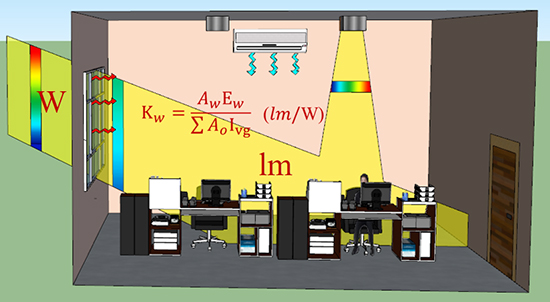
Natural daylight is essential to architectural design because it enriches visual comfort, supports human health, and preserves a psychological link to the outside world, however, it also introduces heat, glare, and variability that complicate environmental control. As energy demands in buildings continue to rise, achieving harmony between illumination and thermal performance has become increasingly complex. Designers face a persistent dilemma: to maximize daylight to reduce electric lighting, while avoiding the excessive solar gain that disrupts comfort and increases cooling energy. Previously, several quantitative methods have been devised to address this balance. The classical Daylight Factor, and more recently dynamic indices such as Daylight Autonomy and Useful Daylight Illuminance, have allowed designers to estimate daylight levels under different conditions. However, these metrics view daylight purely as a measure of brightness and fail to account for the energy cost of achieving it. They do not describe how effectively solar radiation is transformed into visible light inside a room. To this account, new research paper published in Solar Energy and conducted by Dr. Xiaoyang Lin, Prof. Nan Zhang and Professor Peng Xue from the Beijing University of Technology along side by Prof. Yifan Fan from the Zhejiang University with Professor Tao Luo from the China Academy of Building Research, the researchers developed a new quantitative framework—Daylighting Efficacy (DE)—to measure how effectively a building converts incoming solar radiation into useful interior illumination. They also established a parametric simulation model integrating Radiance and EnergyPlus to evaluate DE across various design and climatic scenarios.
The research team built a reference office model located in Beijing (39.8°N, 116.5°E) and used a parametric workflow based on Rhino, Grasshopper, and its Ladybug–Honeybee simulation environment to test the robustness of this new metric. Radiance and EnergyPlus served as the computational engines, providing precise modeling of luminous flux and solar irradiance. The base case—a south-facing room with a window-to-wall ratio of 0.45 and a glazing transmittance of 0.65—was used to establish a benchmark for DE over a typical meteorological year and through a series of parametric variations, they explored eighteen conditions encompassing changes in orientation, sill height, glazing configuration, window-to-wall ratio, and three advanced daylighting systems. The authors showed the baseline model has a clear diurnal and seasonal pattern: DE peaked between 10:00 and 14:00 when solar altitude was highest and incidence angles smallest, reaching values above 40 lm/W. Analysis separated direct and diffuse components, showing that while diffuse light produced a nearly constant DE (≈40–45 lm/W), the variations in overall DE were dominated by changes in direct sunlight incidence which confirmed that orientation and solar geometry govern the system’s optical efficiency far more than meteorological variability alone. They also found that when the room orientation changed, the annual average DE decreased from 38.7 lm/W in the south-facing configuration to 33.7 lm/W when facing north. East- and west-facing orientations produced intermediate values due to limited periods of direct solar exposure. Moreover, adjusting architectural parameters yielded further insight: lowering the window sill height enhanced DE by roughly 3.9% per 0.1 m, while increasing glazing transmittance by 0.1 raised DE by more than 18%. Additionally, a larger window-to-wall ratio or taller glazing slightly reduced DE, indicating diminishing returns when admitting more radiation than the space can effectively convert into useful light. It is important to mention that the autors reported that among the daylighting systems, lightshelves reduced average DE by 37%, mainly due to their shading effect on direct sunlight during mid-day hours. Photovoltaic windows, despite their capacity to convert radiation into electricity for lighting, did not compensate for the reduced transmittance, resulting in a 35% decrease in DE. Electrochromic windows performed moderately better, achieving a 30.9 lm/W average DE by modulating transmittance according to exterior irradiance.
In conclusion, Professor Peng Xue and colleagues introduced Daylighting Efficacy which marks a conceptual shift in how building performance can be evaluated. These new models reported in the study link the optical and thermal dimensions of daylighting, allowing designers to quantify the trade-off between visual performance and solar heat gain with unprecedented clarity and by linking luminous benefit to radiative cost, the metric transcends traditional illuminance-based measures and opens a pathway toward integrated thermal–optical optimization. It acknowledges that a building façade functions as a converter rather than a passive filter: it transforms the complex spectrum of solar radiation into a usable luminous field within the interior. From a design standpoint, DE encourages engineers to ask not only how much light enters a room but how well that light is produced in proportion to the energy received. This dual perspective has broad implications for sustainable architecture. In climates where solar heat gain is a liability, achieving a high DE implies that a space can maintain desirable brightness while admitting minimal thermal load. Conversely, in cold climates where solar gain is beneficial, a lower DE may be acceptable. Thus, DE provides a continuum for balancing visual and thermal goals, potentially informing adaptive envelope strategies, daylighting controls, and photovoltaic integration. Because it can be computed from standard simulation tools and field measurements, DE is also practical—it can be embedded in existing design workflows with minimal complexity. We also believe, DE holds value as a research construct and it could be correlated with the solar heat gain coefficient (SHGC) to develop unified indices for evaluating transparent materials or incorporated into generative design algorithms seeking energy–lighting balance. Its adaptability to different surfaces, time scales, and building types suggests scalability and in the long term, the establishment of normative DE ranges similar to the accepted thresholds of Daylight Factor could enable designers and regulators to define performance targets grounded in both physical realism and occupant comfort. Indeed, by quantifying how effectively buildings harness the visible portion of solar energy, the concept of Daylighting Efficacy aligns architectural design with the principles of optical engineering and sustainable energy use. It transforms the act of admitting light into a measurable process of energy conversion—a perspective that may well redefine how the next generation of architects think about façades, glazing, and daylight as renewable resources in their own right.


Reference
Xiaoyang Lin, Yifan Fan, Nan Zhang, Peng Xue, Tao Luo, Daylighting efficacy: A new metric for solar radiation utilization and daylighting design, Solar Energy, Volume 293, 2025, 113456,