Advances in Engineering Advances in Engineering features breaking research judged by Advances in Engineering advisory team to be of key importance in the Engineering field. Papers are selected from over 10,000 published each week from most peer reviewed journals.

Significance Statement
A landmark agreement was reached in the 2015 Paris climate conference (COP21) which aimed at combating climate change by maintaining the increase in global temperature well below 2°C. Energy-efficient cities, referred to as smart cities, are seen as the means to an ecological future, whereby energy use is optimized in the transport and building sector, and sustainable solutions are exploited through information communication technology. These cities apply methodologies and tools meant to support and monitor their actions, by exploiting a wide range of multidisciplinary data that city authorities use to optimize energy and enhance sustainability. An impediment to the development of this novel idea has been the lack of a framework for processing the multidisciplinary data in such a way that integrates the data sources from different domains to optimize energy efficiency and to assess the energy use of the cities at the same time.
In a recent research published in Energy Procedia, Ilias Papastamatiou and colleagues from the Decision Support Systems Laboratory of the National Technical University of Athens (EPU NTUA) proposed a decision support system framework, which integrates the assessment and energy-use optimization in cities, by merging data sources from users’ feedback, building monitoring, weather, energy production and energy-use domains. The aim of the suggested framework is to optimize the use of energy, which in turn reduces energy costs and carbon dioxide emissions. Climate change and the arising problems occur by the on-going urbanization of cities require urgent actions. With the proposed Framework and the novel Decision Support Tools for Cities’ Energy Assessment and Optimization, we contribute to the transition from “Traditional Cities” to “Smart Energy Cities”, said Ilias Papastamatiou. The publication by Ilias Papastamatiou et al. has been selected as a key scientific article contributing to research excellence in science and engineering by AIE (Advances In Engineering).
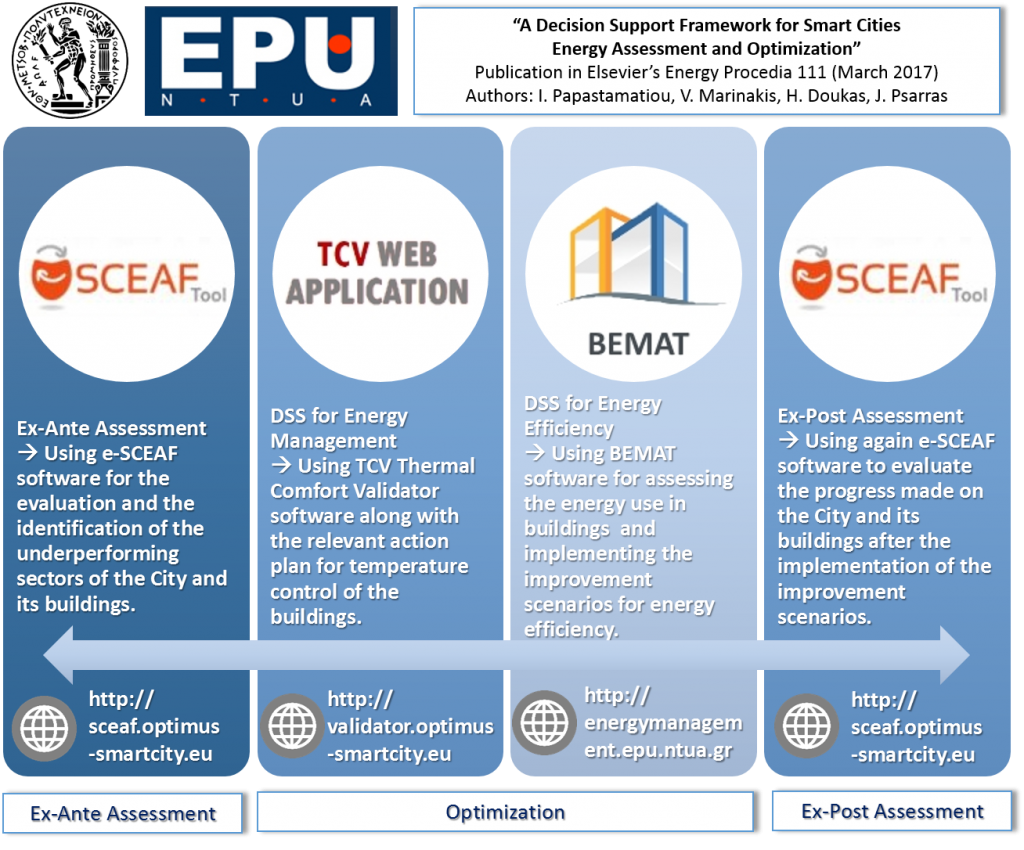
The proposed framework includes an assessment pillar and an optimization pillar. In the assessment pillar, underperforming sectors, strengths, and the energy optimization potential of a city are highlighted. What follows is the optimization pillar which includes a range of action targeting plans aimed at improving energy use in buildings. Once the selected scenarios are implemented, city authorities can validate the city’s progress by once again running the assessment pillar.
The authors note the importance of a city’s ex-ante assessment prior to application of the proposed optimization scenarios, and this form the beginning of their proposed framework in the assessment pillar. They applied the novel Smart City Energy Assessment Framework tool (e-SCEAF), which was developed by the authors for this pillar. Once annual data is entered into this tool, it analyzes and produces results regarding the city’s energy status and underperforming sectors. The framework gives a cohesive set of 21 indicators which are organized into 3 axis which include political field of action, related infrastructure and information communication and technology, as well as energy and environmental profile. The 3 axes are used to examine the smart city energy performance.
Once the underperforming sectors are identified, the optimization pillar is used to run targeted short and long-term improvement scenarios. The pillar integrates 2 decision support system tools which are for the energy efficiency measures and energy management. For the energy efficiency measures, the authors created a toolset for assessing energy use in buildings (BEMAT software), which gathers energy consumption data after, and then it calculates energy savings from 11 different improvement scenarios.
In the second component, energy management, energy managers of the buildings are able to adjust thermal comfort parameters in a way that optimizes energy use while maintaining comfort levels at acceptable ranges through the Thermal Comfort Validator (TCV software) along with the relevant action plan for temperature control of the buildings. In this action plan the authors utilize 3 values which include the predicted mean vote index, the actual mean vote, and the observed mean vote. After this pillar, an ex-post evaluation is made using the web based tool in the assessment pillar, in order to compare results of both before and after the implementation of the improvement energy scenarios.
Acknowledgements
Part of this research is conducted within the EU funded project “OPTIMising the energy USe in cities with smart decision support system (OPTIMUS)” (grant agreement n° 608703) under the coordination of Decision Support Systems Laboratory – Electrical and Computer Engineering of the National Technical University of Athens (EPU NTUA).




Reference
Ilias Papastamatiou, Vangelis Marinakis, Haris Doukas, John Psarras. A decision support framework for smart cities energy assessment and optimization. Energy Procedia 111 (2017) 800-809.
Go To Energy Procedia