Advances in Engineering Advances in Engineering features breaking research judged by Advances in Engineering advisory team to be of key importance in the Engineering field. Papers are selected from over 10,000 published each week from most peer reviewed journals.

Significance Statement
Computational modeling of tensile deformation of polymeric hollow fiber membrane used for water purification
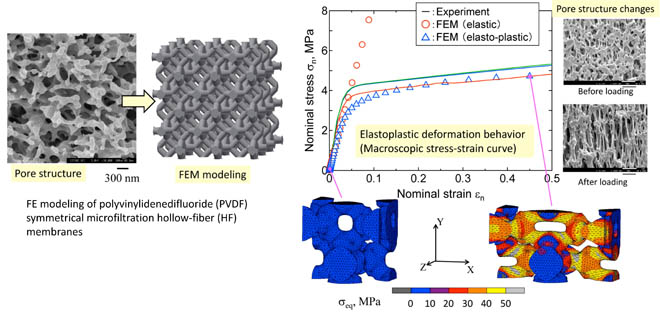
Microfiltration of polymeric hollow fiber membrane has been promising technology for water purification owing to a cost-effective way. For the long-term operation with repeated cleanings, the deformation mechanics is now becoming important. We investigated the tensile deformation behavior of polyvinylidenedifluoride (PVDF) symmetrical microfiltration hollow-fiber (HF) membranes, having submicron pores with a three-dimensional open-cell structure. The computational modeling of macroscopic and microscopic deformation is our challenge.
During uniaxial tensile tests, the membranes underwent elastic deformation and plastic deformation. Large deformation induced pore growth along the tensile direction due to plastically stretched ligament of PVDF matrix, resulting in an increase in water permeability. In order to establish a mechanical model for tensile deformation, the computation with finite element method (FEM) was employed. In this model, the Kelvin polyhedron (truncated octahedron structure) was used to mimic a three-dimensional open-cell structure. A one-unit cell based on this structure was created, and a periodical boundary condition was employed for the FEM computation. Our FEM model could reproduce the overall elastoplastic deformation behavior of the porous membrane, and also capture the microscopic pore deformation behavior.
Therefore, our computational framework may be useful for various purification materials with pore structure and may provide insight into the material fabrication and operation; for instance, optimization of a physical cleaning process with minimal mechanical deformation, new fabrication method to improve the mechanical property (deformation resistance), and prediction of membrane operation lifetime, from the viewpoint of long-time use and recycling efficiency.




Journal Reference
Journal of Membrane Science, Volume 497, 1 January 2016, Pages 421–429.
Shouichi Iio1,Akio Yonezu1,, , Hiroshi Yamamura2,, , Xi Chen3,4
[expand title=”Show Affiliations”]- Department of Precision Mechanics, Chuo University, 1-13-27 Kasuga, Bunkyo, Tokyo 112-8551, Japan
- Department of Integrated Science and Engineering for Sustainable Society, Chuo University, 1-13-27 Kasuga, Bunkyo, Tokyo 112-8551, Japan
- Department of Earth and Environmental Engineering, Columbia University, 500W 120th Street, New York, NY 10027, USA
- International Center for Applied Mechanics, SV Lab, School of Aerospace, Xi’an Jiaotong University, Xi’an 710049, China[/expand]
Abstract
The tensile deformation behavior of polyvinylidenedifluoride (PVDF) symmetrical microfiltration hollow-fiber (HF) membranes was studied. The membranes had submicron pores with a three-dimensional open-cell structure. The surface and cross section of the porous membranes were observed by FESEM (field emission scanning electron microscope) to investigate the microstructure of the cell, namely, its size and ligament geometry. During uniaxial tensile tests, the membranes underwent elastic deformation and plastic deformation. Large deformation induced pore growth along the tensile direction, resulting in an increase in water permeability. In order to establish a mechanical model for tensile deformation, the finite element method (FEM) was employed. In this model, the Kelvin polyhedron (truncated octahedron structure) was used to mimic a three-dimensional open-cell structure. A one-unit cell based on this structure was created, and a periodical boundary condition was employed for the FEM computation. The FEM model could reproduce the overall elastoplastic deformation behavior of the porous membrane and provide useful insight into the fabrication of porous membranes and reliable operation of water purification.
Go To Journal of Membrane Science