Advances in Engineering Advances in Engineering features breaking research judged by Advances in Engineering advisory team to be of key importance in the Engineering field. Papers are selected from over 10,000 published each week from most peer reviewed journals.

Significance Statement
Modifying the topology of material microstructure can be a good way of improving the mechanical attributes of composite materials. For example, a method based on structural topology optimization is normally adopted in finding the best space distribution of material phases that constitute the microstructure. Realizing optimal distribution of periodic stress-strain fields existing on a microscale for a periodic elementary cell, normally termed as the base cell, is the main objective of designing composite material microstructure with periodic cells.
A base cell is normally studied adopting the finite element method, then a method of topological optimization of this periodically repeated cell can be analyzed instead of analyzing the entire composite structure. Normally, homogenization method is adopted in a bid to average complex micro-structural behavior of elastic materials and come up with macroscopic attributes of a unit cell.
The process of homogenization has been established as an appropriate modelling method for characterizing mechanical behavior of composites with periodic microstructures. Unfortunately, for complex microstructures of elastic material, determining analytically the stress-strain fields is a bit challenging. For this reason, to establish the most effective attributes of an elastic medium, the process of homogenization is applied by numerical method, like the finite element method.
Several researchers have made attempts in a number of topology optimization algorithms as well as interpolation schemes such as evolutionary structural optimization scheme, the level set method, and solid isotropic materials with penalization. These approaches have been adopted extensively in solving design problems for both microstructures and macroscopic structures.
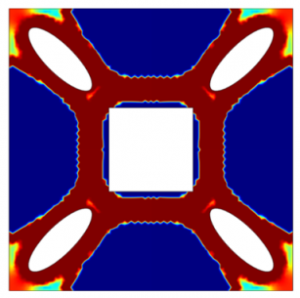
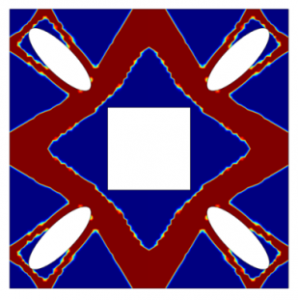
All these recent studies have been made for composites with one or two materials for a homogeneous base cell. Vadim Krys’ko, Sergey Pavlov, Maxim Zhigalov and Kseniya Bodyagina at Saratov State Technical University in Russia in collaboration with Jan Awrejcewicz at Łódz´ and Warsaw University of Technology investigated the maximization of static stiffness problem for a base cell composite material that it having maximum of shear modulus and bulk modulus. They solved, for the first time, the problem of topological optimization for the base cell of the composite with previously established technological holes and inclusions. Their work is published in peer-reviewed journal, Composite structures.
The authors had the objective of identifying the optimal spatial distribution of components within a composite material in order to realize a material with enhanced functional properties. They adopted the method of homogenization in a bid to establish the relationship between macro and micro-structural attributes of composite material. The researchers also investigated the problem of identifying optimal microstructures of a number of materials, while aiming at obtaining maximum rigidity for the base cell of a composite material. To validate and illustrate the proposed method, the authors provided numerical examples.
The approach of topology optimization was demonstrated and adopted in finding the optimal microstructure in a given composite structure. The results of the study indicated that the optimization aiming at obtaining the extreme bulk modulus and shear modulus allowed the finding of a composite microstructure being considerably reinforced. Therefore, the authors concluded that it was possible that micro-scale elastic attributes of a composite could be designed and defined through investigations done on a microscale.





Reference
J. Awrejcewicz, S.P. Pavlov, K.S. Bodyagina, M.V. Zhigalov, V.A. Krysko. Design of composite structures with extremal elastic properties in the presence of technological constraints. Composite Structures, volume 174 (2017), pages 19–25.
Go To Composite Structures