Advances in Engineering Advances in Engineering features breaking research judged by Advances in Engineering advisory team to be of key importance in the Engineering field. Papers are selected from over 10,000 published each week from most peer reviewed journals.

Significance
An increase in communication and data traffic has presented a new demand of large-capacity and high-speed communications systems. High-performance optical fibers have been researched to meet this demand. Particularly, photonic crystal fibers consisting of air holes have attracted research attention owing to their unique properties including high birefringence and flexible dispersion control. According to past research reviews, they have been used to effectively realize single-polarization transmission in elliptical-hole core circular-hole holey fiber having air holes introduced in the core region. Consequently, several methods such as polarization division multiplexing comprising of polarization splitters have been proposed to enable large-capacity communication. However, crosstalk effects have remained a big challenge as it causes undesirable system behaviors. Subsequent studies have, therefore, focused on achieving polarization separation without crosstalk.
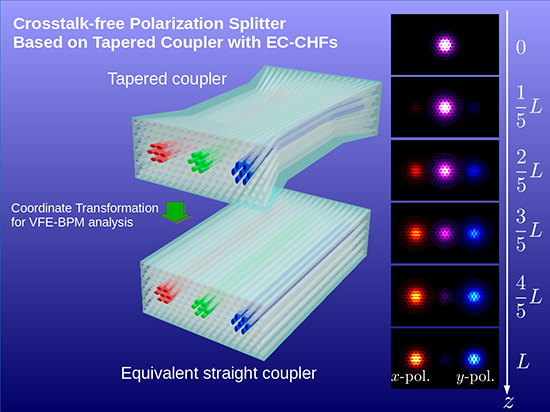
In an effort to overcome this problem, Shingo Kawamura (Ph.D. Student) and Professor Yasuhide Tsuji from Muroran Institute of Technology together with Dr. Zejun Zhang from Kanagawa University developed a new tapered polarization splitter based on elliptical hole core circular-hole holey fiber (EC-CHF). The approach comprised of a full-vectorial finite element beam propagation method (FE-BPM) that uses coordinate transformation for analysis of waveguides with varying structure along the longitudinal direction. They aimed at enhancing mode coupling by enabling simultaneous waveguide separation at the input and output ends. The work is currently published in the research Journal of the Optical Society of America B.
Briefly, the authors commenced their work by first exploring in detail the formulation of the coordinate transformed full-vectorial FE-BPM (CT-VFE-BPM), which was then used in the design and development of the proposed tapered polarization splitter. The coordinate transformed finite element beam propagation method was charged with transformation of the tapered waveguide into an equivalent linear waveguide to prevent degradation of computation accuracy associated with the step approximation and the interpolation of the electromagnetic field in the propagation direction. The cross-sectional structure design consisted of five air holes between the adjacent cores to obtain sufficient waveguide separation.
The author achieved an efficient CT-VFE-BPM design capable of achieving desirable polarization splitting without any crosstalk attributed to enhanced mode coupling and simultaneous full waveguide separation at the input and output ends. Although crosstalk may occur due to fabrication errors, structural tolerance is also discussed. Furthermore, the coordinate transformation based full-vectorial finite element beam propagation method enabled efficient analysis of waveguides with varying structures along the longitudinal direction. These approaches greatly improved the efficiency and computational accuracy of the systems. The transmission of the designed polarization splitter was investigated. Results showed that its wavelength depended on its coupling efficiency indicating that it can operate in a wide wavelength band.
In summary, the research team utilized a practical application of waveguide separation to design a tapered polarization splitter based on the single-polarization of elliptical hole core circular-hole holey fiber. The polarization splitter exhibited enhanced mode coupling and simultaneous full waveguide separation at the input and output ends and achieved crosstalk-free polarization separation in wide wavelength band. This significantly contributed to enhanced practical applicability. Furthermore, the proposed CT-VFE-BPM also contributed to greatly improve computational efficiency and accuracy. Thus, Professor Yasuhide Tsuji believes the study will play a great role in the development of high-performance optical fibers to meet the rising demand for efficient communication systems.



Reference
Kawamura, S., Tsuji, Y., & Zhang, Z. (2020). Design of tapered polarization splitter based on EC-CHFs by full-vectorial FE-BPM using coordinate transformation. Journal of the Optical Society of America B, 37(4), 1075.