 Advances in Engineering Advances in Engineering features breaking research judged by Advances in Engineering advisory team to be of key importance in the Engineering field. Papers are selected from over 10,000 published each week from most peer reviewed journals.

Significance
In most engineering applications, linear spring-damping-mass systems are commonly used to control and attenuate vibrations. As linear isolators fail to effectively combine low-frequency vibration isolation with high load carrying capacity, nonlinear stiffness systems have drawn significant attention. Among them, quasi-zero stiffness (QZS) vibration isolators exhibiting high-static-low-dynamic stiffness have been extensively researched. QZS isolators are typically obtained by connecting in parallel, negative and positive stiffness components.
Buckling beams and oblique springs are the commonly used negative stiffness components to design QZS vibrators as they are relatively simple and easy to assemble. Regardless, magnetic springs have two key advantages: it avoids friction effects as the generation of magnetic force is independent on the contact and replacing the magnet with an electromagnet can enable active control of QZS isolators. Consequently, disk springs could produce larger axial nonlinear force than coil springs despite having a smaller working displacement range due to short stroke length.
With the advancement of QZS isolators, cam-roller structures have become of great interest owing to their two crucial flexibilities: the ability to provide negative stiffness in torsional and translational directions and to improve the performance of the QZS vibrator isolators by optimizing the cam profiles. However circular cam-roller (CCR) QZS vibration isolators only achieve low stiffness in a small range, cannot withstand excitation with large amplitude, and are prone to errors due to the complex nature of the restoring force expression. It is hypothesized that adopting other cam profiles to design CCR QZS isolators could effectively overcome these limitations.
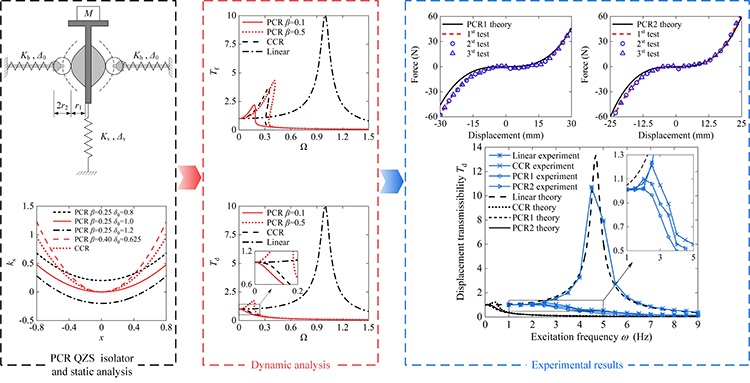
On this account, Mr. Song Zuo, Professor Dayang Wang and Professor Yongshan Zhang from Guangzhou University in collaboration with Dr. Quantian Luo from the University of Technology Sydney proposed the design of a parabolic cam-roller (PCR) QZS vibration isolator. The theoretical formulations of the PCR QZS isolator were derived under harmonic excitation in detail and the desired condition for it to outperform CCR QZS isolator was obtained. Following the analysis of the design parameters, an optimal design of the vibration isolator was investigated. Eventually, PCR QZS vibration isolator prototype was fabricated and tested to verify its perceived superior performance. Their work is currently published in the journal, International Journal of Mechanical Sciences.
The authors showed that the presented PCR QZS vibration isolators effectively overcome the two critical deficiencies of CCR QZS isolators. Compared with the CCR QZS isolators, the proposed PCR QZS isolator achieved lower transmissibility and a lower dynamic stiffness in a wide region. It also obtained lower effective isolation frequency and can withstand excitation with larger amplitudes in the QZS range than CCR QZS isolator. The force-displacement relationships of the isolators obtained by the test can agree well with the theoretical predictions.
From the dynamic and static tests involving various isolators, the superiority of the current PCR QZS isolator was demonstrated. This included a better overall isolation performance, indicating the significance of the optimal design of PCR QZS isolators. Moreover, the restoring force of the PCR QZS isolator was relatively simple and did not require further simplifications.
In summary, the study developed and investigated parabolic cam-roller QZS isolation system model. The proposed theoretical formulations were successfully validated by the experimental results. The prototype lays a foundation for practical applications of such vibration isolators. In a joint statement to Advances in Engineering, the authors said their findings will advance the design of high-performance PCR QZS vibration isolators for a wide range of practical applications.



Reference
Zuo, S., Wang, D., Zhang, Y., & Luo, Q. (2022). Design and testing of a parabolic cam-roller quasi-zero-stiffness vibration isolator. International Journal of Mechanical Sciences, 220, 107146.