Advances in Engineering Advances in Engineering features breaking research judged by Advances in Engineering advisory team to be of key importance in the Engineering field. Papers are selected from over 10,000 published each week from most peer reviewed journals.

Significance statement
Nanocomposites of transition metal oxides and graphene, combining the properties of graphene and the transition metal oxide, have found a broad range of application in fields such as energy storage devices in supercapacitors and Li ion batteries, energy conversion, gas sensing and photocatalysis.
Herein, we report the preparation of RGO/Cu2O composite films on Cu foil for supercapacitor by directly reacting metallic Cu foil with GO through hydrothermal treatment in water without using any additional reducing agent or solvent.
The major merits of this method include:
– This is a simple one-step and green method that only involves immersing Cu foil in GO suspension in water under hydrothermal conditions without using any reductant or oxidant through a hydrothermal approach;
– There is no side production and no impurities from the reducing agent;
– As prepared RGO/Cu2O/Cu nanocomposite films were directly used as electrodes for supercapacitors, unlike those metal oxide/RGO powder for which an electrode-made procedure is necessary.
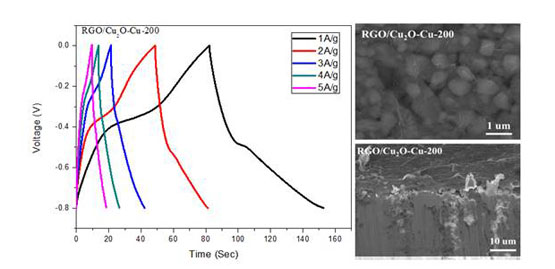
– The above RGO/Cu2O/Cu composites film used as electrodes for supercapacitors exhibited high specific capacitance of 98.5 F g−1 at 1 A g-1, and 63.2 F g−1 at 5 A g-1 which is much better than that of Cu2O/Cu.
– RGO/Cu2O/Cu composite films were successfully synthesized on the surface of copper foil substrates through an in situ redox reaction between the GO and the Cu foil, assisted by hydrothermal treatment, which is not ever reported by others. Due to its unique structure (i.e. RGO layer completely covered and in good contact with the Cu2O layer), the RGO/Cu2O/Cu electrode exhibited a good specific capacitance.
Figure Legend: RGO/Cu2O nanocomposites were synthesized in a simple hydrothermal way by changing temperatures optimize the system, by this method the reduction of graphene oxide and the formation of Cu2O nanocomposite are finished in one step, simplifying the preparation of electrodes of supercapacitors. The specific capacitance of the RGO/Cu2O-Cu-200 electrode reached 98.5 F/g at 1 A g–1.
Journal of Alloys and Compounds, Volume 586, 2014, Pages 745–753.
Xiangmao Donga, 1, Kun Wanga, 1, Chongjun Zhaoa, b, Xiuzhen Qiana, 1, Shi Chenc, , Zhen Lib,
Huakun Liub, 2, Shixue Doub, 2
a Key Laboratory for Ultrafine Materials of the Ministry of Education, Shanghai Key Laboratory of Advanced Polymeric Materials, School of Materials Science and Engineering, East China University of Science and Technology, Shanghai 200237, PR China and
b Institute for Superconducting and Electronic Materials, University of Wollongong, Wollongong 2500, Australia and
c School of Information Engineering, Wuhan University of Technology, Wuhan 430070, PR China.
Abstract
Reduced graphene oxide/cuprous oxide (RGO/Cu2O) composite films were directly synthesized on the surface of copper foil substrates through a straight redox reaction between GO and Cu foil via a hydrothermal approach. Characterization of the resultant composites with X-ray diffraction, Raman spectroscopy, X-ray photoelectron spectroscopy, and field emission scanning electron microscope (FESEM) confirms the formation of Cu2O and reduction of GO, in which Cu2O nanoparticles were well covered by RGO. The resultant composites (referred to as RGO/Cu2O/Cu) were directly used as electrodes for supercapacitors, and their electrochemical performance was assessed by cyclic voltammetry (CV), galvanostatic charge–discharge (GCD), and electrochemical impedance spectrometry (EIS) in 1 M KOH aqueous solution. A specific capacitance of 98.5 F g−1 at 1 A g−1 was obtained, which is much higher than that of pure Cu2O prepared under the same conditions, due to the presence of RGO.